


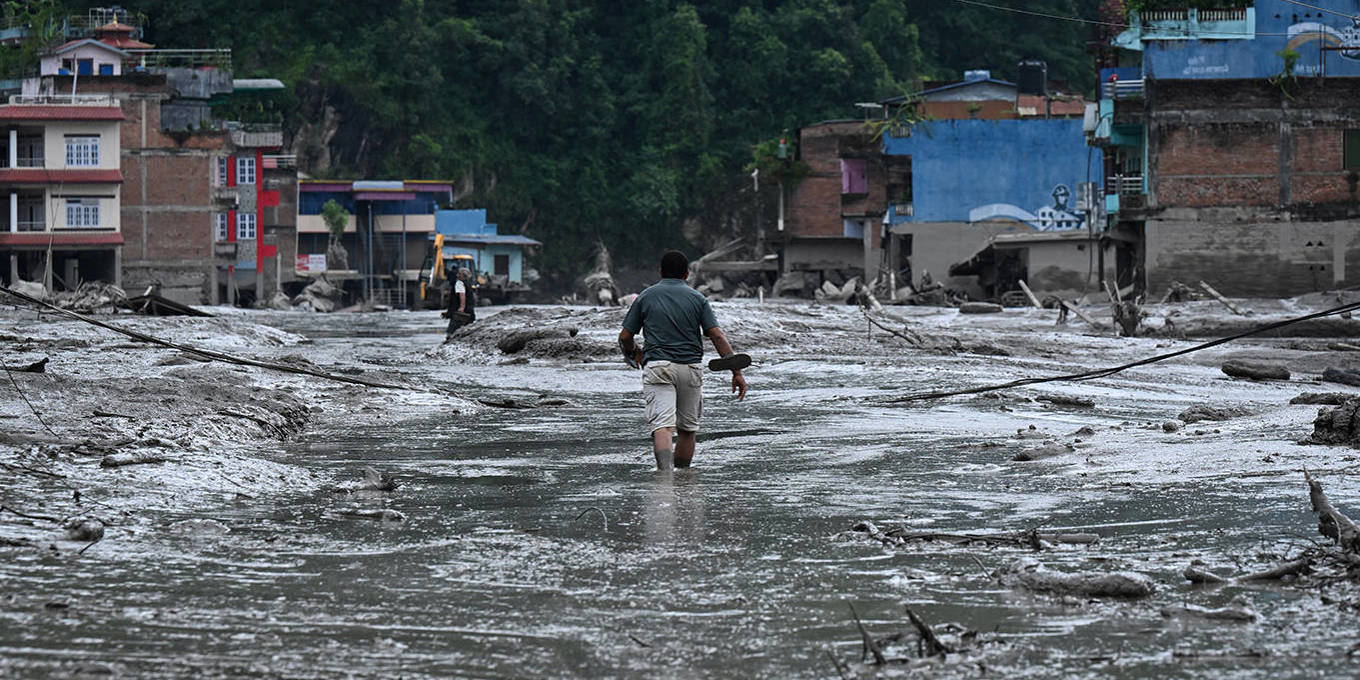
The devastating floods in Nepal demonstrate what happens when reckless development puts climate-vulnerable communities in harm’s way. They also highlight a climate-finance system that is unable to provide the funds countries need in the immediate aftermath of such disasters.
KATHMANDU—In the wake of Nepal’s devastating floods, which killed at least 1,300 people, Nepalese officials and others were quick to cite climate change as the primary cause. They were not wrong. The Hindu Kush Himalayas are warming roughly three times faster than the global average, even though Nepal produces only 0.1% of global greenhouse-gas emissions. But climate change alone does not explain why so many people and so much vital infrastructure were directly exposed to a known hazard.
The catastrophic damage was as much the result of a failure to price location and risk as it was an effect of climate disaster. Climate risks were privatized when infrastructure projects were approved and socialized when things went wrong. While businesses and political insiders benefited from hydropower concessions, road contracts, and floodplain development, households and workers bore the consequences when those assets were swept away.
The warning signs were already there. The 2021 Melamchi flood in Sindhupalchowk District began with heavy rain and an upstream blockage, then swept an enormous amount of sediment downstream, burying the headworks of Kathmandu’s flagship water project under 15–20 meters (49–66 feet) of debris. Five years later, water and debris tore through the Trishuli Valley, where infrastructure projects had been assessed one at a time rather than as part of a single system.
Four development failures made the disaster worse. One is slope destruction in the name of connectivity, which Nepalis have come to call “bulldozer terrorism.” Politically driven and poorly engineered road cuts have left nearby slopes twice as prone to landslides, which were then blamed on the monsoon.
Hydropower hubris is another failure. Although reviews of the impact of the 216-megawatt Upper Trishuli-1 hydropower project on the river had already warned that climate risks had not been adequately assessed, those warnings were ignored. So were the risks of building bazaars, customs yards, and worker camps along historic riverbeds.
These dangers are compounded by the Himalayas’ growing instability as retreating glaciers leave behind glacial lakes and weakened rock. While climate change increases the risk of glacial collapse, the extent of the damage ultimately depends on what gets built and where.
Nepal does not need to stop building, but it does need to stop pushing development into its river corridors. New projects should face a worst-case flood test, and the most exposed communities should be relocated rather than rebuilt in the same flood-prone areas. As former UK Prime Minister Gordon Brown has argued, Nepal must also rethink where it puts schools and critical infrastructure. Its solar potential is far greater than its hydropower capacity, much of which was wiped out in a single morning.
That said, Nepal’s development failures do not absolve the countries that are most responsible for global warming. Nepal’s petition for $20 million in compensation is the first real emergency test of the Fund for Responding to Loss and Damage (FRLD), established at COP27 in Sharm el-Sheikh in recognition of the fact that poor countries are increasingly stuck paying for climate damage they did not cause.
With pledges totaling roughly $822 million, the FRLD has nowhere near enough money to meet the demand. So far, developing countries have submitted 176 requests for $2.8 billion. The first funding window, known as the Barbados Implementation Modalities, set aside just $250 million for $5–20 million grants. Nepal’s request for $20 million therefore reflects the program’s ceiling, not the scale of the country’s losses. In fact, reconstruction is projected to cost $4–5 billion—one-tenth of Nepal’s GDP.
The FRLD is slow, too. Its 11-step cycle may make sense for multiyear programs, but not for a country whose trade routes and payment infrastructure have just been destroyed. And as Liane Schalatek has observed, if the fund shields donor countries from liability, it could act as an alibi rather than a genuine burden-sharing mechanism.
Nepal’s government is now asking the fund to act outside its normal funding cycle. This month, Prime Minister Balendra Shah plans to press the case before the United Nations General Assembly, while board members representing African, Asia-Pacific, and least-developed countries have called for an emergency meeting.
Pre-arranged disaster-risk finance can help absorb the initial shock, but someone must ultimately pay for the damage caused by climate catastrophes. If the FRLD can’t pay when disaster strikes, countries will have to fill the gap by borrowing, pushing them further into the climate-debt trap. The 2022 floods in Pakistan, for example, killed more than 1,000 people and forced the country to borrow more to cover $30 billion in reconstruction costs.
When climate-related disasters hit communities made vulnerable by reckless development along flood-prone rivers, the cost should not simply be passed on to displaced households or piled onto sovereign debt. Without stricter zoning laws and immediate grant financing in place when disaster strikes, developing countries like Nepal will remain hostage to a warming planet and a climate-financing system that delivers too little, too late.
