


Stay informed with free updates
Simply sign up to the Life & Arts myFT Digest — delivered directly to your inbox.
An evening walk through Islington with an Australian friend. He looks around at the Georgian facades, at the Lime-biking locals, and grows ruminative.
“They say it’s the best city in the world . . . ”
I wait for the counter-argument.
“ . . . but they don’t say it enough.”
Of where else will they say it in future? Which will be the next city to penetrate the club of two or three that vie for number one status in surveys?
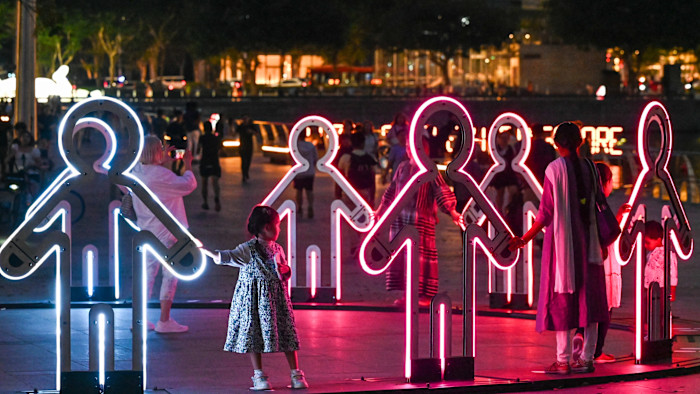
Ask around, as I have done for months, pestering thoughtful and mobile people in various lines of work, and the reflex answer is Singapore. For sentimental reasons, I hope this is borne out. It could have become a majoritarian ethnic Chinese state after independence. Because it didn’t, relatives of mine have been safe there ever since. Not to be a Singa-bore, one of those centre-right western men who extol the island’s technocratic feats, but the Terminal 5 project at Changi Airport is unimaginable in most cities.
The question is whether Singapore will ever have the cultural assets to go with all the hard infrastructure. And whether, if artistic expression entails the political kind, it even wants them.
The same issue hangs over Dubai, which was another common answer. There is also the problem of scale to reckon with. Its population, while a broad approximation of what the world really looks like, is less than half that of London or New York, or greater Paris. The Iranian drones will go but will an extra 4mn people come over time? Not if the Saudi project to erode Dubai as the Gulf’s expat hub even half-succeeds.
Mumbai has the inverse of the Singapore-Dubai problem: an embarrassment of creative riches, but infrastructure that might take until mid-century to catch up. Bangkok, then? This has long been my bet, on account of its diversity, its Asia-in-one-city feel. But the more commercially minded point out that it ranks 100th in the Global Financial Centres Index. The other cities suggested here, however fun, rest on a huge business base.
A generation ago, Hong Kong might have been the top answer. Perhaps due to qualms about its political drift, no one I asked mentioned it, or any mainland Chinese megalopolis either. Nor São Paulo or Mexico City, though the eternal British blind spot for Latin America was always going to skew the survey.
You see, name a city — any city — and there will always be a gripe: not enough ethnic groups, not enough symphony orchestras, only two or three hundred parks, scarcely a Jason Atherton menu in sight.
We have here a puzzle. For half a century, perhaps since Opec made its power felt, the world has seemed to be tilting from the west to whatever we call the non-west. And still the latter has not quite thrown up a best-in-the-world city, at least according to received opinion. This could mean two things.
First, received opinion is subjective, parochial and western-brainwashed. There is a lot to this. (I am struck by how few “Global South” respondents, including diplomats who are paid to bat for their countries, quibbled with the top two cities, which I hardly need name.)
But there is something else too. History is sticky. There is a lag between structural change in the world and the visible fruits of it. There is an age between hard-won economic power and the prestige assets that are its ultimate reward. A city has to be rich for centuries, not decades, to accrue the sheer quantity of stuff that makes it the best, or at least most complete. Live in one, and the notion of western decline can feel abstract and remote.
Call it the Grand Slam theory of history. It is, on the face of it, absurd that tennis’s four biggest tournaments are all western, and all but one anglophone. But that is who ran the world when these things were settled. Over time, a fifth Slam might go to a Gulf or Pacific city. (And I don’t mean Indian Wells.) After all, Formula 1 set up grands prix outside its European comfort zone as globalisation set in. By then, however, it will have taken an absolute aeon. Meanwhile, there is Wimbledon. “The rise of the rest”: it is at once the biggest story of my lifetime, and hard to perceive on the streets.
Find out about our latest stories first — follow FT Weekend on Instagram, Bluesky and X, and sign up to receive the FT Weekend newsletter every Saturday morning
