


Unlock the Editor’s Digest for free
Roula Khalaf, Editor of the FT, selects her favourite stories in this weekly newsletter.
A decade ago, when Daniel Kinahan, the Irishman accused by multiple western governments of running one of the world’s biggest cocaine cartels, became embroiled in a bloody gang war, it appears he invested on two fronts: contract killings and public relations.
While the crime family he is alleged to command hired foreign hitmen to assassinate rivals on the streets of Dublin, a film crew was hired to shoot a mini-feature dramatising the feud in a flattering light to Kinahan. He would later use London defamation lawyers to threaten reporters who wrote about his activities.
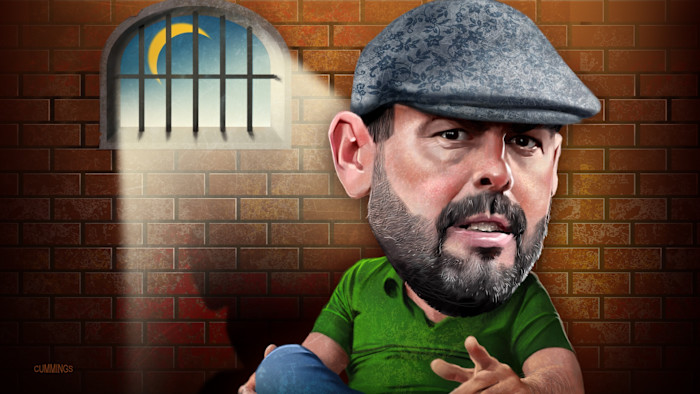
This month, as Kinahan sat inside a Dubai prison facing extradition to his homeland, the 49-year-old heir to one of Ireland’s leading criminal dynasties made a final attempt to control the public narrative.
“I believe I haven’t been an angel in my life and I don’t think anyone’s been an angel,” he said in a thick Dublin accent down the phone to a friendly podcaster. “I don’t want to play like I’m a martyr . . . but yeah I believe that in a way I’m a scapegoat.”
Last Sunday, Kinahan — who has not lived full-time in Ireland for 25 years — was flown under maximum-security conditions from the UAE to face charges of “directing the activities of a criminal organisation” between 2015 and 2017. It was the culmination of a multi-country, multi-year operation.
While the outcome of his forthcoming trial remains uncertain, it was the tension between Kinahan’s desire to be seen as a legitimate businessman, boxing promoter and adviser to Middle Eastern royalty while allegedly running a murderous cross-border crime empire worth hundreds of millions that helped bring about his capture.
“Successful criminals who run organised crime groups should know one golden rule — you can’t go around shooting people and not get police attention,” Michael O’Sullivan, a former assistant Garda commissioner who had pursued the Kinahan crime family since the 1980s in Dublin, told the FT in 2023.
“The smart move is to keep a low profile . . . Some criminals, the power goes to their head. And the coke sometimes goes to their head too.”
Befitting the Instagram-influencer world of Dubai bling that he embraced, flight-tracking site Flightradar24 said the Dassault Falcon 6X that flew him back to Ireland was the most-followed flight in the world that day.
On Monday, the man whom the US Treasury has accused of controlling “a murderous organisation involved in the international trafficking of drugs and firearms” that was “a threat to the entire licit economy” spent his first full day in Portlaoise Prison, ahead of appearing again before the court in October.
Kinahan was born in Dublin in 1977, the eldest son of Christy Kinahan, a middle-class convicted heroin dealer and patriarch of the Kinahan family who spent much of the 1990s building high-level criminal connections as an expatriate in Amsterdam.
Having lived apart from his father as a youth, Daniel and his younger brother Christopher Jnr later fell under his influence and came of age as Europe’s drugs market was undergoing a generational boom. Rising disposable incomes combined with ample supply from Latin America and improved global logistics opened new opportunities for European criminal entrepreneurs.
The Kinahan crime group came to the attention of international law enforcement by the late 2000s, with a 2009 US diplomatic cable describing Daniel Kinahan as “an Irish businessman involved in narco-trafficking throughout Europe”. But it was a 2016 assassination attempt in Dublin that set in motion the events that would make the gang internationally notorious.
Kinahan had by then begun working as a small-scale boxing promoter. The attempt on his life by a rival Dublin crime dynasty took place during a weigh-in at the Regency Hotel in Dublin. He survived, but the gang war that followed claimed 18 lives and made him one of Ireland’s most famous people.
Kinahan fled Europe for Dubai, where a group of multinational crime lords had set up shop, attracted by luxury hotels, supercars, loose anti-money laundering rules and the absence of extradition treaties with many EU countries. He allegedly went on to form a powerful alliance with crime bosses connected to Italy’s Camorra mafia and Latin American cartels who, according to Europol, at one point controlled a third of Europe’s cocaine market.
By 2020, Kinahan had emerged as a major player in international boxing, acting as adviser to former world champion Tyson Fury. The same year, he was named a sports management adviser to a company founded by a member of the Bahraini royal family.
But by 2022, Kinahan’s efforts to juggle high-profile business deals and alleged organised criminal activity were brought to a sudden halt when US authorities imposed economic sanctions on him, his father and his brother. In April, he was arrested at the request of the Irish authorities.
He will now face a non-jury Special Criminal Court in Dublin in what is likely to be one of the most watched trials in modern Irish history. Kinahan has claimed the trial cannot be fair and called it “a circus”. But after months in an Emirati prison, an eight-hour flight, and being shipped to court in a bulletproof and bombproof van, he appeared to have kept his sense of humour.
Standing with his hands clasped in front of him as the charges were read out on Sunday, he told the court: “I think we all know I won’t be getting bail.”
