


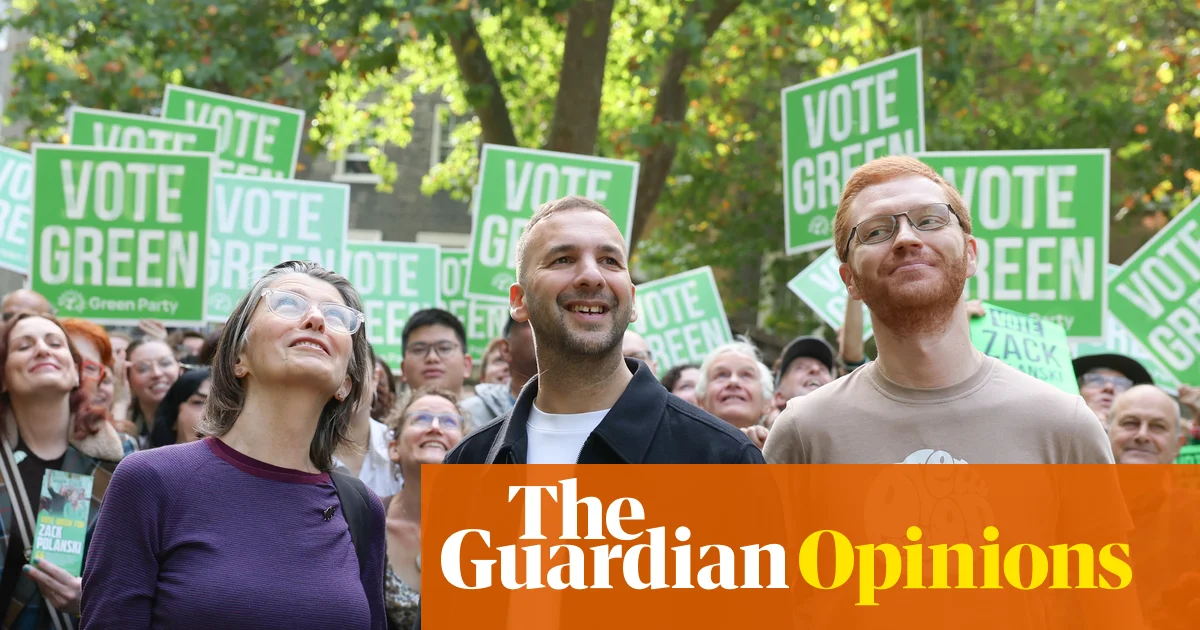
It’s a strange time to be a Green. We have just held our largest conference ever, but it was overshadowed by a controversial motion that was attacked by the media as racist. Then, when we lost a byelection in a Camden seat that is so Labour it has estates named after Blair-era ministers, the headlines called for Zack Polanski to resign.
It does, however, mark the end of phase one for Polanski’s Greens. Polanski burst on to the political scene in 2025 and ate up attention, enjoying an easy monopoly on hope while Labour was sucked into the black hole of Starmerism. Labour has since escaped, with Andy Burnham giving social democracy with Mancunian characteristics a half-hearted go. But Burnham’s honeymoon already seems to be ending. John Healey’s budget of “difficult decisions” and “fiscal responsibility” is likely to disappoint everyone but the financial markets, and a winter energy bill crisis driven by a possible El Niño deep freeze is just one of many problems he’ll soon have to face.
One school of thought says Polanski can carry on as before, focusing on points of difference with Labour. Healey announces a no-change budget; Polanski calls for a tax on wealth to fund public services. Angela Rayner sides with landlords over renters; Polanski proposes an emergency rent brake and explores Berlin’s plan to expropriate the properties of corporate landlords.
These interventions matter, especially in our attention-driven politics. But on their own they are only tactical manoeuvres in response to the politics of Labour. If we act like we’re only a Labour pressure group, that’s what we will become. And in doing so, we will neglect to answer the deeper question: what are society’s fundamental problems and what is our plan to fix them?
In practice, Burnham’s “radical vision” promises only modest regulation of public utilities, limited devolution and reform of the voting system and of social care after the next election. Weighed against the crises we face – climate breakdown, bankrupt public services, rampant inflation, runaway rents, an epidemic of loneliness, a billionaire-owned media, a deranged elite of tech oligarchs who literally want the world to end – his vision reads more like the managed decline of a system in crisis.
If phase two of Polanski’s Green party is about anything, it should be about breaking this spell. Part of this is naming capitalism as the root cause. Naomi Klein made the best-selling case more than a decade ago that the fight of our times is capitalism v the climate – that a livable world and continued resource extraction are fundamentally incompatible.
But Burnham will not go there. He names neoliberalism as the problem and then neglects to fix it, unceremoniously dumping any intention to expand public ownership and shrink the role of the market.
Polanski should go there, rooting his day-to-day interventions in a credible programme to transition away from capitalism – not only imagining the end of capitalism and what might come next, but planning in painstaking detail just how we are going to get there. He must build a credible Green party vision that shows Burnham’s to be meek and hollow.
Don’t get me wrong, the Green party isn’t there yet, nor anywhere close. We have 5 MPs, 10% of the vote and we’re still learning to be a mass of 230,000 members. But if we don’t start taking ourselves seriously, why would anybody else? Trust in political parties is on the floor, and that affects the Greens too. Why should people put their faith in us and dare to hope if we don’t have a programme that is honest, rigorous and credible?
We only need to look to the French leftwing party La France Insoumise to see what this looks like. In 2016 Jean-Luc Mélenchon’s movement published L’Avenir en Commun, which went straight into the bestseller list and has been read by hundreds of thousands of people. It is a visionary, comprehensive programme that would be written into the constitution so that companies can never take more from nature than they give. It’s a plan to provide free water and energy to every household, to redraw France’s regions around river basins, mountain ranges and forests, and to organise ecological planning. It is more extensive and detailed than any manifesto for ecological transition in Europe, and polls suggest Mélenchon could lead the French left into next May’s presidential runoff against Marine Le Pen.
after newsletter promotion
The Green party’s programme must be similarly full of strategy and vision: reckoning honestly with the forces arrayed against us and setting out precisely what we’d do in our first year of government. It should also talk about the good life and what we’re fighting for, in words that resonate with voters, rather than dry policy. Written in a big open process where lots of groups are involved: unions, community groups and thinktanks, farmers watching harvests fail, pensioners battling fuel poverty, renters priced out of homeownership and workers whose jobs are vanishing – it should become a comprehensive point of unity that can provide an answer to those who aren’t voting Green because they doubt our credibility, and fill the void currently occupied by single-issue policy motions.
Polanski is correct when he says that Burnham isn’t serious about socialism. But we have to be honest: right now, neither are we. If Burnham’s vision is meek and hollow, ours is still being formed. And as Labour faces the tests of governing, now is the time to write it.
