


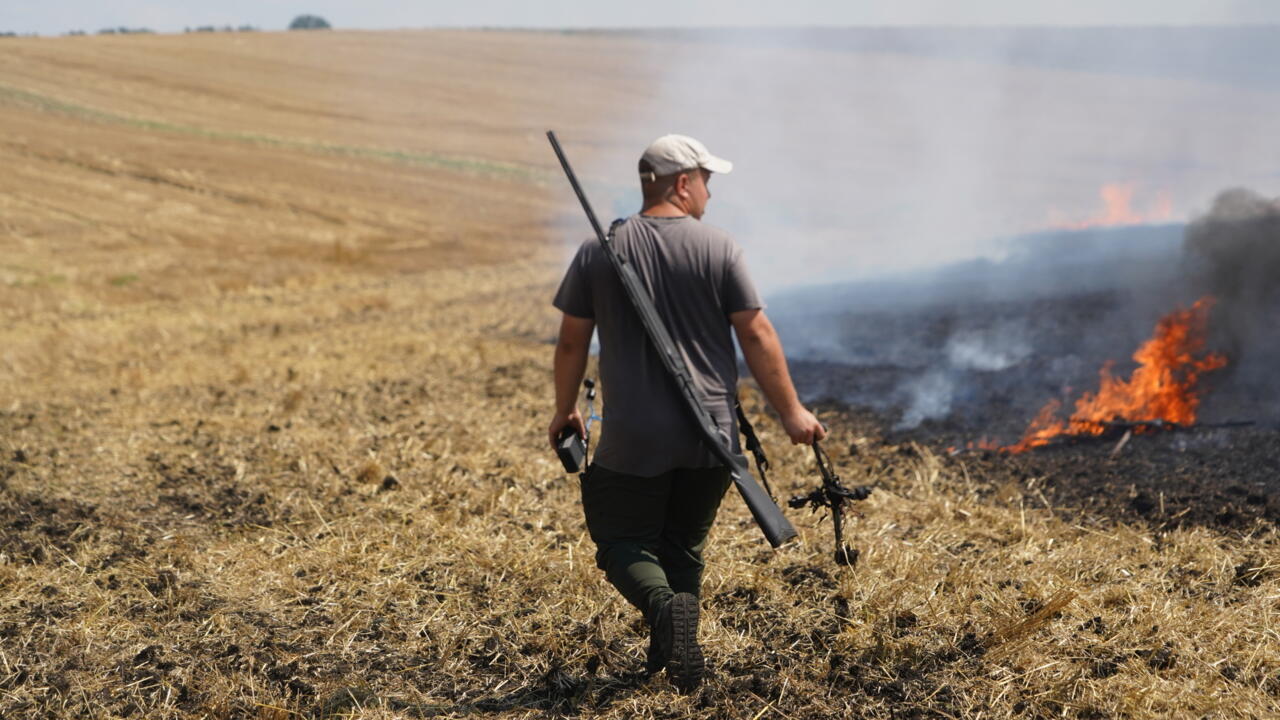
The fields are white for harvest, but the way through the Black Sea is shut.
Faced with a grinding Russian advance towards the last cities in the Donbas left under Kyiv’s control, Ukraine’s state security services in June launched what Ukrainian President Volodymyr Zelensky called a “40-day campaign” of mid-to-long-range drone strikes deep into Russian territory.
The aim of these strikes, he said, was to put pressure on Moscow by targeting infrastructure vital for the country’s economic life – first and foremost, the oil refineries needed to sustain Russia’s lucrative fossil fuel exports and keep Russian consumers able to fill up at the pump. Kyiv has also carried out deadly air strikes against online retailers’ warehouses that many Russian small businesses rely on to reach their customers.
Read moreLive: Zelensky calls on allies to cover €27 billion gap for Ukraine’s air defence needs
Since July, Ukraine has also targeted Russian ships transporting grain through the Black Sea and hammered rail and port infrastructure around the neighbouring Sea of Azov. Earlier this month, grain terminals at the major port of Novorossiysk – where the remnants of Russia’s Black Sea fleet have taken shelter – came under heavy drone fire from Ukraine.
In response, Russia has stepped up its own strikes on Ukraine’s critical infrastructure, raining down drones and missiles on the grain silos and port facilities around the Black Sea city of Odesa and shelling any ship that tries to dock.
For weeks now, Kyiv and Moscow have both struck commercial container ships and grain export terminals in and around each other’s Black Sea ports, effectively cutting off both nations’ ability to ship grain – or anything else – through the crucial sea route.
In a state media interview published Saturday, Russian President Vladimir Putin accused Ukraine of having “opened … Pandora’s box” and pledged to pummel the embattled nation’s “most sensitive economic sectors”.
Agriculture certainly qualifies. Ukraine’s farmers are among the world’s leading producers of wheat, barley, sunflower seeds and corn, and 90 percent of those exports reach the world through the Black Sea. In peacetime, the country’s thriving agriculture sector made up a full fifth of Ukraine’s economy, and almost half of its exports.
So perhaps it’s no surprise that Zelensky on Sunday said that Russia had rejected Kyiv’s efforts, through third parties, to establish a Black Sea truce that would allow civilian vessels to move through the waters unmolested by either side.
Instead, he alleged, Moscow had insisted that any such deal would only be struck if Kyiv called off its campaign against Russian energy infrastructure, which has triggered worsening fuel shortages across the country. Russia, for its part, has devastated Ukraine’s energy infrastructure throughout the war, trying to starve the country of heat and light as each winter draws near.

Aysmmetric warfare
Oleh Nivievskyi, an associate professor at the Kyiv School of Economics, said that the consequences of the Black Sea blockade weighed far heavier on Ukraine than on Russia.
“For Russia, this is an asymmetric issue, because yes, they export a lot of grain, predominantly wheat,” he said. “But for the economic powerhouse, agriculture is not as important as the energy sector. So on paper it might look the same – Ukraine does not export, and Russia does not export – but it’s really asymmetric, because for Ukraine, sea routes are more important economically in terms of the share of exports and in terms of the share of the overall economy.”
Between them, Russia and Ukraine account for more than a quarter of the world’s agricultural exports, most of which feeds people in North Africa and the Middle East. Despite this, Russia’s agricultural exports last year made up less than 10 percent of its total export revenues.
In some ways, we’ve been here before. Tens of millions of metric tonnes of grain remained grounded in Ukraine’s Black Sea ports in the first months of Russia’s February 2022 invasion as Russian ships blockaded the waterway.
Making a deal
As global food prices surged and analysts began to warn of the very real threat of famine in the countries relying upon Black Sea grain, Ukraine, Russia, Turkey and the UN signed the Black Sea Grain Initiative in July 2022 to carve out a safe passage for ships transporting food and fertiliser through to the Bosphorus Strait.
Russia-Ukraine war: Grain hub attacks raise fears over global food prices
One of your browser extensions seems to be blocking the video player from loading. To watch this content, you may need to disable it on this site.

Moscow pulled out of the deal almost a year to the day later, alleging that Western sanctions continued to interfere with Russia’s own food and fertiliser exports. Despite this, both countries have largely continued to move their agricultural exports through the Black Sea – until now.
Nivievskyi said that the renewed blockade could prove far harsher than that of 2022.
“If you look at this from all angles, the situation is much worse,” he said. “The timing now is to plant winter crops, and winter crops are very important for Ukraine – winter wheat makes up the majority of the wheat that Ukraine produces.”
August is the height of Ukraine’s wheat harvest, and farmers would normally begin harvesting the country’s corn crop next month. If farmers can’t sell this year’s harvests, Nivievskyi said, many will struggle to raise the money they need to plant next year’s crops.
“For this, farmers they would need the liquidity, the working capital, to buy the seeds – and it’s not available right now,” he said. “Usually, around 50 percent of the harvest that’s sold in Ukraine is to purchase the materials for the autumn planting season, and this is now difficult to get because the prices are much lower, and volume-wise we cannot really sell as much as last season. And that’s going to be difficult.”

Storage pressures
With Ukraine’s grain exports down by some 75 percent year-on-year the first two weeks of August, the question of where exactly producers are going to store all the grain they can’t shift is becoming critical. Agriculture Minister Taras Vysotsky said the country’s grain storage shortfall could reach as much as 11 million metric tonnes.
All-Ukrainian Agrarian Council deputy chairman Denys Marchuk told DW last week that Ukrainian farmers have already harvested more than 28 million tonnes of grains and pulses – and the corn harvest, estimated at some 33 million metric tonnes, hasn’t even begun.
“The capacities to store the exportable surpluses that Ukraine cannot really export right now are also limited — and the major harvest is still in the fields,” Nivievskyi said. “So that’s also going to create additional pressure on Ukrainian farmers, because they have to store the stuff somewhere.”
As local grain piles up, he added, domestic prices have only fallen further.
“Domestic prices in Ukraine now are quite low compared to the world market prices, and compared to the production costs,” he said. “There are messages and interviews of farmers saying that domestic prices are not at the level of production costs. So they will have to decide whether it’s worthwhile to bring the harvest in – or to keep it in the field.”
And while Russia is trying to reroute its grain shipments through the Caspian and Baltic Seas, Ukraine may struggle to find its own alternatives. The Danube River that has long served as Ukraine’s other major grain route has fallen to historically low levels as droughts wrack Europe, and the ports along its banks come under regular attack from Russian drones and missiles.
Nor can the country’s railways pick up the slack. Ukrainian authorities in July said Russia had damaged more than 200 locomotives in 2026 alone as Moscow systematically targets the country’s rolling stock. According to the agriculture minister, river and rails between them can carry just a third of what used to flow through Ukraine’s Black Sea ports.
Logistics aside, the political landscape has also changed considerably since the opening months of the full-scale war. Where the European Union once liberalised agricultural trade with the beleaguered country, suspending all import duties and quotas to help farmers move their produce west, the resulting influx of Ukrainian wheat and falling prices sparked fierce farmers’ protests across eastern and central Europe. Poland, Slovakia and Hungary all maintain bans on specific Ukrainian agricultural goods in the name of safeguarding their own farmers’ livelihoods.
“The willingness of European partners to help Ukraine out is also not there as it was in 2022,” Nivievskyi said.
