


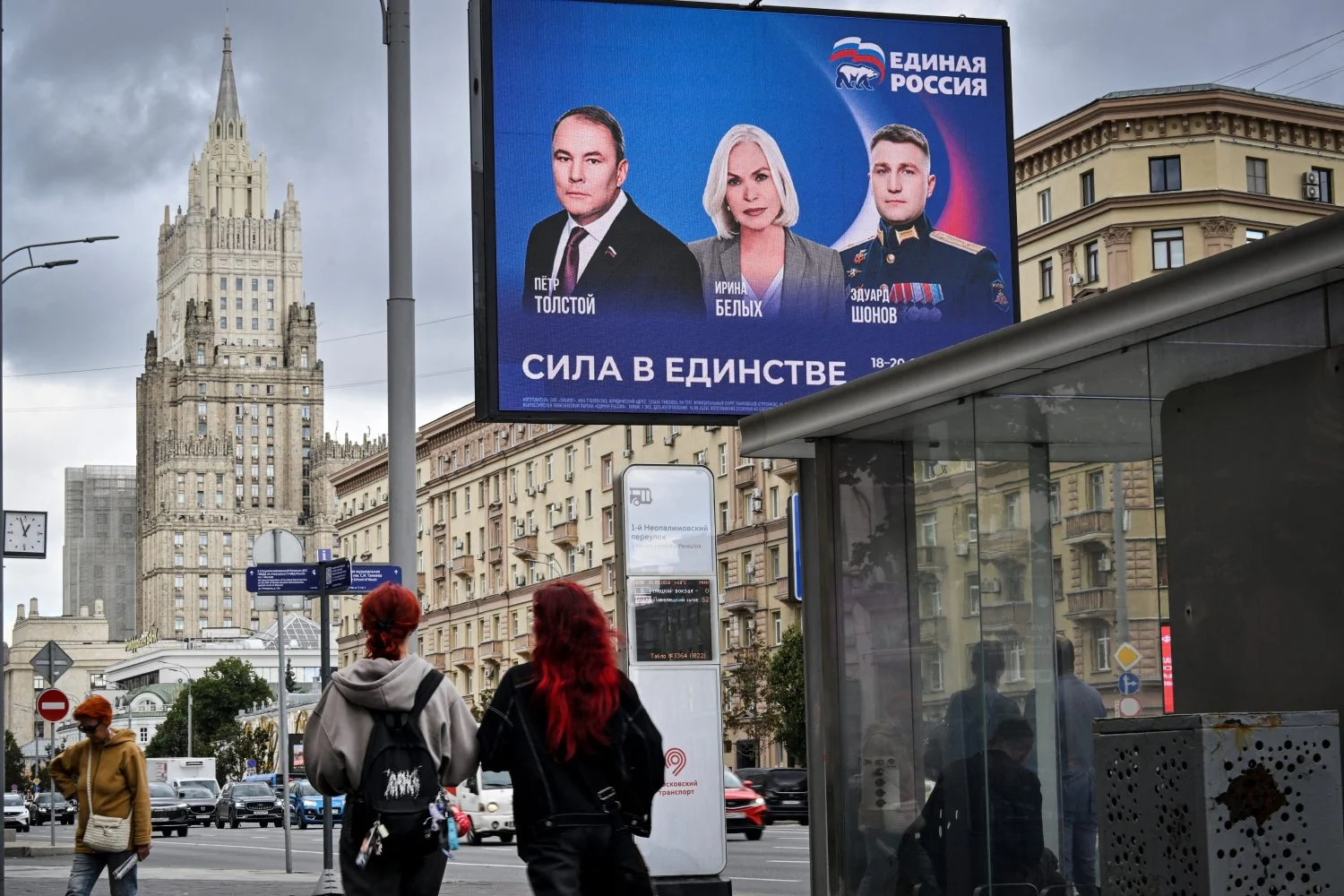
What passes for elections in Russia these days bears little resemblance to any recognizably democratic process. Opposition figures are jailed, exiled, or dead. Remaining candidates are carefully screened. In Russian-occupied parts of Ukraine, ballots are cast at gunpoint. Some precincts’ vote tallies are mathematically impossible, and most Russians know that the outcome is predetermined. But in a dictatorship, even a rigged election has meaning. What matters is not the predictable victory declared by the ruling party, United Russia, following the Sept. 18-20 parliamentary elections but the signals that this completely orchestrated piece of political theater sends across Russia and to the world.
The first signal is the illusion of legitimacy. By adhering to constitutionally mandated electoral cycles, an autocrat asserts his legal claim to power—never mind that Russian President Vladimir Putin’s mandate from the last more or less genuine election in 2000 has long expired. Putin is very fond of recalling his studies to become a lawyer, and one of the words he has used most often in all his public speeches is “law.” In the process of building his dictatorship, Putin always thought to keep the legal fabric intact. On the surface at least, procedures should be followed—a sham legality we know from other dictatorships, including the Soviet Union and Nazi Germany.
What passes for elections in Russia these days bears little resemblance to any recognizably democratic process. Opposition figures are jailed, exiled, or dead. Remaining candidates are carefully screened. In Russian-occupied parts of Ukraine, ballots are cast at gunpoint. Some precincts’ vote tallies are mathematically impossible, and most Russians know that the outcome is predetermined. But in a dictatorship, even a rigged election has meaning. What matters is not the predictable victory declared by the ruling party, United Russia, following the Sept. 18-20 parliamentary elections but the signals that this completely orchestrated piece of political theater sends across Russia and to the world.
The first signal is the illusion of legitimacy. By adhering to constitutionally mandated electoral cycles, an autocrat asserts his legal claim to power—never mind that Russian President Vladimir Putin’s mandate from the last more or less genuine election in 2000 has long expired. Putin is very fond of recalling his studies to become a lawyer, and one of the words he has used most often in all his public speeches is “law.” In the process of building his dictatorship, Putin always thought to keep the legal fabric intact. On the surface at least, procedures should be followed—a sham legality we know from other dictatorships, including the Soviet Union and Nazi Germany.
Right now, holding elections generates an extra sense of self-righteousness for Putin as he seeks to delegitimize his Ukrainian counterpart, Volodymyr Zelensky. The Ukrainian Constitution, like that of various other democracies, bans the holding of elections during wartime. Putin will thus try to argue that Zelensky’s term in office has expired while he himself is legitimately elected and just scored another resounding “victory” for his party. Never mind that the word “election” has a completely different meaning in the two countries. In Russia, voters cannot loosen Putin’s grip on power. This distinction will, of course, be lost on U.S. President Donald Trump, who echoes Putin’s lies about Zelensky’s electoral legitimacy.
The second signal of this recent vote concerns Russia’s borders. Holding national elections—first presidential, then parliamentary—in the occupied parts of Ukraine is supposed to shore up the legitimacy of Russian control, even if those elections take place at gunpoint and are otherwise manipulated. If the residents of illegally annexed territory vote in Russian national elections, after all, that must mean they are Russians now and acknowledge Moscow’s authority. This is how the Kremlin spins it both in Russia and abroad.
No one knows how many Ukrainians remain in these areas or how many current residents moved there from Russia since 2014 (and especially since 2022), not to mention the number of Russian military and security personnel voting in these front-line areas. This attempt to legitimize Russia’s illegal annexations may hold no weight outside the bubble that surrounds the Russian dictator and his supporters. But it is part of Putin’s logic of sham legality.
The third signal is about shifting popular support. Elections may not pose a direct threat to the regime in terms of losing power, but even highly manipulated results can be a political barometer. What the regime chooses to ban sends a message as well.
For example, the most fervently militaristic party, A Just Russia, lost 11 of its 27 seats after struggling even to clear the minimum threshold needed to enter the Duma. (The official result of precisely the required 5 percent strongly suggests that the real total was lower.) The Yabloko party, on the other hand, was initially permitted to run with an anti-war message, in the Kremlin’s expectation that it would suffer a resounding defeat. When Yabloko began climbing rapidly in the polls, the risk to Putin and his war project was deemed unacceptable, and the party was removed from the ballot, ostensibly on technical grounds. This continues the Kremlin’s policy of outlawing everything and everyone opposed to the war.
A fourth signal is about institutional power shifts. For the first time, management of the election was transferred to Russia’s Federal Security Service—the successor of the KGB that is responsible for fighting terrorism, political opposition, and other threats to the system. Elections have thus become yet another part of the Russian system that the security services have taken over.
This was apparent from the more heavy-handed tactics used to mobilize voters and influence the result, which seemingly included abducting a candidate in Moscow. One outcome of these tactics was seemingly a record voter turnout. The reported participation rate was higher (60 percent) than in the last Duma election in 2021 (52 percent). The Putin-aligned United Russia party, which made support for the war the centerpiece of its campaign, increased its share of the vote from 49.8 percent to 57.8 percent. Given internet blackouts, gasoline shortages, Ukrainian attacks deep inside Russia, and the widespread alarm reflected in the success of Yabloko’s anti-war platform before the party was banned, those numbers look improbable.
The fifth signal concerns the political direction of a generation of young Russians that has come of political age during Putin’s war on Ukraine. They did not live through perestroika or the chaotic 1990s, nor were they of age during the more liberal periods of Putin’s first two terms, Dmitry Medvedev’s presidency, or the mass protests in Moscow in 2011-12. For this age cohort, collecting signatures in support of Boris Nadezhdin—an anti-war candidate who was barred from the 2024 presidential election—and supporting Yabloko before it was excluded from the ballot are serious formative experiences. The anger of these young people may not yet pose a serious challenge for the regime, but it should be enough to send an unpleasant chill among the leadership.
The sixth signal to come out of the Duma election is that a new war elite is here to stay. For the first time in its post-Soviet history, Russia’s parliament is becoming militarized: Almost 1 in 8 deputies are now veterans of the Ukraine war. Putin and the entire regime leadership are promoting veterans as a new patriotic elite, not only in the federal Duma but also among regional governors and their deputies.
This could lead to new conflicts in Russian society. The established civilian bureaucracy, for example, will be reluctant to welcome unpredictable, war-hardened veterans into their ranks on equal terms. That is why Ukraine war veterans still remain rare in the federal executive branch.
Nor is there any clear demand among the general public for a new elite made up of Ukraine war veterans. The leadership may refer to them as the best of the nation, but in the villages, small towns, and city suburbs where contract soldiers are recruited for the war, opinions of them are often very different. In those places, they are not heroes to be glorified but very often people who are notorious in their community—members of a precarious underclass who frequently have a checkered history. According to polling by the Levada Center, Russians increasingly worry about the impact that soldiers returning from the war will have on them and their communities.
Skeptical attitudes toward Ukraine war veterans will inevitably color people’s perceptions of the new Duma. Instead of constituting a new elite, the new fighters-turned-deputies may turn out to be a thorn in the side of society.
The Kremlin got the result it wanted. Russia is not in revolutionary ferment, and the country has already missed the point at which elections could have overturned the regime. But more and more Russians are unhappy with a war that has dragged on and is now coming home in the form not only of coffins but also of wartime shortages and disruptions.
Russians are also unhappy that there is no way to tell their authorities this. The usual channels of feedback no longer work: not the press, not open discussion on social media, and not elections. This does not mean that all dissatisfaction is anti-war. Many Russians still complain that their military is not fighting “for real” or brutally enough. But polls show that a majority would welcome an early cease-fire.
The regime’s answer to any such feedback is repression. Elections, now even more tightly managed by the same security services tasked with other forms of repression, have become the latest turning of Putin’s screw. It is unlikely to be the last.
In his first public remarks after the election, Putin told Russian servicemen that the result demonstrated support for the war against Ukraine. As of now, the Russian electoral process is no longer even an imitation of democracy. It has become an element of the war itself.
