


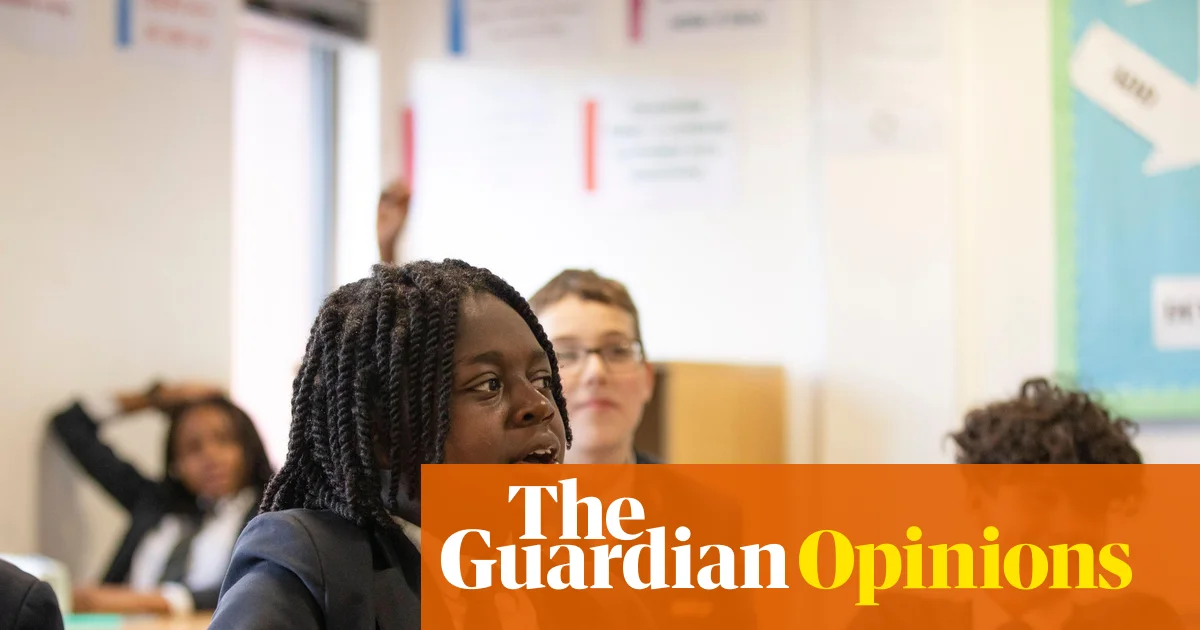
At last the fourth R is born. Articulation – speaking – is to join reading, writing and arithmetic in the education canon. What has become the mighty struggle against the dictatorship of the screen can begin in earnest. The spoken word, human-to-human communication, must finally be recognised by the gods of reactionary schooling. The pundits call it oracy.
On Thursday, the education secretary, Lucy Powell, called the academics’ bluff. She wants a radical reform of the national curriculum in England to reduce “desktop” working in favour of verbal fluency and practical skills. This will take courage. For decades, education’s senior leaders have been ramming easily forgotten “subjects”, such as maths and French, into children’s brains so they can be judged and measured in league tables. These tables have grown ever more dominant as ministers seek to climb “global rankings”.
After the second world war, an “academic” secondary education was shaped by the increased demand for a university-educated workforce. Higher education was expanded, but Britain’s technical and vocational schools and colleges were relegated out of sight. Teaching became enslaved to exam quantification and lost contact with the real world.
But the act of excluding communication skills from this academic orthodoxy has come home to roost. Artificial intelligence and mobile phones are progressively distancing young people from adults and each other. I notice gatherings of young people who used to chatter, laugh and banter. They now stand gazing at their screens or they just shout at each other. Conversation – sharing, informing, discussing, sympathising – seems on the way out.
Speaking itself is going out of fashion. Research suggests that in the past two decades the number of words people say each day has shrunk by nearly a third. They prefer texting. A quarter of young people now say they never even answer the phone unless pre-arranged. They fear a phone call means bad news.
Powell’s promotion of oracy means teaching young people once again to use the spoken word to their advantage. It is about conveying what one means clearly; listening, debating and handling disagreement. Speaking well means using eye contact and appropriately adjusting your tone of voice. It means politeness and tolerance. Above all, it enables young people to present themselves to others effectively, whether in work, play, argument or friendship.
To the Greeks and Romans, oracy was the towering skill of rhetoric. It was central to citizenship. The New Education movement of Steiner and Montessori in early 20th-century Europe stressed building on the qualities of the individual child rather than imposing rote learning from above. It is significant that the movement has seen a revival in the Waldorf schools now favoured by California’s AI executives in Silicon Valley.
That such ideals of progressive education have long been drummed out of the English curriculum is outrageous. The aversion to the spoken word has corresponded with the increasing prominence of maths in the curriculum, its skills beyond foundational arithmetic irrelevant to all but a tiny minority of adults. Children need to master elementary maths in primary school. But after that they only need to know how to use a calculator. I wonder how many readers remember being able to answer this question from last year’s GCSE paper: “The volume of a sphere is 4/3πr³ where r is the radius. Work out the volume of a sphere with diameter 20cm in terms of π.”
It is extraordinary that passing this exam is still required for most apprenticeships. Yet while he was prime minister, Rishi Sunak wanted maths to be compulsory until the age of 18. Small wonder it has long headed the list of “most hated” school subjects.
Quite how the teaching profession will react to Powell is not clear. The hyper-centralisation of British government has meant ever more school time spent on exams. This has led to cutting back on individualised learning and creativity, which typically flourishes in teaching of the arts. Teachers are pressed to “teach to the test”, at peril of damnation from Ofsted. These days, only the private sector dares resist. Winchester college devotes an hour a day to its form of oracy: “div” and “forum” sessions, when pupils discuss contemporary topics not covered by the examination syllabus: scientific ideas, philosophy, politics, music, critical thinking and the acceptance of others’ opinions.
after newsletter promotion
Such speech-centred concepts as group learning and peer tutoring are being pursued in some universities, and the cause was taken forward in the 2024 oracy commission report. But the catch is always resources. The essence of teaching people how to speak must lie in personal contact. It is in the human relationship of tutor and pupil, which was once the essence of teaching as a profession, not a mechanical skill.
One key might lie in killing maths. Leave it to its enthusiasts. For the rest, school should be about the world outside, a world of other human beings. It is about how to go about handling them that young people have most to learn.
