


Democrats scored a stunning victory in the 2026 midterms. Although many pollsters predicted a strong showing for the party out of power, few expected the map to look so blue by the end. In some ways, Texas looked as Democratic as New York or California.
Now the question for Democrats is: What comes next?
However large their majorities in the House of Representatives and the Senate, they will face a Republican president who is extraordinarily aggressive in his use of executive power, as well as a Supreme Court that has been generally sympathetic to his vision of the presidency. If Democrats pass legislation, President Donald Trump will likely veto it. If Democrats investigate him, he will stonewall and wield his pardon power for allies who do the same. If they try to stop the war in Iran, he will draw on decades of accumulated presidential war powers to keep doing what he wants.
But the 120th Congress is not the first to face such a difficult situation. In 1975, the new class of House and Senate Democrats elected in the aftermath of President Richard Nixon’s resignation squared off against Republican President Gerald Ford. For all his talk of healing the nation and moving beyond the most contentious issues of the moment, Ford was also willing to use the veto to cut the Democratic Congress down to size. Though he understood that in Nixon’s shadow he had to scale back the presidency, he was not willing to give up the many tools at his disposal.
Yet the 94th Congress—propelled by the Watergate Babies, as they were known—found ways to use its legislative power to pursue internal reform, advance a legislative agenda, and help create the conditions for Jimmy Carter’s election in 1976. Democratic members of the incoming “No Kings Congress,” as we might call it, should take notes.
In November 1974, the nation was reeling from division, scandal, and crisis. A decade of domestic conflict over race relations and the Vietnam War had opened deep rifts throughout U.S. society. Public trust in government had plummeted, largely as a result of the war. The economy was also in shambles in the early part of the decade, as the United States, which had enjoyed unprecedented economic growth after World War II, suffered from unemployment, inflation, and an oil embargo.
Then came Watergate. Richard Nixon revealed what an imperial presidency looked like. Not only did he continue with secret military operations in Southeast Asia despite having promised to end the war in Vietnam, but he used the executive branch to intimidate, spy on, and threaten U.S. citizens; impounded money that Congress had appropriated; and engaged in dirty tricks against his opponents. As the scandal unfolded between 1972 and 1974, a story that began with a break-in at the Democratic National Committee Headquarters in the Watergate Complex grew into something much bigger: a revelation about the abuse of power that culminated in Nixon’s resignation, after being told that many Senate Republicans would vote to remove him from office if the House of Representatives passed articles of impeachment. After Nixon left office, Ford eroded the goodwill the public had for him by pardoning Nixon for any crimes that he might have committed. Ford’s approval ratings plummeted and many Americans came to see him as part of the problem.
The midterm campaigns had centered on the economy and on corruption in the political system. Democratic candidates promised a robust response to Americans’ pocketbook struggles and vowed to fix the problems the scandal had exposed in the political system. The midterms delivered a body blow to Republicans, even though they still controlled the White House. Democrats gained 49 seats in the House, bringing their total to 291, and a net of four seats in the Senate.
A new generation of House Democrats—such as Henry Waxman and George Miller (California), Tom Harkin (Iowa), Chris Dodd (Connecticut), Tim Wirth (Colorado), Thomas Downey (New York), and Paul Simon (Illinois)—came to Capitol Hill not wedded to older axioms and determined to bring about change. The day after voting, James Naughton of the New York Times wrote, “Democrats swept yesterday toward domination of the next Congress as voters across the nation apparently blamed Republicans for the Watergate scandal and for economic disruption.”
Looking back at the period, two of the Watergate Babies, Downey and Toby Moffett of Connecticut, recalled in a recent column in the Hartford Courant: “We were determined to challenge a sclerotic Congress where entrenched power sapped the idealism and creativity of newcomers. Led by the activism of new members — and supported by a key group of existing policymakers, dozens of newly empowered subcommittee chairs launched investigations on clean air violations, nuclear plant safety, pharmaceutical pricing and human rights abuses abroad — we had idealism, the staff, and the authority to change the way Congress functioned.”
But in November 1974, just as in November 2026, it was not clear what this new Congress would be able to accomplish. The government was divided, Democrats themselves were still split between a liberal northern and a conservative southern wing, and public distrust was so high that voters would be difficult to satisfy regardless of who was in power.
Yet the Democrats found a way to keep moving forward. Their first step was to clean up their own institution before turning on to the presidency. In December 1974, Democrats pressured Arkansan Wilbur Mills, the powerful chairman of the House Ways and Means Committee, to step aside as a result of a scandal that involved his relationship with a local stripper named Fanne Foxe and his addiction to pills and alcohol. In January 1975, the freshman class of Watergate Babies led the drive to depose three other House committee chairmen—F. Edward Hébert, W.R. Poage, and Wright Patman—after questioning every sitting chairman about how responsive he would be to the party caucus and finding them wanting. The spirit of reform also reached the Senate, where Democrats tweaked the committee system and also lowered the number of votes needed to end a filibuster from two-thirds of the senators present and voting to three-fifths of senators.
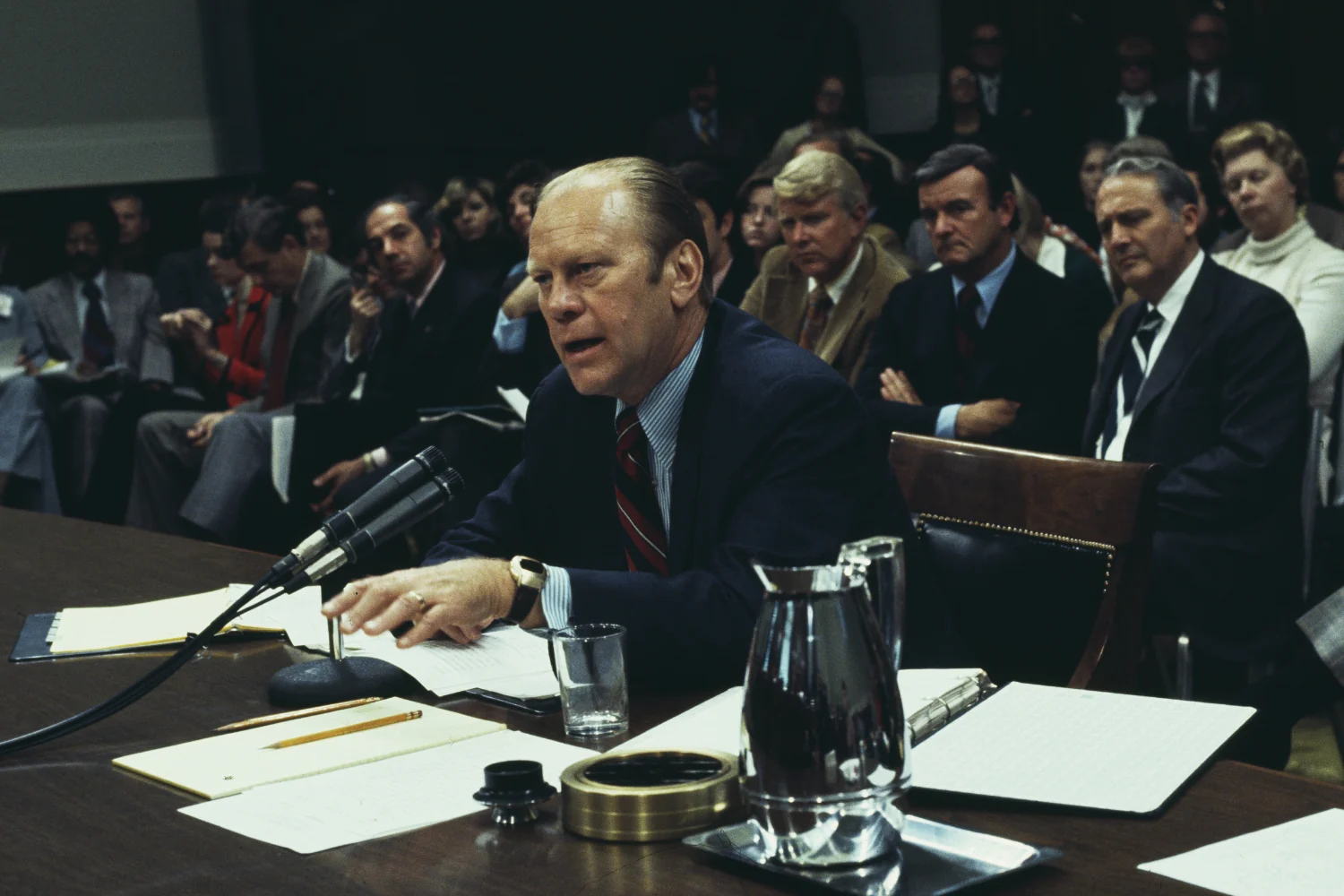
Congress also investigated the Ford administration. In October 1974, Ford appeared before the House Judiciary Committee to answer tough questions about pardoning Nixon. New York Rep. Otis Pike and Idaho Sen. Frank Church led high-level hearings investigating the Cold War national security state, producing bombshell revelations about how officials had abused their authority and lied to the public, building public support for reforms that ultimately passed in 1978.
The 94th Congress also legislated. On some issues, it found points of agreement with Ford, who signed legislation providing tax rebates, creating the Earned Income Tax Credit, and establishing the Strategic Petroleum Reserve and CAFE fuel economy standards. In some cases, such as a bill funding public works jobs, Democrats overrode the president’s veto after scaling back the measure. In others, such as farm price supports, they passed bills that Ford successfully vetoed but that showed what the party might do in power. They had the effect of pushing voters to think about “what if?”—what if Democrats also had control of the White House? Some of the new Democrats, like Waxman, used their media platforms to promote issues, such as clean air legislation, that were only starting to gain attention.
In 1976, former Georgia Gov. Jimmy Carter won the presidency with 297 electoral votes. Although Carter was not a Washington insider, his campaign built on many of the themes that the 94th Congress had advanced and kept the same agenda: government reform, transparency, help for working Americans, and restoring the balance of power in Washington. Democrats also maintained massive majorities, with 292 seats in the House and 61 in the Senate.
The lesson from the Democrats of the 94th is that Congress can still accomplish a great deal in 2027, whether Trump chooses to govern in a transactional fashion with Democratic leadership or whether he decides to double down and fight.
Given the election results, Democrats can investigate corruption, conflicts of interest, and decision-making on matters such as Iran. Congress can work on cleaning up its own house, including legislation to restrict stock trading by sitting members. As Moffett and Downey wrote in the Hartford Courant, congressional reform is even more essential than in 1975, due to the erosion of staffing, expertise, and institutional knowledge. They propose revitalizing subcommittees as a first major step toward the path of reconstruction.
The No Kings Congress can look for legislation on pressing problems such as healthcare costs or Social Security that a lame duck president sees as being in his interest to reform, or that a shattered congressional Republican Party perceives as being in its own interest to join with the opposition on (thus making a bill veto proof). And Congress can keep pushing legislation on issues such as affordability and immigration that lets voters see what unified Democratic control might accomplish in 2029.
The one thing the 120th Congress can’t afford to do is nothing. A massive electorate and a diverse caucus, ranging from progressives in Michigan to preachers in Kansas, put Democrats into power. Voters have sent many signals that they want their leaders to do something about the crushing burden of affordability that weighs on U.S. families, the corruption that has afflicted Washington, and the sense of runaway presidential power. If Democrats live up to the moment, they could find themselves, two years from now, in an even stronger position to bring the era of MAGA to a decisive end.
