


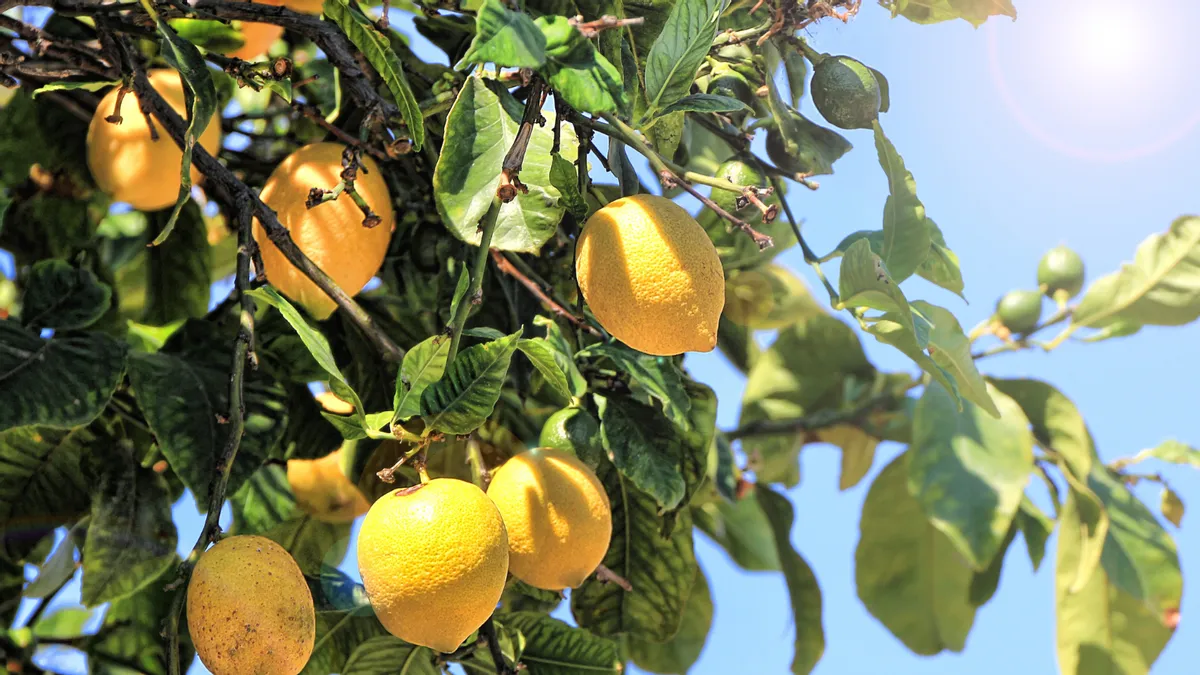
Lemons are not a “naturally occurring” fruit as they are a manmade hybrid of a sour orange and a citron.
Thousands of years ago, bees likely facilitated the transfer of pollen between the sour orange and the citron, which resulted in the creation of lemons – a natural hybrid of the two species. Humans later propagated the fruit through grafting and cuttings to preserve its desirable traits, but humanity did not invent the lemon.
In August 2026, social media users
For instance, one Instagram post (archived) read:
Apparently, lemons aren’t naturally occurring
Lemons are a hybrid fruit created by crossbreeding a bitter orange and a citron, meaning the fruit we know today was cultivated through centuries of selective breeding rather than existing as a naturally occurring wild species

(Instagram user @davidattenborough_fandom)
For years, the claim spread across various platforms including
In short, as we found when we looked into the topic in 2024, the claim that lemons are not “naturally occurring” because they are a manmade hybrid is false. Lemons are indeed hybrids of citron and sour orange, but there is no evidence humans deliberately crossbred those species to create the first lemon. Researchers told Snopes the hybridization most likely occurred naturally thousands of years ago, potentially through insect pollination. Humans later selected and propagated lemon trees through horticultural techniques such as grafting and cuttings.
Where did lemons come from?
Citrus fruits have a complicated history. As National Geographic explained in a 2017 article (archived), citrus species can easily mutate and cross with each other, which allowed their genes to mix naturally over thousands of years, and later through human breeding.
A 2016 study titled “Phylogenetic origin of limes and lemons revealed by cytoplasmic and nuclear markers” noted that the origins of “most lemons and limes” remained “controversial or unknown.”
However, a 2018 study published in the scientific journal Nature confirmed lemons originated as a hybrid of citron and sour orange (see image below).

(www.nature.com)
A later 2023 study sequencing the lemon genome reached the same conclusion.
Patrick Ollitrault, a citrus genetics researcher at the French Agricultural Research Centre for International Development, told us via email that phylogenomic research shows lemons resulted from sexual hybridization between citron and sour orange.
Did humans create lemons?
Ollitrault said the hybridization of sour orange and citron, that created lemons, happened naturally, and not through human breeding, as social media users suggested. For example, a bee could have carried pollen from a citron flower to a sour orange flower, causing the two species to cross. After the hybrid appeared, humans selected lemons for their desirable characteristics and propagated them using methods such as grafting and cuttings.
He added that many modern citrus fruits ultimately descend from four ancestral species: citron
In a follow-up email, he said social media posts claiming lemons do not occur naturally are false.
Professor Emeritus Mikeal L. Roose, a specialist in citrus genetics, genomics and breeding at the University of California, Riverside, added some more context via email. Roose told us that lemons could have originated through natural hybridization, but the exact circumstances are not known because this happened a very long time — probably at least 2,000 years — ago.
This timeline is also supported by archaeological evidence. A 2017 study on the spread of citrus found that the earliest known remains of lemon were discovered in Rome’s Forum Romanum and dated to the late first century B.C. or early first century A.D.
Roose said humans may still have played an indirect role. The parent varieties of lemon may have originally grown in different areas, but early humans carried the fruits with them during migrations. This may have brought the plants closer to each other and made natural hybridization possible, likely with the help of bees. Therefore, humans may have helped bring the parent varieties into contact, but there is no evidence they were deliberately crossbreeding citron and sour orange to create lemons.
Fred Gmitter, a professor of horticultural sciences at the University of Florida’s Citrus Research and Education Center who specializes in citrus breeding, genetics and genomics, similarly told Snopes there was no evidence that deliberate human breeding produced the first lemon.
According to Gmitter, the most likely explanation is that a “natural hybridization event that took place several thousand years ago” produced the first lemon tree. He said “true lemons we know today,” including Eureka, Lisbon and Femminello, later appeared through chance mutations from the “ancestral first lemon.”
Human role in the lemon’s history
Although there is no evidence humans created the first lemon, they later played an important role in finding, selecting and propagating lemons.
Gmitter explained that lemons can clone themselves through seeds, meaning they can produce genetically identical trees. Therefore, the first lemon tree could have produced many genetically identical descendants as its seeds spread naturally. Early humans therefore did not necessarily have to find one single, rare lemon tree and may have come across groups of very similar or identical lemon trees.
“Naturally occurring hybridization, not involving deliberate human activity, is how these forms originated,” Gmitter told us, explaining that human involvement came later, when people encountered naturally occurring lemons and began making use of them. As he summarized, “life really did give us lemons” — but through naturally occurring hybridization rather than deliberate breeding by humans.
For further reading, in April 2011 we investigated whether lemons “kill cancer cells” and are “10,000 times stronger than chemotherapy.” Moreover, in March 2020, we debunked a false rumor that hot water with lemons would cure or prevent COVID-19.
Snopes’ archives contributed to this report.
Sources
Center, UF/IFAS Citrus Research and Education. Fred Gmitter – Citrus Research and Education Center (CREC) – University of Florida, Institute of Food and Agricultural Sciences – UF/IFAS. https://crec.ifas.ufl.edu/people/faculty/fred-gmitter/. Accessed 19 Sept. 2024.
CIRAD. “A New Look at the Evolution of Citrus.” CIRAD, 19 Oct. 2021, https://www.cirad.fr/en/press-area/press-releases/2018/a-new-look-at-the-evolution-of-citrus.
Grafting Ornamental Plants and Fruit Trees / RHS. https://www.rhs.org.uk/fruit/fruit-trees/grafting-ornamental. Accessed 19 Sept. 2024.
Gulsen, O., and M. L. Roose. “Lemons: Diversity and Relationships with Selected Citrus Genotypes as Measured with Nuclear Genome Markers.” Journal of the American Society for Horticultural Science, vol. 126, no. 3, May 2001, pp. 309–17. journals.ashs.org, https://doi.org/10.21273/JASHS.126.3.309.
Kasprak, Alex. “Will Lemons and Hot Water Cure or Prevent COVID-19?” Snopes, 26 Mar. 2020, https://www.snopes.com//fact-check/lemons-coronavirus/.
Mikkelson, David. “Do Lemons Cure Cancer?” Snopes, 18 Apr. 2011, https://www.snopes.com//fact-check/lemon-cancer-cure/.
Moore, Gloria A. “Oranges and Lemons: Clues to the Taxonomy of Citrus from Molecular Markers.” Trends in Genetics, vol. 17, no. 9, Sept. 2001, pp. 536–40. ScienceDirect, https://doi.org/10.1016/S0168-9525(01)02442-8.
‘New Plants From Cuttings’. Indiana Yard and Garden – Purdue Consumer Horticulture, https://www.purdue.edu/hla/sites/yardandgarden/extpub/new-plants-from-cuttings-text-only/. Accessed 19 Sept. 2024.
Ollitrault, Patrick, et al. “Citrus Taxonomy.” The Genus Citrus, edited by Manuel Talon et al., Woodhead Publishing, 2020, pp. 57–81. ScienceDirect, https://doi.org/10.1016/B978-0-12-812163-4.00004-8.
“The Citrus Family Tree.” Magazine, 11 Jan. 2017, https://www.nationalgeographic.com/magazine/article/explore-food-citrus-genetics.
UCR Profiles – Search & Browse. https://profiles.ucr.edu/app/home/profile/roose. Accessed 19 Sept. 2024.
Wu, Guohong Albert, et al. “Genomics of the Origin and Evolution of Citrus.” Nature, vol. 554, no. 7692, Feb. 2018, pp. 311–16. www.nature.com, https://doi.org/10.1038/nature25447.
—. “Genomics of the Origin and Evolution of Citrus.” Nature, vol. 554, no. 7692, Feb. 2018, pp. 311–16. www.nature.com, https://doi.org/10.1038/nature25447.
https://academic.oup.com/aob/article/117/4/565/2195970? Accessed 18 Sept. 2024.
