


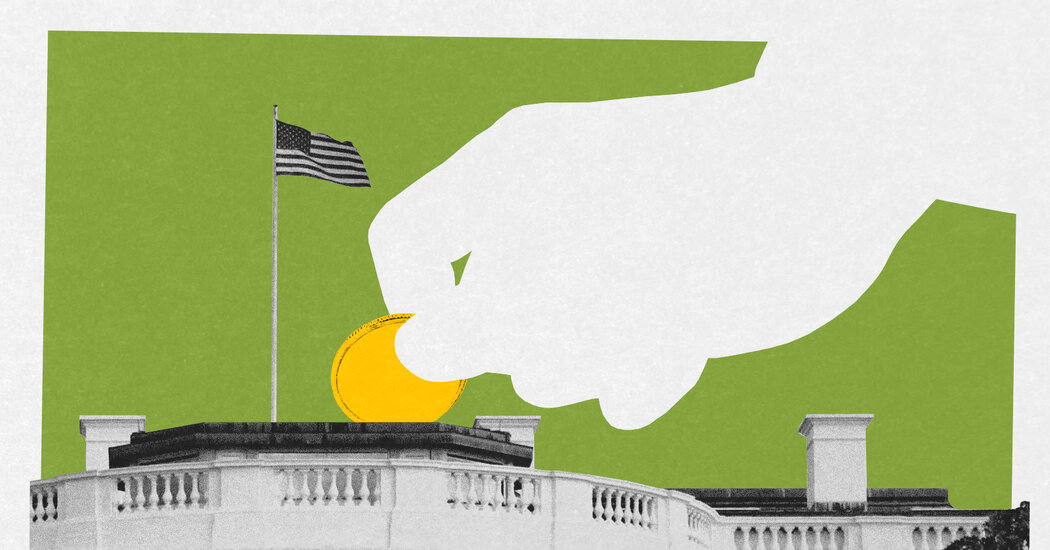
How much is the American presidency worth?
You could start the bidding at $2.2 billion: the minimum amount that President Trump is thought to have earned during his first year back in office. That figure is three and a half times what his family businesses earned in 2024, the last full year before he resumed the presidency. Most of it comes from cryptocurrency ventures. Trump’s family started these shortly before his administration throttled federal oversight of crypto and congressional allies began pushing legislation that would effectively exclude the Trump ventures from ethics rules. Days before his second inauguration, a firm tied to the government of the United Arab Emirates secretly bought a 49 percent stake in one company for half a billion dollars.
From there, you could add another $1.6 billion, the amount of federal financing the administration recently approved for an obscure company subsequently hired to develop a mineral concern in Kazakhstan, in a deal negotiated personally with the Kazakh government by Trump and Secretary of Commerce Howard Lutnick. Surely by coincidence, Trump’s sons are now investors.
Plus $400 million, the market value of the jet that the Qatari government gave Trump last year, now grounded over security concerns.
And there is the $1.776 billion “anti-weaponization fund” that Acting Attorney General Todd Blanche unveiled in May to settle a $10 billion lawsuit brought by Trump’s personal lawyers over the leak of his tax returns during his first term. A Treasury-financed pot of money equivalent to more than half the annual state expenditures of South Dakota, it would be distributed to people prosecuted by the Biden administration — presumably Trump’s allies. Donald K. Sherman, the president of the watchdog group Citizens for Responsibility and Ethics in Washington, described the fund as “one of the single most corrupt acts in American history.”
Americans are chronically pessimistic about corruption. Since 2007, a large majority has agreed that corruption is “widespread throughout the government in this country,” according to the Gallup polling organization.
But this discontent shades easily into apathy. In election-year surveys, corruption does not generally crack the top issues American voters care about. No American politician, arguably, has understood and exploited this ambient cynicism more successfully than Trump, who has campaigned three times against “corrupt” enemies and a “rigged” system and twice led the most flagrantly self-enriching presidencies this country has seen.
There’s a difference, though, between a dozen or so million in government payments to Trump-owned resort properties — the most attention-grabbing form that Trump’s conflicts took in his first presidency — and the multibillion-dollar spoils that have been made public in recent months. And this summer, among at least some prominent members of his party, there is a palpable nervousness that voters have noticed. Senate Republicans bridled openly at the Justice Department settlement, which would invite “a full-on revolt in the Senate,” Senator Ted Cruz warned. (A judge has temporarily blocked the fund, and Blanche has since claimed the administration ditched the idea.)
Their protests reflect the emergence of corruption as an issue of prominence in some midterm races for the Senate, where continued Republican control is looking less certain than it did a year ago. In Texas, the Democratic candidate, James Talarico, has pledged to introduce a “comprehensive anti-corruption package” if elected. In Georgia, Senator Jon Ossoff, a Democrat, is defending his seat with denunciations of “the most corrupt administration of all time.”
This is more surprising than it might initially seem. One lesson that Democrats took from Trump’s first term, in which they struggled to make voters care about sketchy Mar-a-Lago memberships and attempts to host an international summit at a Trump resort, was that American disillusionment with a “corrupt” system helped Trump far more than it hurt him. Has that changed?
If you define corruption the way most corruption experts do, as the misuse of public office for private gain, then the United States, for all its imperfections, is not a particularly corrupt country. And American history is mostly an anticorruption success story.
Corruption was a genuine problem in the 19th-century United States, and the legal scholars Mariano-Florentino Cuéllar and Matthew C. Stephenson have argued that the forms it took then would be recognizable to the present-day citizens of corruption-plagued developing countries like Brazil, India, Indonesia, Nigeria and Ukraine.
Self-interested sales of public lands were common. For patronage and plunder, politicians exploited government offices overseeing industrial development, customs and public infrastructure. The financing of the Civil War and, after it, the westward expansion of the railroads produced spectacular episodes of fraud and self-dealing. In large cities, public services and primitive social safety nets were often maintained by nakedly transactional political machines.
This was systemic corruption, in which the act of robbing the state and its citizens was inseparable from the governance of that state. The process of taming it advanced by fits and starts until the Progressive Era of the early 20th century. That’s when concern about corruption, informed by the financial instability and inequality of the Gilded Age, surged to the center of American politics.
The unglamorous reform work that expanded in that period and continued beyond it — government investigations and prosecutions, civil-service restructuring, the establishment of independent commissions overseeing industries and public works — gradually changed American corruption, Cuéllar and Stephenson argue, from a systemic problem to an episodic one. Norms changed. Corruption went from the thing that got you into office to the thing that got you thrown out of it.
Another way of reading this history, however, is that systemic corruption wasn’t defeated in the United States; it simply evolved.
In her 2016 book, “Corruption in America,” the legal scholar Zephyr Teachout argues that the most pertinent example of corruption in America isn’t Boss Tweed but King Louis XVI of France. Before Benjamin Franklin left his ambassador’s post in Paris in 1785, the king gave him a diamond-encrusted snuff box — a gift without overt strings attached but with obvious enough implications that it became an object of debate two years later at the Constitutional Convention. This informed the Constitution’s foreign emoluments clause, which bars presidents from receiving gifts from foreign powers without congressional approval.
That provision, Teachout argues, reflected the founders’ view that the most pernicious forms of corruption are not necessarily the most direct or literal. That understanding held sway in American law until the 1970s, when the Supreme Court began narrowing the legal definition of political corruption to the sort of out-and-out graft that a century of reforms and prosecutions had by then diminished. This thinking led to the court’s decisions in Citizens United v. F.E.C. and McCutcheon v. F.E.C., in 2010 and 2014, which together removed nearly all constraints and accountability from spending on elections.
The direct consequences of this legal drift were visible in the 2024 presidential election, in which nearly $900 million spent in support of both Democratic and Republican candidates, by The Times’s calculations, was entirely untraceable. Is it any great surprise, in this context, that so many Americans have a hazier definition of corruption than the law does? There may be a few politicians, like the disgraced Democratic senator Robert Menendez — convicted last year of accepting gold bars in a long-running bribery scheme — still out there pursuing 19th-century-style corruption with artisanal dedication. But the real action, everyone knows, is elsewhere.
Voters may be unhappy about corruption, but do they actually care? Concern over its pervasiveness is widespread and bipartisan but also shallow and static. Trump and congressional Republicans spent much of the 2024 campaign cycle accusing President Joseph R. Biden Jr. and his son Hunter Biden of influence-peddling in relation to Hunter’s foreign business dealings. But in The New York Times/Siena poll, the percentage of registered voters who cited corruption as the biggest problem facing the country was practically flat over this time period, growing to just 4 percent in January of this year from 2 percent in December 2023.
Still, other surveys have registered shifts in Americans’ attention to the issue since Trump returned to office. An Ipsos poll conducted in April and May, which asked respondents about their three biggest concerns, found that 37 percent of Americans selected corruption — a 10 percent increase over a year ago.
One theory of what is happening is that Americans simply perceive the difference in scale between the windfalls of Trump’s first and second presidencies. When he was previously in office, Trump gleefully trampled the norms of presidential conflicts of interest, but in pursuit of what now look like comparatively small sums of money. The estimated $13 million that his resorts and other properties made off lobbyists hoping to curry favor with his first-term administration amounts to barely 3 percent of the value of the Qatari plane alone.
Another theory is that Americans feel worse off now than they did in 2017, and they are looking for someone to blame. “There’s two dominant sentiments in our politics now,” said Justin Florence, a founder of Protect Democracy, a watchdog organization established in Trump’s first term. “One is feeling that the economy and economic future doesn’t work for most Americans; the other is the political system is broken and Americans don’t have a say. Corruption ties together those two sentiments.”
You can see this rationale at work in the words of the Democratic candidates campaigning on corruption this year. In his May speech denouncing the “Mar-a-Lago mafia,” Ossoff quickly pivoted away from Trump to a broader criticism of America’s “coin operated” politics: “Money goes in, favors come out, and that’s why spectacular wealth buys an ever-greater share of power over our national affairs, while the mere citizen is treated with contempt.” Here, Trump is exceptional and yet not, a symptom rather than a cause.
But it’s tricky to make Trump the billboard for a broader political dysfunction. In 2024, after all, Democratic candidates benefited from more Citizens United-enabled dark-money spending than Republicans did. Is it possible to run against that system from inside that system?
On some level, this is a rhetorical puzzle. For decades, Americans have lamented the comparatively subtle corruption of campaign finance in the language of the 19th-century outrages. That has made the unexpected return of actual 19th-century-style self-dealing — at previously unheard-of scale and dare-you-to-stop-me openness — harder to confront on its own terms.
The first step is to recognize that these are related but different problems. This is the realist’s argument for a narrow definition of corruption, however insufficient it may be. It makes the project of fighting it seem less hopeless and thus more possible. It may not be everything, but it is something.
Source images for illustration above: Pool Photo by J. Scott Applewhite; Jupiterimages, via Getty Images; iStock, via Getty Images.
