


Conventional wisdom in U.S. politics holds that foreign policy rarely matters in midterm elections. When it comes to the composition of Congress, voters care about many issues, but ordinarily, what the United States does overseas is usually not among them. Bread-and-butter concerns (or, in today’s parlance, the issue of affordability) are much more likely to drive voters’ decisions about who should represent them. As Thomas E. Ricks wrote for this magazine in 2012, “Americans frankly don’t give a damn about foreign policy, Scarlett. By a 81 to 9 percent margin, they care more about the economy.”
There have, however, been notable exceptions where politics does not stop at the water’s edge, and 2026 is shaping up to be one of those years. It typically takes extraordinary circumstances for foreign policy to influence voting behavior, whether that concerns a full-scale mobilization, as in the 1942 and 1944 elections, or the deployment of large numbers of ground troops, as in the 1970 or 2006 elections. Yet the connection between military operations and economic conditions can also become politically potent.
When voters can readily perceive a direct link between a president’s national security decisions and the state of the economy, the conditions are ripe for the opposition party to connect the dots in its argument for rebalancing power on Capitol Hill.
This dynamic was an important part of the story in the 1966 midterm elections.
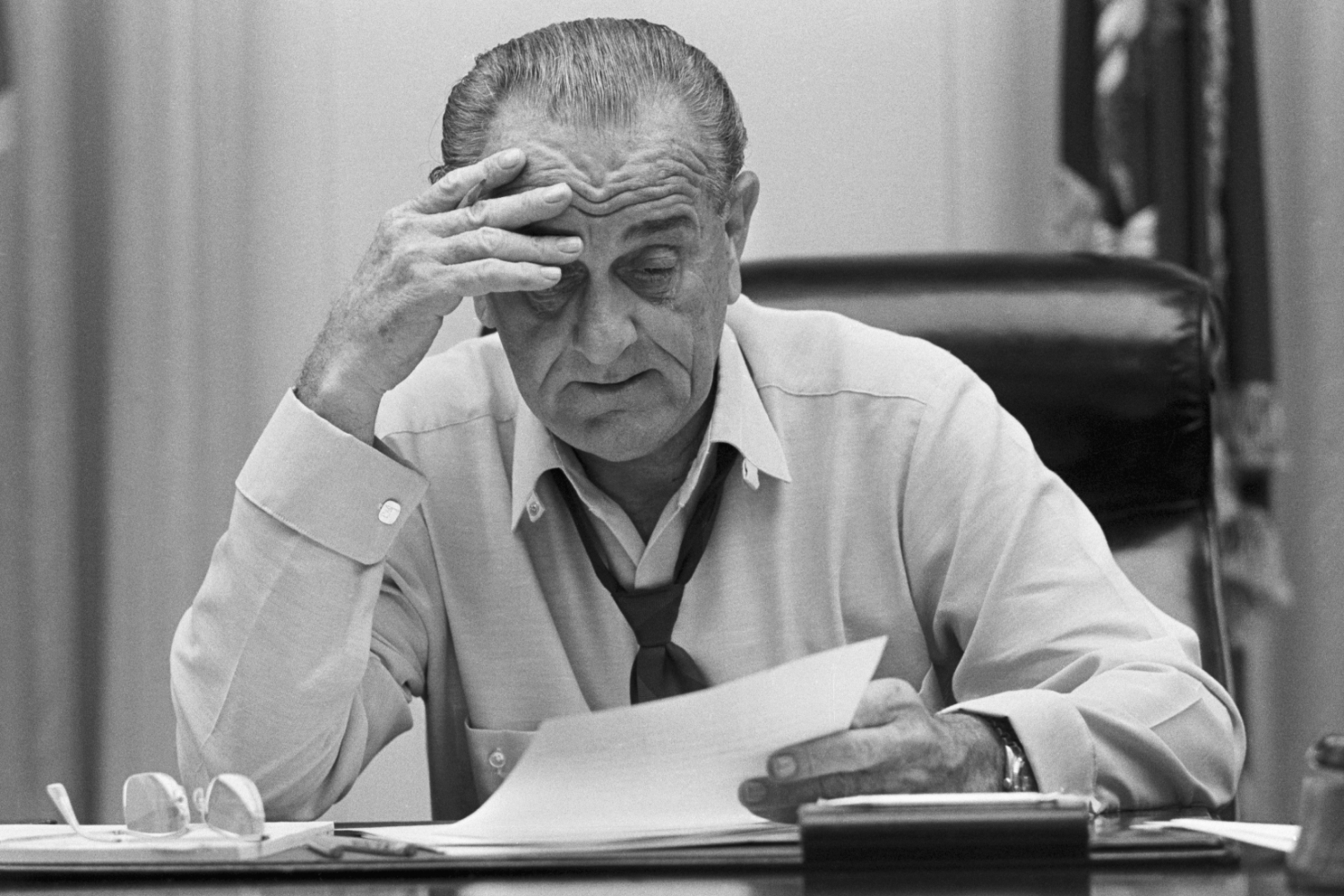
President Lyndon Johnson knew that the 1966 midterms would not be easy. From the moment he took over the presidency following John F. Kennedy’s assassination in November 1963, he urged his advisors to move quickly and decisively, recognizing that the window for major legislation would begin to close once lawmakers turned their attention from governing to reelection.
The strategy worked. Between 1963 and 1966, Johnson and the Democratic Congress enacted a sweeping array of Great Society programs, including the War on Poverty, the Civil Rights and Voting Rights Acts, Medicare and Medicaid, federal aid to elementary and secondary education as well as higher education, immigration reform, and much more.
Johnson’s decisive defeat of the conservative Republican Barry Goldwater in 1964 greatly strengthened his position. The landslide victory was widely viewed as a mandate for his agenda, and left Democrats with enormous congressional majorities: 295 seats in the House and 68 in the Senate. It also helped discredit conservative extremism within the GOP; within the Democratic Party, the balance of power shifted decisively away from the conservative southern committee chairs and toward liberal northerners.
By 1966, however, Johnson was struggling to hold his coalition together. Beyond the normal rhythms of the electoral cycle, the civil rights agenda was becoming increasingly contentious within the party’s northern wing, which had long supported civil rights when the issue centered on the Deep South. The administration’s proposed open-housing legislation, which would have prohibited racial discrimination in the sale or rental of housing, provoked fierce resistance in cities such as Chicago. Of the violent white mobs he encountered there, Martin Luther King Jr. said, “I’ve been in many demonstrations all across the South, but I can say that I have never seen—even in Mississippi and Alabama—mobs as hostile and as hate-filled as I’m seeing in Chicago.” In Nixonland, the historian Rick Perlstein recounted how Republican candidates in the Midwest spread all sorts of rumors about possible racial violence to stoke the fears of ethnic urban white voters who had long been part of the New Deal coalition.
Although there was a brewing backlash to some domestic initiatives, namely the War on Poverty, much of the growing discontent with the administration centered on Vietnam. Despite the presence of more than 300,000 U.S. troops in Vietnam by the fall 1966, the deployment itself was not yet the central political issue. The anti-war movement, largely concentrated on the left, was still in its formative stages and on the margins of politics. The angle Republicans focused on in their effort to reclaim seats was the economic cost of the war, as well as the Great Society—that is, rising federal deficits and inflationary pressures. While Republicans argued that Johnson was an ambivalent warrior, unwilling to unleash the United States’ full air power against North Vietnam, the economic consequences of the conflict became a centerpiece of their campaign. Republicans remembered how successfully they had used the rising cost of living during the Korean War to regain control of Congress and the White House in 1952.
Americans in 1966 still cared deeply about balanced budgets. The issue carried powerful symbolic weight because voters viewed government finances through the same lens as household finances. Republicans warned that Johnson’s war, combined with his ambitious domestic agenda, was producing large deficits. Those deficits, they argued, were fueling inflation. The federal deficit remained relatively modest by later standards—$2.3 billion in 1966—but it was larger than what Americans had become accustomed to during the 1950s.
For most of the post-World War II period, the nation had enjoyed extraordinarily low levels of inflation. In 1966, however, the Consumer Price Index registered the largest increase since 1957. Economists have generally agreed that wartime spending was the central driver, more so than the new domestic programs. At a Republican Party dinner in October 1966, House Minority Leader Gerald Ford warned that Johnson was “planting the seeds of a future depression.”
Worse still, Republicans argued, the increases were concentrated on basic goods such as pork chops, beef, transportation, medical care, and other household items. One internal White House poll found that 76 percent of respondents in California disapproved of the president’s handling of the cost of living. Johnson himself remarked that, whereas politicians in the 1950s could hardly meet a voter without being asked, “What do you think about McCarthy?” (a reference to Cold Warrior Sen. Joseph McCarthy), in 1966 the question had become: “What do you think about inflation?” In October, housewives in many states staged boycotts of local supermarkets to protest higher food prices.
Johnson knew that there was little political support for imposing price controls. He and congressional leaders understood that instead they would have to raise taxes or cut spending. Great Society programs remained popular, but Republicans used the mounting costs of Vietnam to deride “Great Society funny money,” arguing that domestic spending was worsening the problem. Republican campaign pamphlets warned voters that “progress is a shrinking dollar.” GOP candidates staged supermarket photo opportunities to dramatize the issue. “Every housewife who shops in a grocery store knows this,” Senate Minority Leader Everett Dirksen lamented. “They are the living, breathing signs of this destructive burglarizing force.”
Richard Nixon, whose political career had appeared finished after his loss to Kennedy in 1960 and his subsequent defeat in the 1962 California gubernatorial race, reinvented himself by traveling the country on behalf of Republican candidates, speaking about inflation and deficits, and raising over $6 million for their war chests.
Although Johnson delayed consideration of a tax increase, Federal Reserve Chairman William McChesney Martin raised the discount rate from 4 percent to 4.5 percent in December 1965. The decision infuriated the president and contributed to rising interest rates and a credit crunch during the summer of 1966. Housing starts declined, as did homebuilding and commercial construction.
The elections were disappointing for liberal Democrats. Although the party retained control of Congress, its majority fell to 64 seats in the Senate and 248 in the House. Republicans gained 47 seats in the House and three in the Senate. The conservative coalition of southern Democrats and Republicans expanded, recovering much of the ground it had lost in the Democratic landslide of 1964. At the state level, Republicans captured eight governorships and 557 state legislative seats. The GOP rebounded throughout the Midwest, where Goldwater’s candidacy had cost the party heavily two years earlier.
Surveying the results, pollster George Gallup concluded that Vietnam was the “great underlying issue and probably the prime reason why the G.O.P did so well.” Yet voters had not rewarded Republicans because they opposed the war. Rather, they punished Democrats for a failure to be aggressive enough, and due to the sense that the administration was failing to manage economic strain. California’s newly elected governor, former actor Ronald Reagan, demanded that Johnson authorize the full use of military force to bring the conflict to a decisive conclusion. House Majority Leader Carl Albert later reflected that the election “broke the back of the Great Society right there.”
The predictions proved correct. In 1967 and 1968, as the opposition to the war intensified on the left, Johnson’s coalition began to unravel. Conservatives in Congress forced reductions in domestic spending and blocked further expansive social programs. Faced with the growing costs of war, the administration increasingly chose guns over butter. By the next presidential election, when Johnson withdrew from the race, the Democratic Party was also deeply divided over the war. In 1968, Vice President Hubert Humphrey lost the election to Nixon. A new, more conservative era was underway.
Democrats are currently facing an opportunity similar to the one Republicans confronted in 1966. Although the war in Iran has not approached the scale of Vietnam and probably never will, its economic consequences have been substantial, and in some ways more transparent. Moreover, it has been unpopular from the start.
By destabilizing global oil and trade markets, the operations have directly contributed to higher prices for consumers—who are already struggling to keep up with the cost of living. Whereas Republicans are benefitting from the hundreds of millions of dollars Elon Musk has poured into his super PAC, Democrats may possess an even more powerful campaign message, through the price of gasoline that Americans see at the pump and the price of food they see at the grocery store register. And whenever they turn on the news, they see again that the president who promised to avoid so-called forever wars has entangled the nation in one himself, with working Americans, red and blue, paying the prices at home.
