



A denim-clad rancher poses on horseback, crimson-red shirt against a hazy blue sky. A farmer in a T-shirt stands surrounded by his crop, leaves bending toward weathered hands. “Real Americans wear cotton,” reads bold text over a photo of a sprawling white field.
This Americana-laden imagery came in an X post from Agriculture Secretary Brooke Rollins, uploaded in late May. The post — and its subsequent reply by Health and Human Services Secretary Robert F. Kennedy, Jr. — accompanied the release of the U.S. Department of Agriculture’s “Great American Cotton Plan,” an initiative with sweeping promises of reviving American cotton production and bringing textile manufacturing jobs back to the U.S.
Over the past half-century, many American clothing companies have moved their factories to China, Indonesia and Bangladesh, decreasing the need for domestic cotton production. Climate change has depleted southern soils and contributed to the nation’s reduction in the cotton sector, moving the U.S. behind Brazil in 2023 as the world’s largest cotton supplier.
Yes: plant, not plastic. Proud to support @USDA, @SecRollins, and the Great American Cotton Plan. American-grown cotton supports our farmers, strengthens rural communities, fuels U.S. manufacturing, and gives families a natural alternative to synthetic, plastic-based materials.… https://t.co/tuFsc6fLDb
— Secretary Kennedy (@SecKennedy) May 28, 2026
The USDA’s new cotton plan hopes to rebuild the industry, primarily by strengthening crop insurance for cotton and increasing direct funding toward American mills.
Rollins’ announcement comes as major voices of the nation’s health and agriculture policy — lawmakers, farmers, researchers and a new wave of online activists — have set their sights on the fabrics we wear and the plant it often comes from.
The political turmoil surrounding today’s textile industry marks a modern chapter in the complex, often painful and historically fraught, legacy of cotton in America. The battle has played out in a distinctly modern setting: in social media disagreements of a health-conscious electorate, weighing the presumed peril of microplastics with the fear surrounding agrochemicals.
But after decades of disappearing cotton acres and textile jobs, some are skeptical that renewed attention is enough to slow the industry’s decline. Some farmers, frustrated by the impact of retaliatory tariffs, say the plan does little to counter the fallout from other policies under President Trump’s administration.
“Look at any shirt, anything with cotton is made overseas,” said Jonathan Coppess, an associate professor of agricultural policy at the University of Illinois at Urbana-Champaign. “And so you’d have to reverse that in some form or fashion, which paying farmers isn’t going to do.”
As the USDA faces mounting pressure from industry groups and internet forums, the plan represents a search for a strategy that will unseat polyester from the majority of America’s closets — and reclaim the nation’s former place as the world’s top provider of cotton.
In the process, cotton has taken on a new meaning in American politics — the waning industry swept up into the center of long-standing debates about both domestic manufacturing and public health.
“It [cotton] doesn’t occupy the same place in the American imagination,” said Trevon Logan, a professor of economics at The Ohio State University. “But it didn’t go away.”
Generational decline
For more than a thousand years, demand for cotton fabrics from India influenced trade, and later colonization, throughout Eurasia. But as Europeans arrived in North America, they encountered a species of cotton with longer fibers, making for better textiles. After the invention of the cotton gin made it easier to turn the plant’s sticky seeds into workable fiber, Gossypium hirsutum became America’s greatest driver of economic growth, and of the burgeoning system of slavery.
“More than any other commodity,” writes author Thor Hanson in his book “The Triumph of Seeds,” “it gave the young American nation wealth, clout and international prestige.”
By the mid-1800s, the American South was the source of two-thirds of the world’s cotton. A century later, though, global demands changed the ways people bought their clothes. Innovations brought on to meet the demands of World War II meant synthetic fabrics like polyester were gaining traction among consumers. Then, in the 1970s, expanded trade relationships with China opened a new population of inexpensive laborers to American clothing manufacturers.
As U.S. clothing factories shuttered and moved overseas, so too did the other components of a thriving textile industry. The number of cotton mills has dropped from nearly 900 during the late 1800s to just around 100 today, leaving farmers with fewer options to sell their crop domestically.
Agricultural policymakers have tried to address the shrinking domestic industry with a series of programs designed to alleviate the expenses of cotton producers and processors.
Launched in 2016, the Cotton Ginning Cost Share Program paid more than $215 million to cotton farmers between 2017 and 2019 to mitigate the costs of processing raw cotton. Still, in 2025, U.S. cotton mill use was down 50.8% from 2016.
The 2025 Working Families Tax Cuts Act (better known as the One Big Beautiful Bill) included several provisions for U.S. cotton producers, including increased funding for crop insurance, support for milling facilities and clothing manufacturing and new trade protections.
Other proposed legislation, like the Buying American Cotton Act introduced earlier this year, hopes to reinvigorate the domestic industry by focusing on demand for U.S.-grown cotton. The House resolution, sponsored by U.S. Rep. Gregory Murphy, a North Carolina Republican, would provide tax credits for consumers of U.S.-produced cotton goods and implement programs to track the manufacture of domestic cotton products.
In 2025, Murphy’s campaign received $10,000 each from the National Cotton Council, a Cordova, Tennessee-based industry trade group, and the American Cotton Shippers Association, based in Memphis.
‘Press-release policy’
Coppess said he wasn’t surprised by the new Great American Cotton Plan — support for cotton production has been a sticking point in American agricultural policy for generations. But he isn’t confident in its ability to reverse the direction the domestic cotton industry is heading.
“The idea that they’re going to roll this thing out and magically undo something that’s been going on since the 1940s, it’s marketing,” he said. “It’s political marketing, but the realities are really difficult.”
From New Deal provisions for cotton farmers to NAFTA agreements on textile exports, prior administrations pushed for policies — financial subsidies, import quotas, strategic market interventions and domestic manufacturing campaigns — but were largely unsuccessful in slowing the industry’s decline.
The past decade has not been any better. Tariffs implemented during the first Trump administration hit the cotton industry particularly hard, according to USDA analysis, with cotton exports to China dropping by more than 37% between 2017 and 2018.
In the past two years, retaliation from the president’s second wave of tariffs brought down cotton exports to China by 84% between 2024 and 2025, according to researchers at North Dakota State University. Amid the dispute, Brazil extended its lead as the world’s top cotton exporter.
In early April, trade groups across the agricultural sector, including the National Cotton Council, signed an open letter to Rollins demanding an end to the trade war.
Both Murphy’s bill and the Working Families Tax Cuts Act are mentioned extensively in the Great American Cotton Plan. The plan, as a whole, does not outline any new policy the agency intends to pursue.
Rather, the plan describes how existing legislation and initiatives will work in concert, with the ultimate goal of reviving America’s cotton industry.

According to Logan, whose own family history includes several generations of cotton farming, the industry’s decline in prevalence is a natural consequence of America’s economic growth. Cotton no longer determines the nation’s place on the world stage.
“You can think about cotton in the 19th century the way that we think about oil today,” he said. “If green energy comes along … we wouldn’t be talking about oil being so important. There will still be combustible engines using oil, but we won’t care as much about it as we do today.”
Coppess described the USDA plan as “press-release policy,” and said cotton’s issues are much older than the plan seems to address.
“We’re not addressing the underlying problems for the markets and for farmers. We’re just throwing money at it, or in this case, packaging up existing programs, existing funding,” he said. “And it is kind of a pretend thing. We pretend we’re doing something, but we’re not addressing the problems the domestic textile industry has.”
The USDA press office did not respond to multiple email requests to answer questions about the policy. In a press release announcing the new plan, the USDA said it will continue to partner with lawmakers and industry leaders to promote cotton.
Beyond cotton
In the face of an 80-year decline and massive global shift in clothing manufacturing, some experts worry that it might be too late for these policies — or any policies — to reverse the trend. Rebuilding America’s textile industry, Coppess said, might mean looking at new crop markets.
“All of us intuitively know that putting all your eggs in one basket is never a good idea. And so why are we only focused on cotton?” he said. “If we want more fiber production for textiles, then we should be looking at alternative crops.”
One leading alternative is hemp, in large part because of its supposed lower environmental impact compared to cotton. Sarah Stephens, CEO of Kansas-based Midwest Hemp Technology, said business has been improving over the past several years in her still-fledgling industry.

“You’re seeing the interest in hemp because farmers are in a difficult spot,” she said. “Fertilizer is really high. Hemp uses a little bit less fertilizer. And so it really can meet the moment that a lot of these problems feel overwhelming.”
Last year, hemp producers received a blow from lawmakers: a surprise addition from Republican Sen. Mitch McConnell of Kentucky to the bill that would end the nation’s longest government shutdown and would make many hemp operations functionally illegal.
The ban targets any product intended to intoxicate consumers — and so would not impact producers like Stephens, growing hemp for feed or fiber — but she said the news still hit the entire industry hard.
“For us, it hasn’t changed our day-to-day operation here…” she said. “But I do think it’s just one more kind of black eye, or negative headline that people read with the word hemp in it.”
Stephens isn’t advocating to replace cotton with hemp. Instead, she said hemp could allow farmers to diversify their crops to reflect a changing domestic textile market and the growing movement for natural fiber products.
MAHA and microplastics
Almost as soon as the USDA announced the Great American Cotton Plan, its message was shared on the X account of MAHA Action. Tony Lyons, a long-time friend of HHS Secretary Kennedy, leads the nonprofit organization dedicated to supporting the movement’s political ambitions and documenting its legislative wins.
The plan’s warm reception by MAHA’s biggest figures is a dramatic change from the movement’s initial attitudes toward the cotton industry.
The original MAHA report was highly critical of cotton, a crop that relies heavily on fertilizer, pesticides and diverted groundwater. The 2025 report, outlining the supposed causes of the epidemic of childhood chronic illness, placed the industry alongside ultra-processed foods and “overmedicalization.”
But in subsequent meetings between the government commission and cotton industry representatives, a different story emerged.
Marjory Walker, vice president of council operations and communications with the National Cotton Council, a trade organization that lobbies for pro-cotton policies and legislation, argued that agrochemicals were essential to producing natural fibers to clothe America’s children — to keep microplastics off of their bodies, NOTUS reported. That argument caught the MAHA commission’s attention.
Months later, Kennedy and many of his followers have become key voices in raising the profile of U.S. cotton. Both he and the USDA have co-signed the “Plant Not Plastic” initiative, a campaign to raise awareness of the health risks associated with synthetic fabrics.
Many on social media are worried about the health risks of synthetic fabrics. Caspar Dowdy, summer reporting intern, asks: what does science have to say? Watch on YouTube.
The campaign’s website, a sleek piece of social media-age design, greets visitors with a banner estimating how many microplastic particles the average person has inhaled since the start of the day. Digital specs float across the screen, revealing descriptions of different synthetic fibers as they shift below the cursor. What is much harder to figure out, until you navigate the page and find a press release toward the very bottom, is the fact that the initiative is a project of the National Cotton Council.
During the 2024 election cycle, the NCC spent over $1 million in political donations, the most in the organization’s history. At the same time, as the Plant Not Plastic initiative was making its way across the internet, the trade group’s expenditures totaled $23.4 million, nearly 28% more than the year before.
The council’s hope of raising interest in cotton has, whether as a result of the organization’s spending or not, appeared to come to fruition. Internet searches for natural fibers more than doubled between June 2024 and the USDA’s announcement a year later. Searches for cotton increased by more than 50% over the same period.
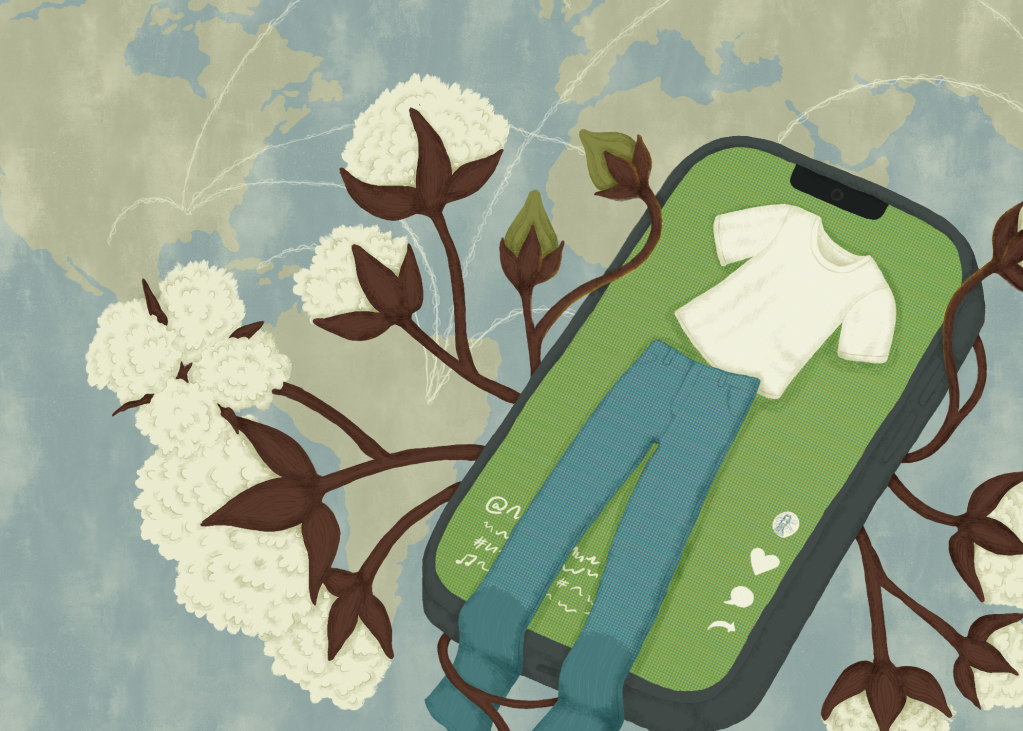
On social media, a subculture of sorts has sprung up around the natural fiber fervor. On TikTok, hashtags like #naturalfibers and #antipolyester garner videos with tens of thousands of likes and comments. Scrolling through videos within the larger genre of “non-toxic living” reveals an endless array of influencers in well-lit, earth-toned rooms, parading across the screen in organic cotton yoga sets, sundresses and blue jeans.

Through these videos, a common thread emerges: confusion and the supposed remedies to it. Where are you supposed to find “non-toxic” clothes? How do you know what’s real and what’s marketing language? Why is everything so expensive?

Bill Morris, the California Polytechnic-educated materials scientist behind the account @fabricsvetted, said he’s seen those kinds of conversations more frequently on social media. In particular, his videos attempting to educate consumers about textiles have grown in popularity since he first began posting to Instagram and TikTok earlier this year.
“There have been people in my world talking about this for decades, but I would say the general public is starting to talk a lot more about it,” he said.
Morris said he is not part of the MAHA movement and that his social media algorithm doesn’t often bring him into contact with the political side of the natural fiber conversation.
But, as a person who’s been talking about the role of textiles in human health for years, he worries that the narrative around certain issues, like microplastic exposure, might be “getting a little bit ahead of the evidence,” and detracting from known issues, such as harmful additive chemicals, that are perhaps more grounded in science.
“I think it’s tricky for me when I see some of these messages getting a little bit jumbled,” he said.
Though research does support the idea that synthetic fabrics can pose exposure risks for some potentially harmful chemicals, the issue is not exclusive to synthetics. The pesticides and fertilizers used to grow fiber crops can carry with them significant environmental drawbacks, for example, and the dyes used to finish most fabric goods can be a source of irritation.

Joaquim Rovira, a biochemistry lecturer at the University of Rovira i Virgili in Catalonia, Spain, has spent several years studying the human health risks associated with textile production and exposure. While he personally believes switching to natural fibers where possible is a healthier option in most cases, he cautions against the idea that any one material is perfect.
“We need a lot of land, a lot of water, a lot of agrochemicals to produce one kilo of cotton to be one shirt or jeans,” Rovira said. “This is also a problem, but we obtain plastic fiber from oil and these also have an impact on the environment.”
One issue with understanding and mitigating the potential risks of exposure, Rovira said, is the “never-ending story” of regulating harmful substances in manufacturing. He points to the example of per- and polyfluoroalkyl substances, or PFAS: consumer product chemicals that were introduced and widely-used, revealed to be harmful to human health and then regulated once the damage was already done.
A potential solution to that cycle, he said, could come from having stronger regulations in the initial phases of a product’s development.
“The problem of the additives that are in the clothes are the same as additives in food, the additives in the furniture, the additives in the paint, all chemical compounds that are added to consumer products,” Rovira said. “The industry goes 10, 20 years in front of scientists and the scientists are the same years in front of the legislation.”
The post USDA wants to revive the cotton industry. Experts aren’t sure that’s possible. appeared first on Investigate Midwest.
