


Unlock the White House Watch newsletter for free
Your guide to what Trump’s second term means for Washington, business and the world
The US has rebuked European allies whose military capability gaps have been described as “a sea of red” in Nato’s colour-coded assessments, as the Trump administration weighs how quickly to withdraw American weapons and troops from the continent.
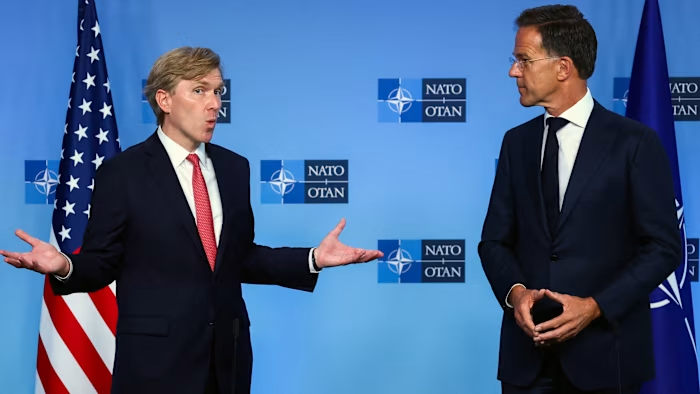
Elbridge Colby, the Pentagon’s policy chief, met Nato ambassadors in Brussels on Thursday to discuss European defence investments in the context of a review of US military deployments in Europe due to conclude in December. He told some European allies to move faster on buying critical conventional weapons systems that the US has long provided.
The US needed to see “major efforts to step up” from European allies and create “a Nato force model that’s going to put Europe in a lasting position where it’s going to be able to lead its own defence”, Colby told reporters after the meeting.
“We hope to see more from countries like the United Kingdom,” he said, while praising Germany, Poland and the Netherlands for their efforts to increase spending.
One Nato diplomat briefed on the discussions said Nato’s national assessments — which mark specific required capabilities as green, amber or red, with red regarded as insufficient — were “not pretty . . . there is a sea of red”. Two others confirmed the talks covered capability shortfalls and demands on many allies to spend more.
European capitals remain uncertain about how the Pentagon review will be carried out. But officials fear Washington could use the findings to punish countries that do not deliver a clear surge in spending and capabilities when deciding what US weapons and troops to pull from Europe.
Some European allies pushed back in Thursday’s closed-door meeting by pointing to areas where they meet or exceed Nato capability targets, according to the three people familiar with the discussions.
The targets assess what countries are expected to contribute to an alliance response in a conflict.
Colby also raised a written questionnaire Washington had sent to Nato ambassadors.
It asked whether their governments had restricted US use of military bases, whether they were buying weapons from American companies, and whether they had been “publicly supportive” of President Donald Trump’s foreign policy.
“We wanted to hear from allies directly, in writing,” Colby added.
Trump has long criticised Nato allies for relying on US protection while failing to spend enough on their own defence. Colby’s boss, defence secretary Pete Hegseth, in June announced a six-month review of US forces in Europe aimed at ending what he described as “freeriding” by some Nato allies.
Trump has forced Nato leaders to agree to increase their defence spending baseline to 5 per cent of GDP by 2035, with 3.5 per cent spent on “core” elements such as weapons and troops. Five of the alliance’s 32 members are expected to meet the 3.5 per cent requirement this year, according to Nato calculations.
Nato secretary-general Mark Rutte, speaking alongside Colby ahead of the talks with alliance ambassadors, said that the process was important to ensure “a more honest and more equitable sharing” within the alliance — an initiative that Hegseth and Colby have dubbed “Nato 3.0”.
There is “still much more to be done,” said Rutte. “We will get there.”
Colby repeated the Trump administration’s position that the US “remained committed to Nato”, but said that Washington needed to “look at the strategic posture at a high level of the US forces in Europe” in order to instead “prioritise the western hemisphere and the first island chain” in east Asia.
