


Unlock the White House Watch newsletter for free
Your guide to what Trump’s second term means for Washington, business and the world
The US government has discussed new sanctions against a Brazilian Supreme Court judge as a diplomatic crisis threatens to drag relations between the two countries to the lowest point in decades.
The Trump administration has considered taking fresh action against Justice Alexandre de Moraes, who it sanctioned last year on human rights grounds before overturning the measure, according to people familiar with the matter.
Washington’s renewed focus on the magistrate could widen a rift with Brasília over trade and politics that has cast a shadow over upcoming elections in Latin America’s largest democracy.
De Moraes was hit with Global Magnitsky Act sanctions just over a year ago, accused by US Treasury secretary Scott Bessent of “an oppressive campaign of censorship, arbitrary detentions that violate human rights, and politicised prosecutions”, including against Brazil’s ex-president Jair Bolsonaro.
The hard-right populist and Donald Trump ally was last year sentenced to 27 years’ imprisonment after being found guilty of plotting a coup.
However, the sanctions against the judge, his wife and a company owned by their family were dropped in December following a meeting and calls between Trump and his Brazilian counterpart Luiz Inácio Lula da Silva.
The US attention on de Moraes has been revived in part because of a case that has sparked a debate over press freedom in Brazil, according to a person familiar with the matter who asked not to be named.
The judge authorised police raids against a journalist and two alleged sources under an investigation into press coverage about a fellow Supreme Court judge and his family.
De Moraes argued that the information was obtained and disclosed illegally, posing a risk to the safety of the justice’s family.
The state department and the White House did not respond to a request for comment. Brazil’s Supreme Court did not immediately respond to inquiries.
A powerful and divisive figure in his homeland, de Moraes gained a global profile after he publicly clashed with Elon Musk a couple of years ago and briefly blocked the billionaire’s X platform in Brazil.
Supporters say he has helped protect Brazilian democracy against a tide of misinformation. But detractors, including the Trump administration, see him as impinging on free speech rights.
“He’s gone after the supporters of the president. Not just Elon Musk, but Maga types in Brazil,” one person familiar with the US government’s thinking added. “Even if we want a good relationship with Brazil, obviously this guy is an enemy.”
Reimposition of the Magnitsky measures was “under consideration”, said another person. The sanctions involve a freeze on US-held assets and a ban on American companies and individuals doing business with those targeted.
There were “many factors [and] a consistent pattern of abuse. This is just the latest,” they added, referring to the journalist’s case. “The concerns never went away.”
Although it is not clear if or when a decision will be taken, any such action would compound an escalating tit-for-tat between the two most populous nations in the Americas.
Tensions exploded more than a year ago when Trump imposed a 50 per cent trade tariff on Brazil, demanding the prosecution of Bolsonaro be dropped. The duty was later struck down by the US Supreme Court.
A brief détente has since ended, with the US imposing a 25 per cent import tariff on many Brazilian goods in July.
Brasília denied entry to a pair of Trump envoys last month over fears of potential interference in the October election — allegations rejected by Washington.
Lula, who is seeking re-election for a fourth non-consecutive term, has suggested the US could act to favour his main challenger, Senator Flávio Bolsonaro, son of the jailed former leader. The 80-year-old leftist has also exchanged public barbs with US secretary of state Marco Rubio.
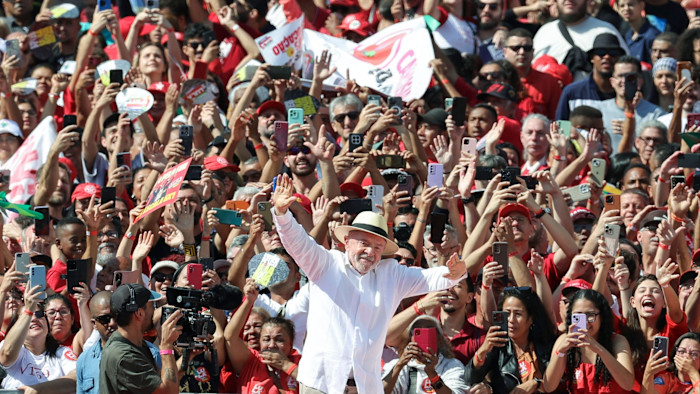
Thousands of supporters greeted Lula at his official campaign launch on Sunday at a stadium in São Bernardo do Campo, an industrial suburb of São Paulo, where he rose to prominence as a trade unionist leading metalworker strikes in the late 1970s.
“I thank the working men and women of this country who believed that someone like them could do more for them than someone different from them,” said Lula. “As long as I am alive, I will not stop fighting and allow the right [to prevail].”
