


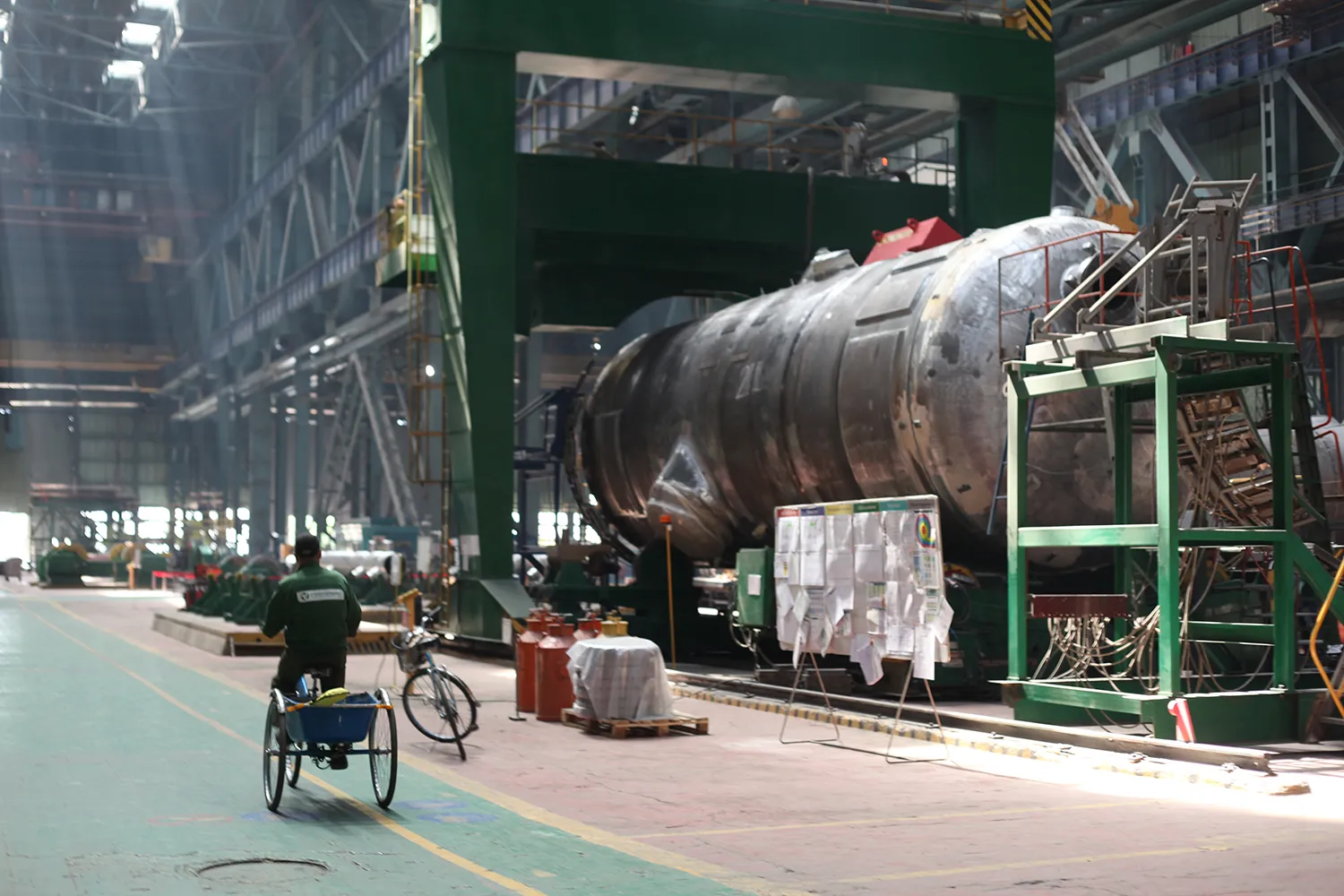
Between 1995 and 2013, the uranium from around 20,000 Soviet nuclear warheads supplied up to 10 percent of U.S. electricity. After the Cold War arms race, the Megatons to Megawatts program turned 500 metric tons of bomb-grade uranium from decommissioned Soviet-era nuclear weapons into low-enriched uranium (LEU) for U.S. nuclear reactors. Today, Russia remains America’s top supplier of enrichment services (the process that turns natural uranium into nuclear fuel). This is odd: Washington banned imports of Russian LEU in August 2024, a move that prompted Moscow to outlaw such exports to the United States three months later. Both bans appear to be theater, and Moscow’s leverage over Washington on uranium supplies could be more powerful than U.S. officials would like to admit.
A brief look at the past helps make sense of U.S. reliance on Russian uranium. During its 18-year time span, the Megatons to Megawatts program ran like clockwork. The conversion and dilution of weapons-grade uranium to reactor fuel took place in four facilities across Russia. Shipments then made their way to Paducah, Kentucky, to complete the process. The $12 billion program was a resounding success, eliminating more than a quarter of the global stock of bomb-grade uranium. Yet this success came at a steep long-term price. Decades of reliance on Russia resulted in chronic underinvestment in U.S. uranium enrichment capacity. Paducah, America’s sole domestically owned enrichment plant, ceased operating when Megatons to Megawatts wound down. The only commercial-scale enrichment facility operating in the United States today belongs to Urenco, a British-Dutch-German firm.
Between 1995 and 2013, the uranium from around 20,000 Soviet nuclear warheads supplied up to 10 percent of U.S. electricity. After the Cold War arms race, the Megatons to Megawatts program turned 500 metric tons of bomb-grade uranium from decommissioned Soviet-era nuclear weapons into low-enriched uranium (LEU) for U.S. nuclear reactors. Today, Russia remains America’s top supplier of enrichment services (the process that turns natural uranium into nuclear fuel). This is odd: Washington banned imports of Russian LEU in August 2024, a move that prompted Moscow to outlaw such exports to the United States three months later. Both bans appear to be theater, and Moscow’s leverage over Washington on uranium supplies could be more powerful than U.S. officials would like to admit.
A brief look at the past helps make sense of U.S. reliance on Russian uranium. During its 18-year time span, the Megatons to Megawatts program ran like clockwork. The conversion and dilution of weapons-grade uranium to reactor fuel took place in four facilities across Russia. Shipments then made their way to Paducah, Kentucky, to complete the process. The $12 billion program was a resounding success, eliminating more than a quarter of the global stock of bomb-grade uranium. Yet this success came at a steep long-term price. Decades of reliance on Russia resulted in chronic underinvestment in U.S. uranium enrichment capacity. Paducah, America’s sole domestically owned enrichment plant, ceased operating when Megatons to Megawatts wound down. The only commercial-scale enrichment facility operating in the United States today belongs to Urenco, a British-Dutch-German firm.
More than a decade after Megatons to Megawatts came to an end, U.S. nuclear power plants still run on Russian uranium. In 2025, Moscow’s state-owned Rosatom supplied 26 percent of the enrichment services that U.S. nuclear utilities bought. Rosatom’s bill stood at $1 billion, roughly 70 percent above the prewar (2019-21) annual average. Showing no sign of abating, shipments reached $631 million from January to July—close to last year’s total when that figure is annualized. For Centrus, the U.S. firm that oversees sales of uranium to nuclear utilities, business with Russia is key. The LEU segment, which relies mostly on Russian supplies, accounted for 77 percent of Centrus’s revenues last year.
Discussing these numbers with former Biden administration officials is a strange experience. Most of them like to boast that President Joe Biden banned U.S. imports of Russian uranium in 2024. This is true, but what most policymakers forget to mention is that the ban includes waivers allowing the import of roughly 470 tons of Russian uranium per year until 2028. The waivers’ fine print makes for a revealing read. For starters, Washington’s nuclear experts appear not to have thought much about caculating a level of imports to exempt from the ban. They copy-pasted, down to the kilogram, quotas from a 1992 uranium anti-dumping settlement. It is also hard to make the case that the sanctions are tough. In 2024, permitted imports were only 4 percent below average prewar shipments. They will drop by just over 1 percent per year before a full ban takes hold in 2028—if it ever does.
Banning the trade of uranium in theory but not practice is also in fashion in Moscow. Three months after the U.S. ban, Russian President Vladimir Putin retaliated with a ban on LEU exports to the United States. Shortly after, however, the Kremlin issued three licenses for deliveries in contradiction of the ban. The licenses came just in time for the Atlantic Navigator II, a Canadian-owned cargo vessel that Rosatom likes to use for global shipments, to deliver 100 tons of uranium to Baltimore in February 2025. This is good business for the Russian government; deliveries to the United States make up nearly half of Rosatom’s export revenues for LEU.
With the 2028 deadline looming, Washington is finding itself in a tough spot to replace Russian uranium after decades of underinvestment in domestic supplies. The data is not encouraging. Urenco’s facility in New Mexico—the only large domestic enrichment plant—supplied just 23 percent of the enrichment services that U.S. utilities bought last year, a lower share than Rosatom. It is hard to imagine U.S. producers catching up anytime soon. Early this year, the U.S. Energy Department handed out $900 million to each of three would-be U.S. enrichment companies. Not one of them expects commercial-scale output before the 2030s. Researchers from the Lawrence Livermore National Laboratory agree with this assessment; last year they concluded that domestic production would not be sufficient to replace Russian uranium by the end of the decade.
With domestic supplies unlikely to be enough, could foreign countries other than Russia step in? The challenge for Washington is that just four firms control the global market: Rosatom (43 percent of the world’s enrichment capacity), Urenco (25 percent), China National Nuclear Corp. (20 percent), and France’s Orano (11 percent). Trading reliance on Russia for dependency on China is unlikely to be a solution; besides, the Energy Department suspects that Beijing facilitated the re-export of Russian-sourced uranium to the United States in 2023-24.
That appears to leave Urenco and Orano as the only viable options. Both firms are hard at work positioning themselves to win a big slice of the U.S. market, but they could face obstacles. Their spare capacity is thin, and the bulk of production from their expansion plans will come online only gradually beginning in 2028. Geopolitics further complicates the picture. It would be odd for Washington to start relying on European uranium suppliers at a time of fraught trans-Atlantic relations. What’s more, European countries are also slashing their dependency on Russian uranium. In other words, Europe and the United States are bidding for the same limited stock of uranium supplies.
The fine print of the Lindsey O. Graham Sanctioning Russia and Iran Act, which U.S. President Donald Trump signed into law on September 18, suggests that Washington has concluded that the 2028 deadline will be hard to meet. Back in 2025, the initial draft of the sanctions-enabling law threatened foreign purchasers of Russian-sourced uranium with sanctions. This provision quietly disappeared from the bill that passed the Senate in August. In addition, planned U.S. sanctions on Rosatom executives have only a slim chance of ever taking effect. These sanctions, which would greatly complicate dealings with Rosatom, will kick in only after the import waivers expire. This means that a one-line amendment to any bill in Congress extending the waivers would postpone the sanctions indefinitely.
Last May, the White House outlined plans for a U.S. nuclear revival. Washington is going all-in on advanced reactors to supply electricity-hungry AI data centers and quadruple nuclear power capacity by 2050. That ought to cause smiles in the Kremlin: Many of the advanced reactors that the United States wants to deploy run on a different type of LEU that only Rosatom sells at commercial scale today.
For the Kremlin, annual uranium shipments of $1 billion to the United States are not about profits for Rosatom. They are a form of leverage, and that leverage will persist as long as uranium keeps flowing across the Atlantic. As U.S. envoys shuttle between Moscow and Kyiv for peace talks, it is hard to imagine that the Kremlin will not somehow make use of this ace up its sleeve.
