


The next UN secretary-general will take over the most prominent position in multilateral governance at a time when multilateralism is arguably at its nadir. Adapting to today’s multipolar reality will require instilling a renewed sense of purpose and demanding more of member states.
BOGOTÁ—Leading the United Nations has always been a balancing act, but the breakdown of the postwar global order has added a new dimension of complexity to the role. The next secretary-general, who will take office in 2027, will fill the most prominent position in multilateral governance at a time when multilateralism is arguably at its nadir. To rebuild trust in international cooperation, the UN’s leader must view this crisis for what it is: an unprecedented opportunity for fundamental reform.
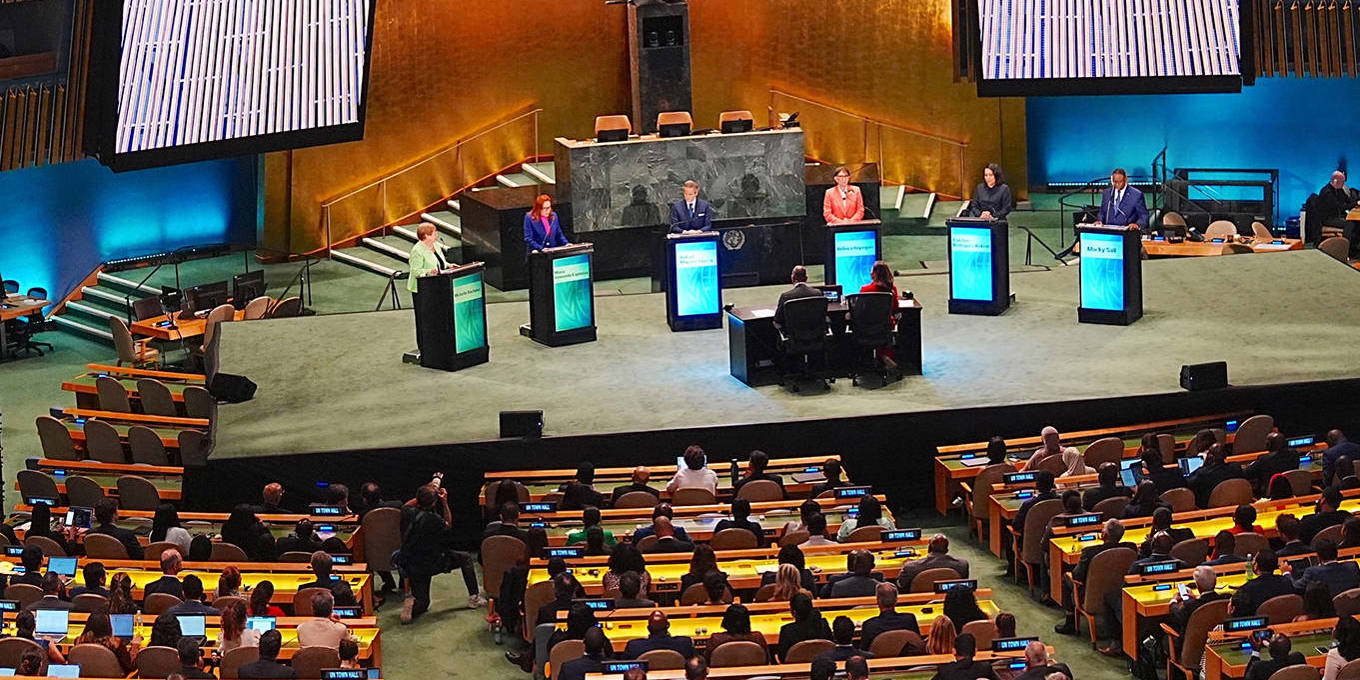
Seven candidates are vying to replace António Guterres, although the third UN Security Council straw poll has further narrowed the field (while indicating members’ willingness to respect the principle of regional rotation, according to which the next secretary-general will be from Latin America or the Caribbean). Rebeca Grynspan of Costa Rica and Carolyn Rodrigues Birkett of Guyana have emerged as the top two contenders, but the absence of a clear frontrunner could encourage a late entrant.
Whomever is ultimately selected will need a transformative roadmap for the first 100 days (and beyond) to shape the UN’s trajectory and ensure that global governance is made fit for the 21st century. Cepei, the Bogotá-based think tank that I head, has partnered with organizations around the world and convened regional consultations with leading scholars, former diplomats, policymakers, practitioners, and other stakeholders to reflect on the agenda and priorities of the next UN secretary-general and the future of UN leadership more broadly.
These meetings show that expectations are high. Although the UN secretary-general’s independent powers are limited, an incumbent wields political capital, serves as the organization’s public voice, appoints senior officials, and oversees management. So, the question becomes, how can the next secretary-general demonstrate leadership, credibility, and direction in the first 100 days while operating within these limits?
For starters, the next secretary-general should focus on delivering consistent messaging and on using the largely predictable UN calendar to achieve some early wins. They should begin with political clarity, not thematic expansion; complete existing agendas, such as the Sustainable Development Goals and climate agreements; and shift the focus from proliferation to execution. More fundamentally, the new head must also commit to making power more transparent; embed inclusion across the UN system; strengthen coordination with member states; and ensure that financing is aligned with governance.
That means rebuilding trust from within. When appointing the senior leadership team, the next secretary-general should select people who demonstrate political courage, independent judgment, discipline in setting priorities, a willingness to take risks and withstand criticism, and a renewed commitment to mediation. Such leaders will be well-positioned in the long term to incentivize coordination, build coalitions that outlive their tenure, and pursue meaningful structural and organizational change backed by concrete accountability mechanisms.
Instilling a renewed sense of purpose in a workforce of around 120,000 people struggling with low morale and impossibly tight budgets will require a compelling diagnosis of the UN’s challenges, a vision for its future, and priorities for action. The diagnosis should focus on political factors first and foremost, as many of its problems can be traced to choices made by member states, weakening consensus, and shifting power relations. To be sure, this limits what institutional reform—or the secretary-general alone—can realistically achieve. But, more importantly, it suggests that the selection and transition agenda should address not only the expectations for the next secretary-general, but also what member states are prepared to provide in return.
The secretary-general will inherit the unfinished UN80 Initiative, which aims to improve efficiency, review implementation of the body’s mandates, and examine possible structural changes and program realignments. In the first 100 days, important decisions must be made about which parts of the reform agenda to continue, which to adjust, and which to abandon, while keeping in mind the need to avoid reform fatigue and ensure that the next phase is shaped and owned by member states.
At the country level, the secretary-general must also make difficult choices about activities the UN should no longer pursue, while improving delivery, localization, and coordination. This requires greater clarity about where the UN adds value, focusing on its universal legitimacy, convening and norm-setting power, and, perhaps most importantly, mediation and “good offices.” The guiding principle should be differentiation, not withdrawal: continuing direct delivery where necessary while relying more deliberately on regional and national actors when they are better placed to act.
Lastly, to reduce the UN’s dependence on voluntary contributions and earmarked resources, often from a small number of major donors, the next secretary-general should begin engaging with member states to develop a more sustainable funding model. This means preparing to make strategic use of the organization’s existing levers of authority to align financing with governance, which would strengthen the system’s effectiveness and accountability. This could be accomplished by maximizing unearmarked voluntary funding and creating project-specific funding windows (where transaction costs do not distort governance), while also providing contributors with appropriate political recognition and greater transparency.
The new UN head’s broader agenda—restore peace, protect the most vulnerable, and convince the world to act on climate change and regulate AI—represents a formidable challenge, especially as geopolitical upheaval impedes efforts to forge consensus or deliver long-term solutions. The UN has not adapted quickly enough to today’s multipolar reality in which influence is dispersed across many sites. Tokenistic engagement and negative narratives reinforce a sense of exclusion, deepening the legitimacy crisis.
But the next secretary-general can change that trajectory. Although rebuilding legitimacy will not be easy or immediate, a leader who demonstrates strong management skills and a commitment to reform in the first 100 days will provide an important foundation on which to build a reinvigorated UN.
