


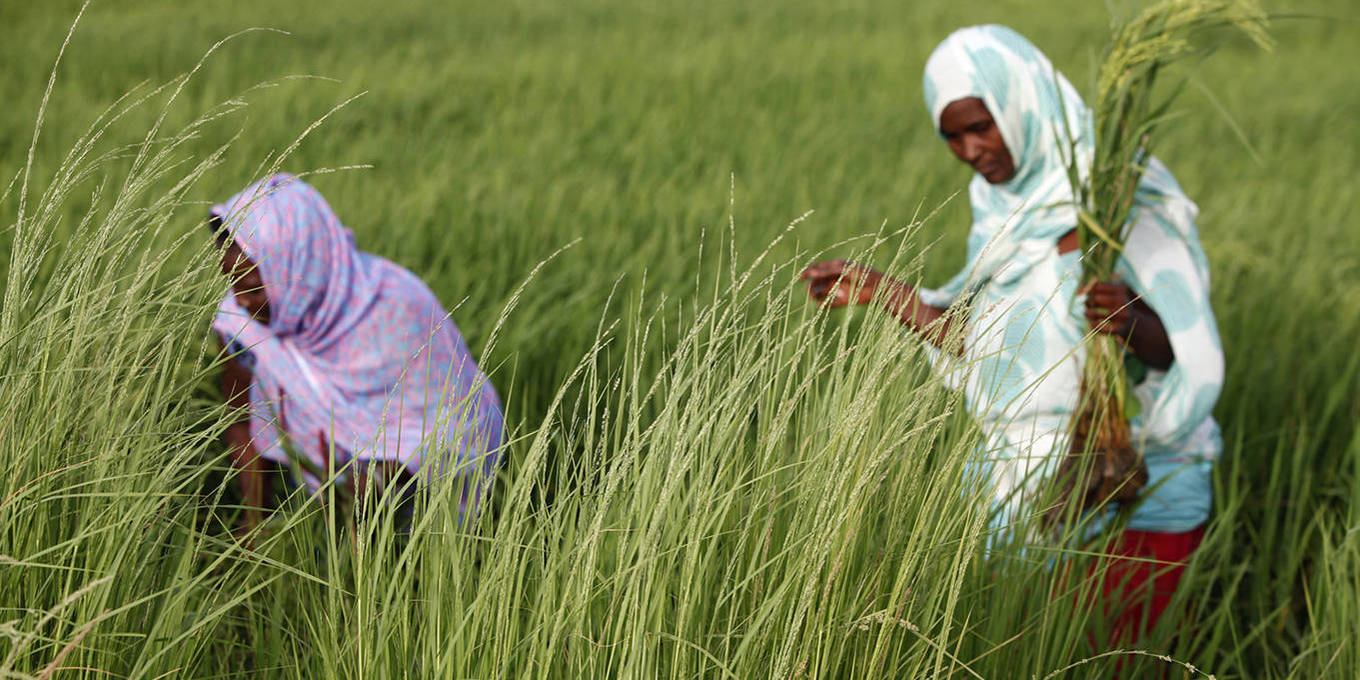
Across Sub-Saharan Africa, women workers dominate agriculture but rarely capture the sector’s economic value. With a systematic approach to closing the gap, policymakers, NGOs, and philanthropic organizations could unlock a $1 trillion market and transform the continent’s food systems for the better.
WASHINGTON, DC—If you picture a woman working in agriculture in Africa, what image comes to mind? Maybe it’s a young woman with an infant slung on her back, hacking at the soil in searing heat, struggling to find affordable fertilizer or a decent price for her crop. Or maybe she’s a successful entrepreneur building a vibrant food business, employing hundreds of workers, and contributing much to her local economy.
Both women are real, of course, as are many variations in between. But the fact is that many more women could be leading farming businesses and driving economic growth if the barriers they face were tackled more systematically. With Africa’s food and agriculture market predicted to reach around $1 trillion by 2030, countries that want to harness the most value cannot afford to forgo women’s economic power.
In Sub-Saharan Africa, over three-quarters of working women can be found in the agrifood sector, where around two-thirds of their work happens off the farm, in processing, aggregation, storage, and informal trade. Although these are the links in the chain where value is added, the women performing such roles often remain trapped in precarious, low-paid, informal arrangements.
At the other end of the spectrum is a growing cadre of dynamic African women food entrepreneurs or “agripreneurs.” I recently encountered some of these women business leaders at the Africa Food Systems Forum in Rwanda, where they were being honored for their success.
Ifeoma Mary Okonkwo, for example, co-founded a solar-powered cassava business in Nigeria that processes 15 tons per day into gluten-free flour, starch, fortified foods, and animal feed for domestic and export markets. In the space of a decade, her company has grown to employ hundreds of people. It has purchased cassava worth more than $4.45 million from its network of 2,000 (mostly women) farmers, while helping them access fertilizer, technical advice, and markets.
Okonkwo’s story shows what can happen when governments and donors make a deliberate effort to empower women-led businesses. Among other advantages, she was able to access finance on favorable terms through women-focused lending schemes.
But much more must be done. A recent World Bank report, Women, Business, and the Law 2026, shows that legal equality on paper does not automatically produce economic opportunity. Women may have the right to register a business or open a line of credit, but their ability to formalize operations, invest, and expand is still limited by weak enforcement, a thin financial infrastructure, restrictive social norms, or unpaid care work.
Updating antiquated land ownership laws would be a good start, since inheritance customs and social norms routinely override women’s legal land rights in practice. Still, passing a law isn’t the same as enforcing it, and the same caveat applies to gender-equal business laws. In each case, implementing legal changes matters as much as enacting them.
Fortunately, when it comes to empowering rural women to move from subsistence farming to viable small businesses, a growing body of evidence shows what works. In Ethiopia, for example, agriculture employs around 80% of the country’s workforce, yet female farm managers were producing at least one-third less per hectare than men—a gender gap that was costing the country more than $1 billion annually. So, the agriculture ministry, with support from the Gates Foundation, partnered with CARE, an international NGO, on a program that cuts out middlemen by connecting women’s producer groups directly to markets and provides training in climate-conscious farming and nutrition.
Over the past decade, this “Farmer Field and Business School” model has expanded across multiple African countries, yielding strong results. In Burundi, for example, women’s crop yields increased substantially. By pooling savings, sharing market intelligence, and lending to one another, women have been able to diversify their small farming businesses, establish credit histories, and build their confidence.
India offers a parallel example. PANI, a local organization rooted in Gandhian values, has spread climate-conscious farming knowledge and market access from woman to woman across tens of thousands of households through trained community advisers.
Underlying these and other programs is a focus on educating and upskilling women, while addressing the deep-seated gender norms that stifle their opportunities. The Ethiopian project engages men in community dialogues to challenge the norms that treat farming as a male pursuit and household chores as a female domain. The women taking part report greater confidence and decision-making power; both women and men say their partnerships are now stronger as a result.
Philanthropy can play its part by helping to scale proven approaches, by backing emerging innovations that are designed around women’s needs—from climate-resilient crops and livestock to AI-powered digital tools—and by linking international financing to clear gender-equality goals.
One promising example, a climate-finance model led by the International Fund for Agricultural Development, ties funding to measurable gains in women’s economic opportunities—making gender equality part of the investment itself, rather than a secondary objective. The model has already helped direct $118.5 million in investments in several countries, helping rural women gain greater control over land and productive assets, strengthen their livelihoods, and build resilience to climate change.
This last point is crucial, because it is now well established that climate change is hitting women farmers hardest, compounding deep-rooted inequalities. Research in low- and middle-income countries has found that a 1° Celsius rise in average temperatures is associated with a 34% greater reduction in income for female-headed households compared to male-headed households.
As the effects of climate change intensify, governments, development partners, and philanthropic organizations must do more to create conditions for rural women to adapt, build resilience, and prosper. Women like Okonkwo show what is possible. They are already sustaining food systems; positioning them to lead will drive the structural changes our societies need.
