


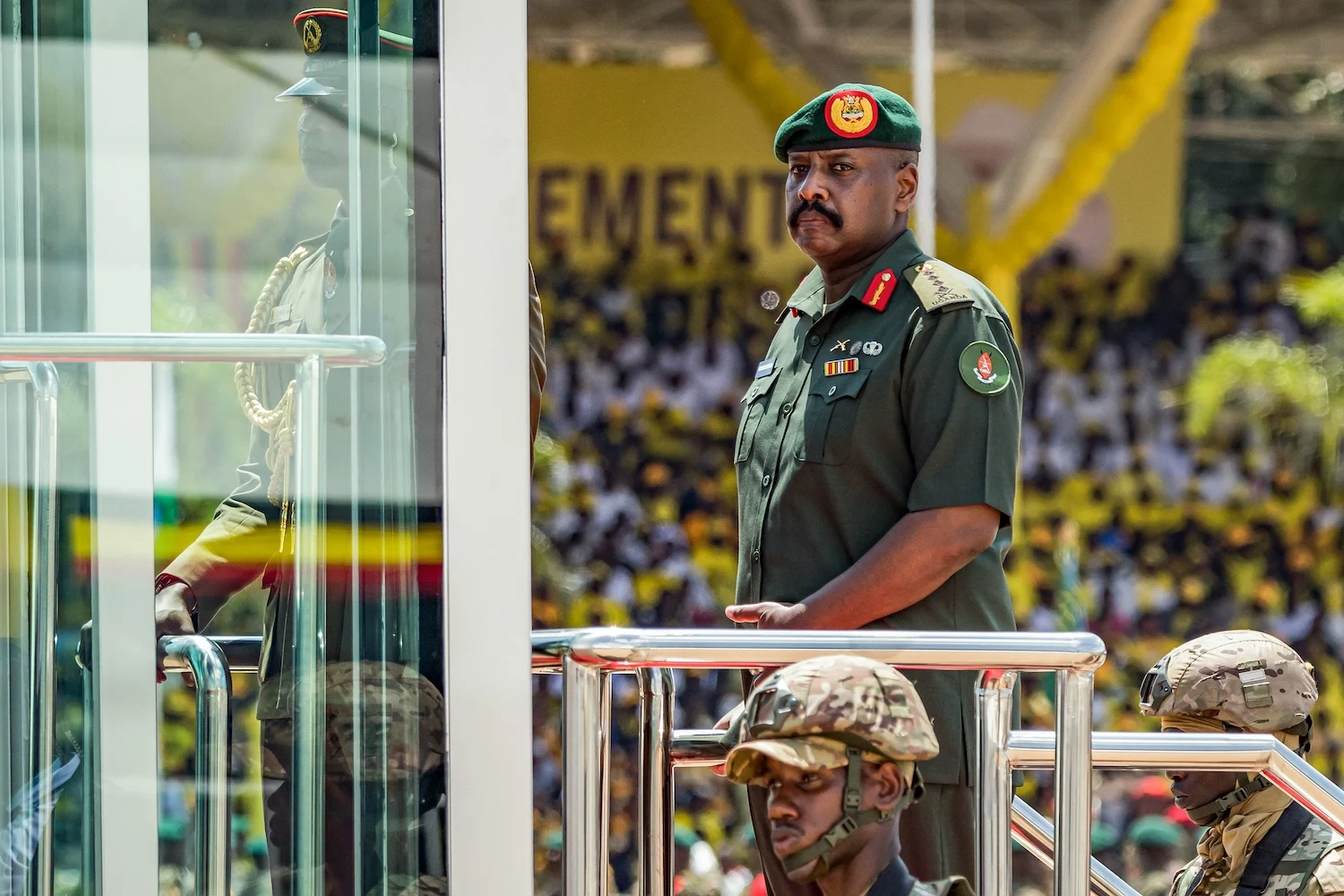
Hours before two of Uganda’s largest independent news outlets were forced to suspend operations in June, the man who claimed responsibility for the shutdown did not wait for a government spokesperson, a regulator, or a court to announce the move. He posted the news himself.
“In Uganda, I do not believe in a free press,” Gen. Muhoozi Kainerugaba—Uganda’s military chief and President Yoweri Museveni’s only son—wrote on social media, adding that he had his father’s blessing to shut down the Daily Monitor and NTV Uganda. Soldiers blocked the premises without notice, and the government later attributed the shutdown to a “security-led inquiry” ordered by Museveni.
Uganda’s political future has long seemed to depend on the fact that Museveni, who is 81 and has held power since 1986, is grooming his 52-year-old son to succeed him. The recent assault on press freedom demonstrates how political power has already been reorganized around Kainerugaba, who commands the army; chairs the Patriotic League of Uganda (PLU), a ruling party-aligned pressure group; and flouts restrictions on political activity for serving officers.
Though Museveni still governs, politicians are learning how to navigate the man expected to come next. But inheriting the longtime president’s power will not necessarily mean inheriting his legitimacy. It remains unclear whether Kainerugaba can build sufficient support among Ugandans or preserve the foreign partnerships that Museveni has cultivated over four decades.
As Kainerugaba’s role has grown, he has increasingly directed the military to suppress political opposition, civil society, and the press. Museveni was declared the winner of a disputed presidential election on Jan. 15, and security forces killed at least seven people in the unrest that followed. Museveni’s main rival, Bobi Wine, went into hiding after soldiers raided his home the day after the vote.
Kainerugaba threatened Wine and his supporters in since-deleted social media posts. In one, he said security forces had killed 22 Wine supporters, writing, “I’m praying the 23rd is Kabobi,” a derogatory nickname for Wine. In July, Wine told radio program The World that security forces raided his home for a second time, assaulting his wife and family, on Jan. 23.
Other opposition activists have been abducted, held incommunicado, or imprisoned—a trend that has intensified in recent months—with detentions often endorsed by Kainerugaba on social media. In one high-profile example, Kizza Besigye, who ran against Museveni four times, was jailed on treason charges in 2024 after being kidnapped in Kenya by men who he identified as Ugandan security agents.
Since mid-June, security forces have seized at least five more critics, according to Human Rights Watch. One was Besigye’s lawyer, Erias Lukwago, who was preparing to serve Kainerugaba with a court summons in a case accusing him of threatening Besigye’s life on social media.
Kainerugaba posted that Lukwago was being held in a basement and shared an apparent photo of him blindfolded before Lukwago resurfaced in police custody two days later.
Kainerugaba’s intrusion into judicial affairs became especially apparent early last year, when he denounced a Supreme Court ruling barring military trials of civilians. Around that time, Eron Kiiza, another of Besigye’s lawyers, was assaulted and detained by soldiers inside a military courtroom.
On July 30, Volker Turk, the United Nations high commissioner for human rights, condemned Ugandan authorities for the crackdowns, citing “increased military involvement in functions ordinarily carried out by civilian institutions.” (That assessment was quickly rejected by Uganda’s ambassador to the U.N., Adonia Ayebare.)
Many Ugandan observers see Kainerugaba’s interventions as an informal transfer of power already underway. Yusuf Serunkuma, a columnist and scholar at Makerere University, called the shift a “gentle, slow-moving coup” obscured by Uganda’s “pretension of democracy.”
Museveni himself has at times ruled with an iron fist, scrapping term and age limits to remain in office for 40 years. He has long managed competing interests through patronage and divide-and-rule strategies, distributing key posts among people from different regions to maintain political balance. Museveni has thus cultivated a “very personalized regime,” said Kristof Titeca, a professor at the University of Antwerp.
However, Museveni’s advancing age necessitates increased delegation, reducing the degree of personal control he once exercised and opening space for his son to assume greater authority. It remains unclear whether Kainerugaba will eventually seek the presidency through an election or assume power through another arrangement.
The power handoff from Museveni to his son must be managed carefully to avoid resembling either a monarchy or an open revolt, Serunkuma said. The protests in January appeared to reflect broader discontent with Museveni’s government, but many Ugandans are reluctant to openly call for change given the repressive tactics used to silence opposition.
Discontent with the current regime hasn’t translated into enthusiasm for Kainerugaba, though: Two surveys conducted between November 2024 and January 2025 found him significantly less popular than his father.
Still, Kainerugaba operates with impunity. In 2022, his father fired him from his position as commander of Uganda’s land forces after he threatened to “capture Nairobi” on X. The tweets embarrassed Museveni, who publicly apologized to Kenya and reprimanded his son for meddling in another country’s affairs. But the punishment was limited: The day that Kainerugaba was fired, he was promoted to full general. He also retained his role as a senior presidential advisor.
Museveni said the social media posts represented one mistake set against his son’s “many other positive contributions” and promoted him again—to his current role—two years later. The president has continued to defend Kainerugaba and no longer attempts to distance himself from his son’s statements and social media posts. “Whatever he tweets, there’s a very high likelihood that it happens,” Titeca said. “There is no form of accountability anymore for him.”
Kainerugaba’s posts now function as political signals. Opposition figures have suffered as Kainerugaba has boasted about violence against them online—evidence of the extent to which “social media and real life are overlapping,” said Derek Peterson, a historian at the University of Michigan.
While Museveni has generally exercised coercion through institutions, bending democratic structures to his will, his son seems to make no effort to retain legal or constitutional cover. This disregard for procedure has unsettled the political establishment.
Kainerugaba will also inherit a patronage system that has held Museveni’s coalition together for decades, said Agather Atuhaire, a Ugandan lawyer and rights advocate. Museveni has allowed those around him to “amass wealth” so they remain content and refrain from challenging him, Atuhaire said.
Though the Kainerugaba-led PLU sits within the ruling party’s orbit, officials positioning themselves for influence in a post-Museveni order may find party membership alone insufficient. “We are in a nervous condition as a country,” Serunkuma said. “We are not sure who is really in charge.”
Part of that uncertainty stems from the mismatch between Kainerugaba’s actual authority and his formal position. According to Uganda’s constitution, the vice president is first in line for the presidency if the role becomes vacant, not the defense chief. Kainerugaba is also supposed to be barred from partisan politics by the constitution—a restriction that no other Museveni-era officer has defied so openly.
There are two possible explanations for why Museveni has not appointed his son as vice president, according to Serunkuma. First, such an overtly dynastic appointment could draw public backlash. Second, Museveni may see command of the military as more powerful than the civilian title. After all, Kainerugaba already exercises “near executive powers,” Serunkuma said.
As a security partner for the United States and Europe, Uganda’s trajectory matters beyond its borders. It contributes troops to the African Union Mission in Somalia, conducts military operations in the Democratic Republic of the Congo, hosts nearly 2 million refugees, deployed forces to South Sudan, and has long served as an important counterterrorism partner.
U.S. Sen. Jim Risch, who chairs the Senate Foreign Relations Committee, has twice threatened to reconsider security ties with Uganda over Kainerugaba’s conduct. However, Western governments and donors rely on the country’s continued cooperation to sustain humanitarian responses.
Although Washington remains the only Western capital to have taken concrete measures against Ugandan officials in recent years, none of those measures have targeted Kainerugaba himself. The United States under President Donald Trump has given little sign that it will initiate any broader response to the current crackdown. (On Aug. 6, Uganda’s parliament voted to deploy troops to Gaza as part of the international force proposed by Trump’s Board of Peace.)
Titeca contrasted the broader donor restraint with the situation in 2005, when Western countries, including the United Kingdom and Sweden, withheld or cut aid to Uganda after the arrest of Besigye, the opposition leader at the time. The United States did not join those aid cuts, limiting its public response to expressing concern about Besigye’s arrest and calling for due process.
Now, Western countries seem to see Kainerugaba’s consolidation of power as the surest path to continued stability, reflected by how visiting U.S. and European officials now routinely meet with him directly in addition to Museveni. Acting U.S. Ambassador to Uganda Mikael Cleverley, for example, met Kainerugaba shortly after Lukwago’s detention.
Wine told The World that those encounters legitimize a commander guilty of serious abuses. “Unfortunately, the world’s known democracies, including America, continue to open up to [Kainerugaba],” he said.
For foreign governments, Kainerugaba may offer continuity. But Museveni’s authority rests on more than control of the army; it was forged in the guerrilla war that brought him to power and reinforced through decades of balancing regional interests, co-opting rivals, and presenting himself as indispensable abroad.
Kainerugaba has no comparable history and thus lacks “the same kind of origin story that his father has,” Peterson said. Whether Kainerugaba can make himself appear as politically essential to foreign governments as Museveni remains uncertain—and even Museveni’s posturing didn’t spare him from donor pressure in 2005.
Though it is impossible to predict how the political transition will ultimately unfold, the gap between Uganda’s formal rules and the behavior of those anticipating a new order is widening. Politicians court Kainerugaba’s movement, foreign officials meet with him, and government institutions respond to his pronouncements.
That does not make his succession inevitable, but it does mean that Uganda’s political system is already being reshaped around the possibility. Kainerugaba is accumulating the powers of a future president before the country has decided whether he should become one.
