


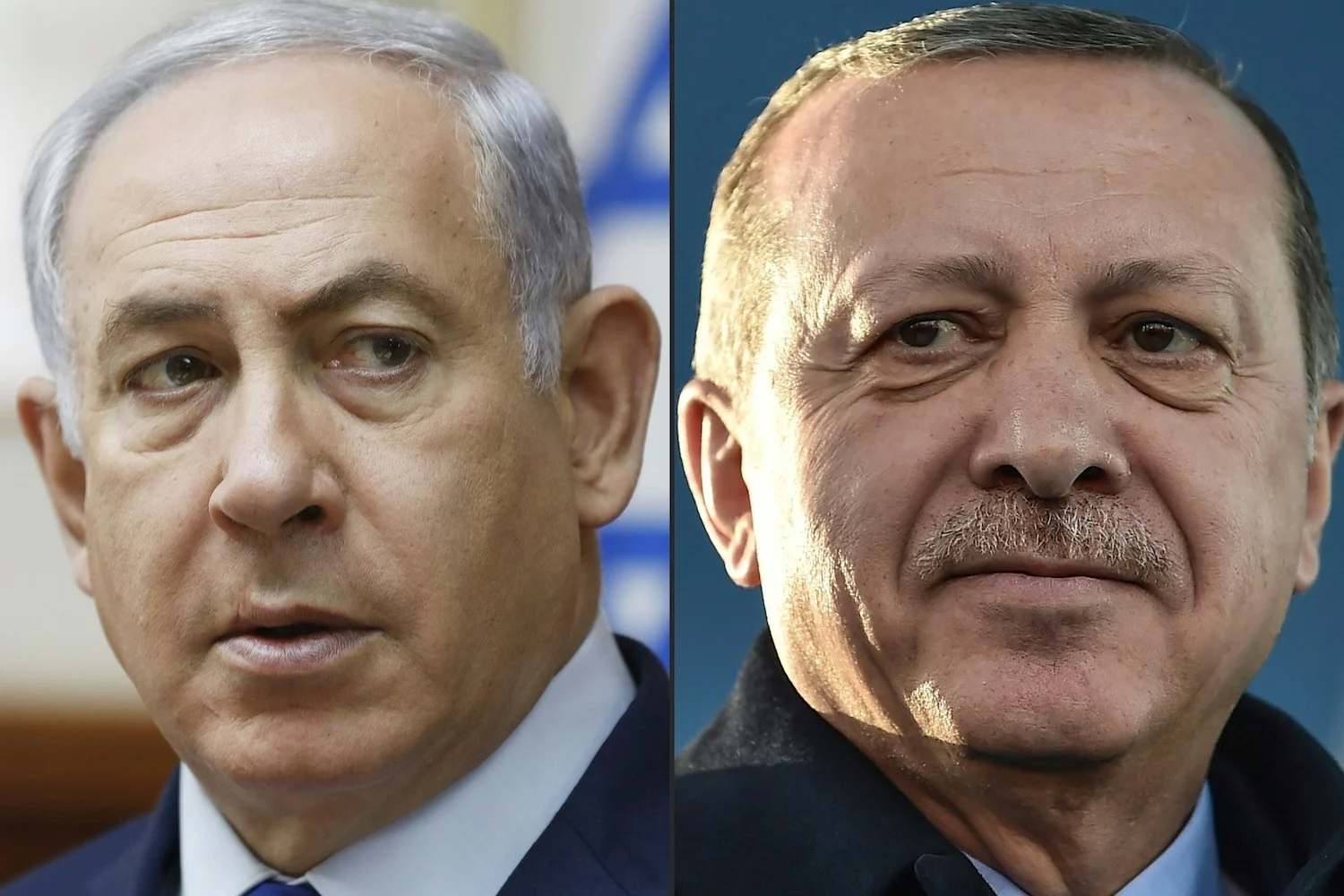
On Aug. 18, Israel attacked the Abu al-Duhur air base in Syria, escalating brewing tensions with Turkey—the United States’ other key ally in the region.
The attack came after Roman Gofman, head of Israel’s Mossad spy agency, spoke to Syrian Foreign Minister Asaad al-Shaibani and warned him against hosting a Turkish military delegation, which Israel suspected would further embed Turkish military capabilities in its neighborhood. Israel saw the visit as a prelude to a permanent Turkish deployment at the base, with air defense radars and armed drones that could limit its ability to hit Iran.
On Aug. 18, Israel attacked the Abu al-Duhur air base in Syria, escalating brewing tensions with Turkey—the United States’ other key ally in the region.
The attack came after Roman Gofman, head of Israel’s Mossad spy agency, spoke to Syrian Foreign Minister Asaad al-Shaibani and warned him against hosting a Turkish military delegation, which Israel suspected would further embed Turkish military capabilities in its neighborhood. Israel saw the visit as a prelude to a permanent Turkish deployment at the base, with air defense radars and armed drones that could limit its ability to hit Iran.
Turkey’s presidential office dismissed the Israeli airstrike as “unlawful” and called it an attack on “Syria’s sovereignty and territorial integrity,” although it didn’t say whether or not it wished to establish a presence at the base in the future. “No actor other than the nation itself can dictate Turkey’s course or set the boundaries of its foreign policy,” Turkish President Recep Tayyip Erdogan said in response to the strikes and Israeli red lines.
Israeli strategists fired back and reminded Turkey of how it has repeatedly violated Syrian sovereignty in Kurdish-dominated areas. (Turkey views some of the Syrian Kurdish groups as extensions of the Kurdistan Workers’ Party, a militant organization that has waged an armed insurgency against the Turkish state.)
The public spat between key allies, however, has created a new problem for the Trump administration: Can it trust them to manage affairs once the United States retreats from the region, or will they come to blows next?
There was no immediate threat necessitating Israel’s attack on the base; it appeared to be a proactive measure to deter Turkish expansion. While Turkey deliberately ignored Israeli warnings, presumably to gauge its limits, more than 20,000 Turkish troops are believed to be currently deployed in Syria.
After the fall of the Assad regime and with both Hezbollah and Iran weakened, Israel and Turkey see a vacuum and are competing to shape the region. Both are trying to establish the other as a destabilizing actor and win over U.S. President Donald Trump.
The primary audience that Israel is seeking to persuade “is not Erdogan but Trump,” said Hay Eytan Cohen Yanarocak, an analyst at the Jerusalem Institute for Strategy and Security and the Moshe Dayan Center.
“Jerusalem is trying to convince Washington that the tensions between Israel and Turkey are not merely rhetorical and that, if left unmanaged, they could escalate into an unwanted military confrontation,” Yanarocak said. “Thus far, unfortunately, the United States has been reluctant to fully acknowledge this danger through diplomatic channels.”
Israel is no longer the United States’ only close friend in the region, while Turkey has never had better ties with a U.S. president. Trump has not only acknowledged Turkey’s military heft and sway over the region, but he has also publicly heaped praise on Erdogan, a fellow strongman.
Tom Barrack, U.S. ambassador to Turkey and special envoy to Syria, sided with Turkey as tensions flared. He said that Israel was “baiting the Turks” and described the Israeli strike as an “unnecessary escalation.”
It is not unusual for politicians to project strength against existing and perceived threats during election season—and Israel’s next election is slated for this October—although caution is advised if the enemy is also a comparable military power. Turkey fields NATO’s second-largest armed forces after the United States and has recently inked the Mecca Joint Defense Agreement, a NATO-like regional security apparatus with oil-rich Saudi Arabia and nuclear-armed Pakistan.
However, while the timing of Israel’s attack on the Syrian air base appeared politically expedient, there is a growing sense that Turkey is increasingly trying to assert itself in Syria, Gaza, and Lebanon.
Turkey has said that it is a benign actor merely trying to help Syria recover from war, aid Hamas—which it sees as a resistance movement—and support the Lebanese state while Israel still occupies parts of southern Lebanon. Others suspect that Turkey is positioning itself as a dominating Sunni power to Israel’s detriment.
“Turkey is poised to be a Sunni power in the region,” said Bassam Barabandi, a former Syrian diplomat. “This is the Middle East; if one power leaves or is ousted and there is a vacuum, another will fill it. Right now, the region is in a flux. Americans want to leave, Iran is out of Syria, and Hezbollah may start a civil war in Lebanon. So, the Sunnis feel uncertain.”
Barabandi said that Arabs can bank on Saudi Arabia for economic help, but Turkey’s military strength makes it an appealing Sunni power. Turkey’s own motives might well extend beyond doing good in the region. “Whether it is Erdogan or another liberal leader, Turkish policy for the region would be exactly the same—expanding influence,” he said.
To boost its say and influence in the region, Turkey has offered to send a contingent to be part of an international stabilization force (ISF) in Gaza, maintain its troops in Lebanon to aid the Lebanese military after the United Nations forces leave by the end of the year, and keep a large presence in Syria.
Israel, however, views Turkey as a hostile power and dreads a “Sunni ring of fire”—a Turkey-led alliance of Muslim Arab nations that Israel fears might encircle and isolate it in the region.
“We cannot allow Turkey to deploy troops on our borders,” said Yaakov Amidror, a distinguished fellow at the Jewish Institute for National Security of America and a former advisor to Israeli Prime Minister Benjamin Netanyahu. “I don’t think anyone will host Turkish forces against Israel’s wishes. That will be a basis for friction in the future—a big mistake.”
Israel’s mistrust of Turkey is underpinned by Erdogan’s support for Hamas, sympathy for the Muslim Brotherhood, and a suspicion that it harbors imperial ambitions. “Erdogan is very close to the Muslim Brotherhood,” Amidror said, noting that Hamas is an offshoot of the organization. “Turkey is hosting Hamas’s leadership, from where they can still plot terror attacks inside Israel.”
It will be a clash of military powers if Israel and Turkey come to blows. A direct attack on Turkey could invoke Article 5 of NATO, involving the United States and Europe against Israel.
But that’s not what is at play here. Neither side wants to militarily engage the other, at least not in a direct confrontation. Israel is dangling a threat over Syria that could turn the war-torn country into a battlefield once again, while Turkey wants to deny Israel normalization deals and military hegemony in the region.
Their tensions hamper progress on the Trump project: peace as a prize for U.S. firms. The United States appointed the same emissary for Turkey and Syria, presumably acknowledging Turkey’s growing prominence, a former Arab diplomat told me, to push economic projects. “Trump wants deals—not democracy—in Syria,” he said. However, Trump’s fondness for Erdogan and the role that he thinks Turkey can play clashes with Israel’s strategic interests.
For the United States, if it can’t weave a cooperative framework or a tripartite agreement, the key question is which of the two allies it views as the dominant power once it retreats.
Both Israel and Turkey are trying to paint the other as a spoiler, but a deconfliction mechanism could go a long way in managing tensions. Israel and Syria have held talks since the attack, and according to an Israeli security official, the Israeli-Turkish back channel in Baku, Azerbaijan, could be activated again.
But this tug-of-war is likely to continue, not just in Syria but in many different theaters in the region. Neither Turkey nor Israel can be expected to permanently abandon their worries or their plans.
