


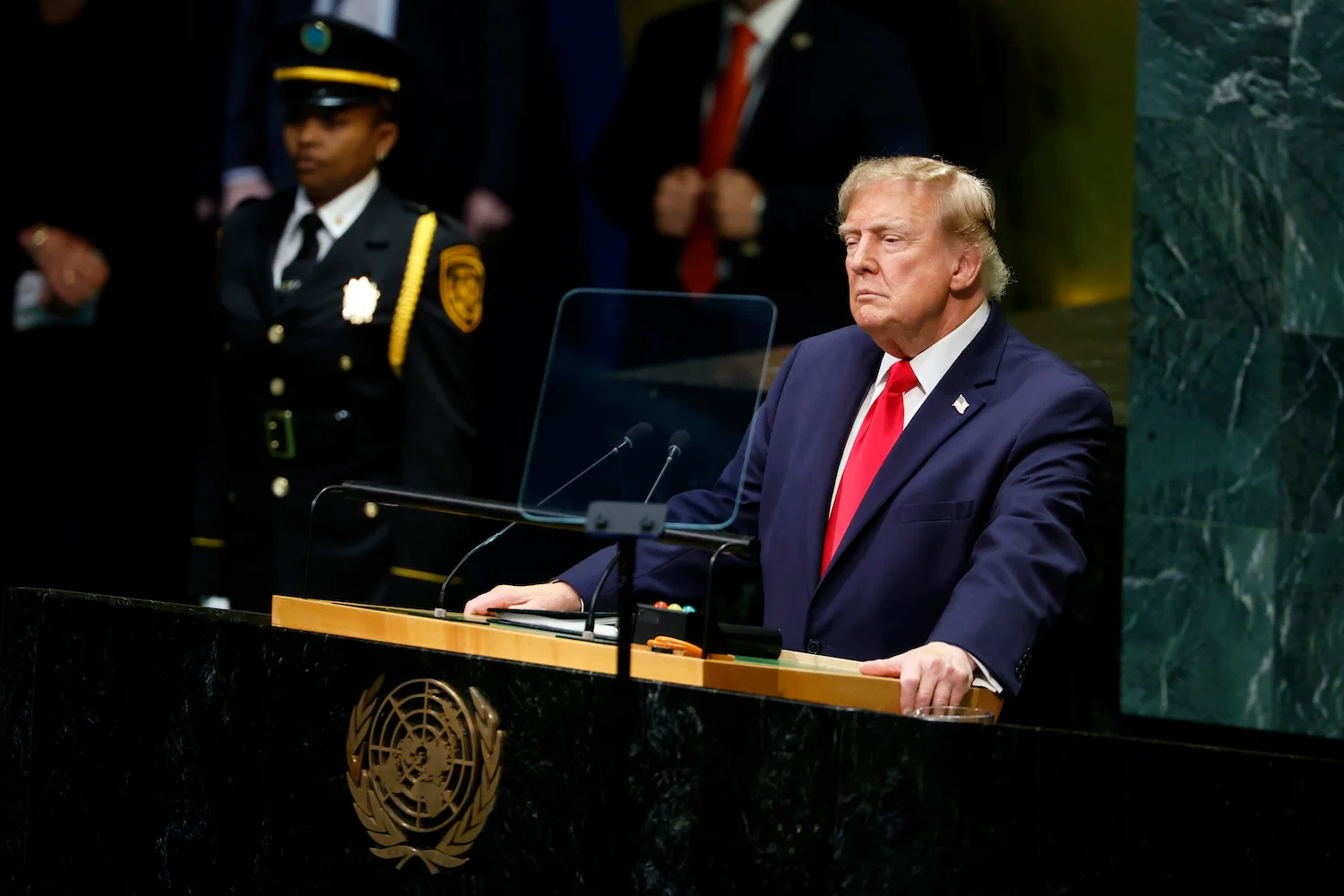
Welcome back to World Brief, where we’re looking at U.S. President Donald Trump’s speech at the United Nations General Assembly, an expanded U.S. military presence in Greenland, and the European Union’s initial free-trade deal with the Philippines.
War Crimes at the U.N.?
U.S. President Donald Trump presented a damning choice during his United Nations General Assembly (UNGA) speech on Tuesday: Make a deal with Iran that “lets them rebuild” or “annihilate” the Islamic Republic. “Do I drive them into hell with no chance of survival and no hope of future greatness or generations?” Trump posed, echoing past threats that experts have argued could be considered war crimes.
Welcome back to World Brief, where we’re looking at U.S. President Donald Trump’s speech at the United Nations General Assembly, an expanded U.S. military presence in Greenland, and the European Union’s initial free-trade deal with the Philippines.
War Crimes at the U.N.?
U.S. President Donald Trump presented a damning choice during his United Nations General Assembly (UNGA) speech on Tuesday: Make a deal with Iran that “lets them rebuild” or “annihilate” the Islamic Republic. “Do I drive them into hell with no chance of survival and no hope of future greatness or generations?” Trump posed, echoing past threats that experts have argued could be considered war crimes.
Although Trump’s warnings are not new, using the U.N. stage to deliver them brings a new dimension to the White House’s continued war of words against the institution’s human rights work.
The Trump administration has repeatedly denounced the U.N.’s justice-seeking bodies. Last Thursday, the White House rejected a U.N. fact-finding mission that found “reasonable grounds to believe” that the U.S. military committed war crimes when it launched separate strikes on an Iranian school and sports facility in February. And on Tuesday, he called the U.N. Human Rights Council “craven hypocrites” for its alleged failure to speak up against the persecution of Christians.
But he saved his toughest rhetoric for the U.N.-allied International Criminal Court (ICC). “You’re an evil group of people,” Trump said. He called on all ICC member countries to immediately resign from the “rogue institution,” which he claimed is an “anti-American,” “out-of-control” tribunal.
Condemning the United Nations in its own backyard is far from a new strategy for Trump. Last year, the U.S. president delivered a rambling, vitriolic UNGA speech that questioned the very existence of the assembly. “All they seem to do is write a really strongly worded letter and then never follow that letter up,” Trump said at the time, though mere hours later, he claimed to support the institution’s “potential for peace.”
Trump’s address on Tuesday was more conciliatory than last year’s. Instead of lambasting the United Nations’ teleprompter and escalator blunders, Trump heralded U.S.-led reforms that slashed the institution’s annual operating budget and eliminated thousands of jobs. He was similarly more civil toward his fellow attendees, whom he called “great leaders” instead of warning that their “countries are going to hell.”
This shift in tone may be part of the White House’s strategy to address the Iran war and ensuing global energy crisis. “If we stand united, we will soon see a world free of the last 51-year menace of Iranian terror, and oil prices will come plummeting down even lower than they were at the start of the conflict,” Trump said on Tuesday. Global diesel costs hit record highs on Monday following further disruptions to shipping in the Bab el-Mandeb strait.
Still, Trump made it clear that he does not need the United Nations—or the rest of the world—to accomplish his war aims. The United States will get it done “one way or the other,” Trump said, hinting that a deal with Iran could be made after the U.S. midterm elections in November.
Other major highlights of Trump’s UNGA speech included condemnation of the Russia-Ukraine war, praise for his administration’s successful blocking of a U.N.-proposed global carbon shipping fee, and a push for further artificial intelligence advancements. He celebrated a looming oil deal with Venezuela, discrediting past U.S. claims that material gain was not a rationale for foreign interventions. He hailed deadly U.S. strikes on alleged drug boats, calling cartels “the ISIS of the Western Hemisphere.” And he stressed the need for regime change in Cuba, prompting a walkout by the Cuban delegation.
Today’s Most Read
What We’re Following
Arctic security. Denmark, Greenland, and the United States signed a deal on Tuesday updating security arrangements regarding the semiautonomous Danish territory. While the agreement reaffirms Denmark’s sovereignty and territorial integrity, it also expands U.S. military access to Greenland’s land and airspace, ending a monthslong dispute over who can capitalize on the strategically located, mineral-rich territory.
Despite the existence of a 1951 Greenland defense treaty between the United States and Denmark, since taking office, Trump has repeatedly threatened to seize control of Greenland. The White House argues that growing the U.S. military presence there is vital to securing the Arctic against competitors such as Russia and China.
Under the deal, the United States can expand its existing Pituffik Space Base as well as establish two new bases, Narsarsuaq and Mestersvig. Non-NATO members are barred from constructing bases on the island without permission from the three signing parties. And the agreement will remain in effect even if Greenland eventually becomes independent from Denmark.
“This is tremendous for Europe and for the United States and for everybody,” Trump said ahead of the signing, adding that the deal will enhance NATO’s abilities in Europe. “And for Greenland, it’s going to be incredible.”
Diversifying trade. The European Union reached an initial free-trade deal with the Philippines on Tuesday. A finalized agreement to eliminate more than 94 percent of tariffs on both sides is not expected for several months. However, the announcement signals the EU’s pivot to Asia in an effort to compensate for the costly impact of Trump’s trade war.
Over the past two years, the White House has repeatedly threatened to impose sweeping tariffs on the EU, citing forced labor allegations and unfair trade practices. Just last week, Trump vowed to impose more duties on the EU or even cut off certain areas of trade with Europe in response to a new proposal to make Canada the bloc’s first “associate member.”
Rather than wait for Washington to play nice, though, the EU has decided to take matters into its own hands. Last September, the bloc concluded free-trade talks with Indonesia while relaunching them with Vietnam. In January, it inked a massive agreement with India nearly 20 years in the making. And according to European Trade Commissioner Maros Sefcovic, the bloc is currently in talks with Malaysia and Thailand. Adding the Philippines to the EU’s growing roster would add yet another avenue for diversifying trade.
Future Chagos Islands talks. British Prime Minister Andy Burnham offered a positive outlook in his first in-person meeting with Trump on Tuesday. “You and I have established a good connection in our early discussions, and we’ve taken that further today,” Burnham told Trump in a joint press conference on the sidelines of UNGA. The two leaders briefly touched on the wars in Ukraine and Iran, Britain’s newly announced limited military support for Saudi forces fighting the Houthis, and the United Kingdom’s dispute with Argentina over the Falkland Islands.
Trump also appeared to be in high spirits. He congratulated Burnham on a “great election win,” described him as a “natural businessman,” and expressed optimism toward their future conversations. However, Trump slammed the U.K.’s Chagos Islands deal, which (currently on hold) would give Mauritius sovereignty over the British territory so long as U.K. and U.S. forces can continue to operate out of the Diego Garcia military base. The U.S. president called it “a terrible deal” over a “very important piece of real estate, militarily and strategically,” adding, “I think the prime minister is going to be looking at it.”
Diego Garcia is strategically located between Africa and Asia and has routinely been used to aid U.S. military operations in the Middle East, including during the Iran war. Trump has heavily criticized the deal, with support from far-right Reform UK leader Nigel Farage. But Burnham has largely stayed silent on the Chagos Islands issue; after Trump’s diatribe on the Chagos Islands, the British premier only had one thing to say: “Mmm, yup.”
Odds and Ends
There’s only one election on FP’s World Brief writer’s mind this week, and it’s not the looming choice for the next U.N. secretary-general. Fat Bear Week kicked off in Alaska on Tuesday, in which 16 brown bears in Katmai National Park are competing for the title of heftiest bear heading into winter. The winner could be anyone, but eyes are particularly on Grazer and Chunk, the victors of 2024 and 2025, respectively. Last year, Chunk was estimated to weigh a respectable 1,200 pounds.
