


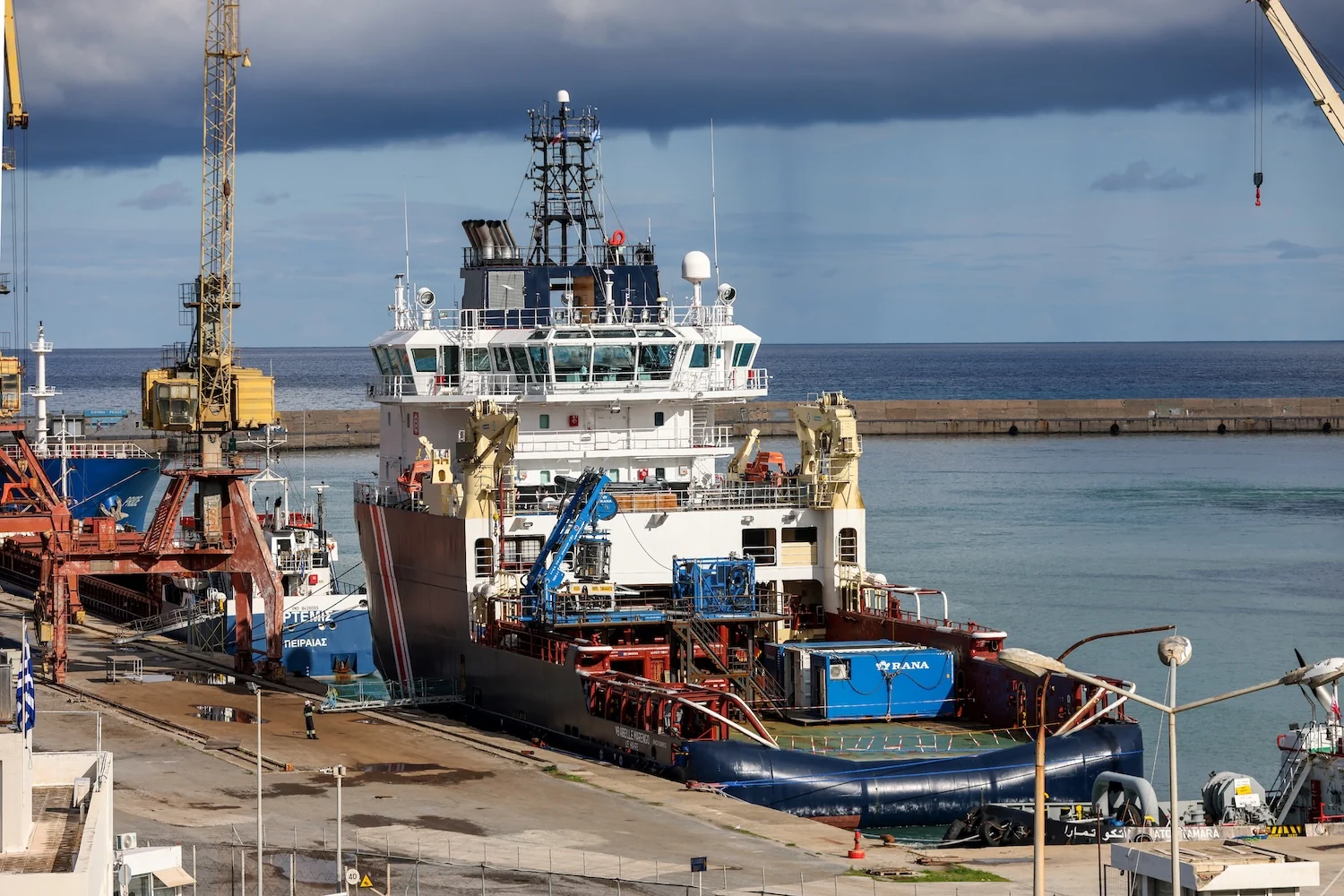
Cutting dependence on fossil fuels is a good thing for climate reasons, and because these days, there’s no guarantee that the Persian Gulf’s plentiful oil and gas will reach their destinations. It is, in other words, no surprise that Greece and Cyprus want to install an interconnector—a seabed power cable—to supply the two nations with electricity.
There’s just one problem: Turkey wants to supervise the project, arguing that it goes through Turkish waters. According to the United Nations Convention on the Law of the Sea, it does not—but these days, plenty of countries are not too concerned about UNCLOS. In fact, we may be seeing a creeping land grab—on the seabed and in the waters above.
“We do not want the status quo to be disrupted in a completely wrong way, nor do we want a precedent to be set that would create even greater problems for both sides,” Turkey’s foreign minister, Hakan Fidan, said in Brussels in late October. That sounds innocuous enough: Who would want to disrupt the status quo or create problems? Fidan was, however, talking about a very specific status quo and a very specific project that, as Turkey sees it, threatens to create problems for both sides.
The status quo concerns the waters of the Aegean. Under the U.N. Convention on the Law of the Sea, a masterpiece of multilateral diplomacy that most of the world’s nations adopted in 1982 and ratified in the years shortly thereafter, each nation and each island have the right to territorial waters of up to 12 nautical miles from their shorelines. They also can claim an adjoining exclusive economic zone, in which they have more limited rights over a wider area.
Turkey strongly objects to this arrangement, at least as it applies in the Aegean, where it greatly benefits island-rich Greece. As a result, Ankara has refused to sign UNCLOS. To this day, Turkey belongs to the scattering of nations—countries such as Israel; Eritrea; Kazakhstan; Iran; and yes, the United States—that have not ratified the treaty.
Indeed, Turkey has gone farther, strenuously objecting to UNCLOS to the point that it considers itself a “persistent objector.” It has also put forward its own set of maritime claims, in which large swaths of the Eastern Mediterranean would fall under Turkey’s exclusive economic zone.
Now, this conflict has come to focus on a humble economic cable. The Great Sea Interconnector, which will connect Greece and Cyprus and eventually also Israel, has been in the making since 2021 and is being partly funded by the European Union. Perhaps unsurprisingly, the Turkish government argues that Cyprus should instead import energy from Turkey, which is far closer to it than Greece. Earlier this month, Energy Minister Turkish Alparslan Bayraktar said that a planned gas pipeline connecting Turkey and the breakaway Turkish part of Cyprus could supply power to the whole island.
This creates a challenge for cable installation companies. These firms operate according to the rule of law and would never risk installing a cable without permission. But what does the rule of law require here? Cables need permission in countries’ territorial waters, and some countries insist, contrary on the U.N. convention, on requiring permission in their exclusive economic zones, too. In fact, China insists on requiring permits within its self-proclaimed nine-dash line in the South China Sea, which is very much not Chinese waters.
What can cable installation companies do? They’re in the business of laying cables, not adjudicating geopolitics. Now Turkey insists that cable companies must submit written notice for any Great Sea Interconnector (GSI) activities, and for purely practical reasons, the cable firms are hardly going to risk a fight with Ankara. Earlier this month, after Greece issued a notice permitting a research vessel to restart work, Turkey responded with a counter-notice, pointing out that it had not consented to the vessel’s activities.
Turkey could even decide to draw inspiration from China, which slow-walks permits in the South China Sea for cables that it’s not keen on. And without Turkish permission, there will be no Great Sea Interconnector. The situation has turned so tense that, according to reporting in the Greek Herald, Greece let it be known that any attempt by Turkey to obstruct the installation of the GSI “will be met with an operational response.”
Imagine if similar land-grabs-in-the-making occurred on land: It would be a huge deal, especially if they involved NATO member states such as Greece and Turkey. The seabed, by contrast, is hidden, out of sight and out of mind. Yet what happens on the seabed doesn’t stay on the seabed, which is precisely why Turkey is so interested in the GSI. If you can claim the seabed as yours, then you can also claim the waters above it.
Indeed, Turkey’s challenge to the GSI hinges on a far larger effort to contest maritime in its neighbourhood. Seven years ago, Ankara signed an agreement with Libya’s Tripoli-based government to establish a maritime boundary between the two countries’ exclusive economic zones. The agreement was in flagrant violation of UNCLOS principles, and vigorously protested by Greece, Cyprus, and Egypt. Yet last month, Ankara succeeded in also convincing the parliament in the eastern part of Libya to recognize the agreement as well.
That’s where we are now. The Great Sea Interconnector’s installers face the nuisance of having to submit notices when no such notifications should be necessary—and the prospect of delays from Ankara.
But it’s not about cable installers. The GSI is part of a bigger shift that involves the violation of maritime rules and the establishment of new maritime borders. Turkey is not the only culprit: Russia systematically violates UNCLOS through its shadow fleet. China has built artificial islands in the South China Sea and harasses ships from other countries there, in addition to falsely demanding installation applications from cable companies. Iran, of course, has closed the Strait of Hormuz.
Even the United States, UNCLOS’s self-declared protector, has recently gone squarely against the treaty. That happened last year, when President Donald Trump signed an executive order permitting unilateral mining in international waters, which UNCLOS expressly bans.
In such a world, why shouldn’t Turkey insist on calling the shots over an interconnector ? In a world of collapsing rules, helping oneself to tactical advantages seems like a much better deal.
Ultimately, countries are likely to discover that maritime anarchy is not in fact a better deal, which is precisely why delegations from the entire globe spent years negotiating UNCLOS. Now, the next generation of leaders is about to find out why their predecessors were so adamant that the oceans needed order.
