


In announcing the latest FBI annual report on nationwide crime, President Donald Trump wrongly cast the decline in crime in 2025 as a dramatic turnaround and made misleading claims about the impact of his administration’s policies.
Speaking to an audience of law enforcement officers at the Nassau County police academy on Aug. 14, Trump said that his speech was meant to “celebrate the historic progress our administration is making together with law enforcement partners nationwide to restore law and order in America.” The FBI that day released data collected from local law enforcement agencies showing that both violent and property crime nationwide declined from 2024 to 2025, with the largest one-year drops in the violent crime and murder rates since the FBI began publishing these estimates in 1936.
The president accurately cited those large one-year reductions, but he ran afoul of the facts and available evidence in taking credit for them:
- Trump claimed that the decline happened “because of what the federal government’s doing.” Criminology experts say there are many plausible factors and the exact reasons are unclear.
- He claimed that the U.S. experienced “a horrible four years” of violent crime during the Biden administration. But violent crime fell during the second half of Biden’s presidency and was lower in the last year of Joe Biden’s term compared with Trump’s final year in office.
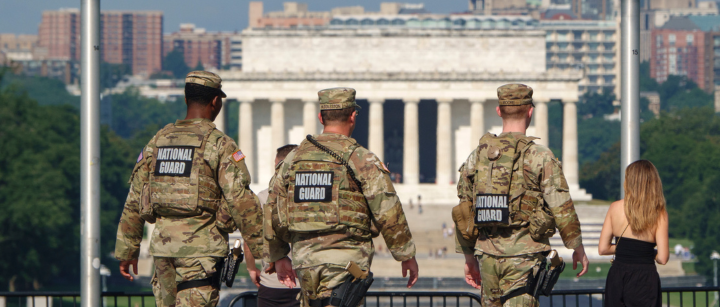
- Trump vastly overstated the decline in crime since his deployment of National Guard troops in Washington, D.C., Memphis and New Orleans, citing 70% or 80% reductions that don’t match up with police data. Experts also say the troops aren’t the primary reason for crime dropping in those cities.
- The president suggested that an executive order he signed upon taking office in 2025 contributed to a significant decline in police officers dying in the line of duty that year. However, the law enforcement organization that keeps records of such deaths said the decrease was “likely” due to other factors.
Trump’s speech embracing the FBI’s report for 2025 is noteworthy because he previously disparaged the FBI reports as “fake,” “phony” and “a fraud” when they showed a decline in crime under Biden.
Reasons for Crime Drop Unclear
Trump cited several statistics from the FBI report and claimed credit for the 2024-to-2025 crime reduction. But criminology experts have said the reasons behind the decrease are myriad and unclear. Also, the large single-year declines in 2025 follow a few years of crime dropping after a spike during the 2020 pandemic.
“And with your help, last year, we achieved the largest drop in murder rate ever recorded, the lowest level in 125 years. That’s since the year 1900,” Trump said, adding that according to the FBI crime report, “we achieved the single largest reduction in violent crime in American history.”
Trump is correct that the FBI report says the data it collects from local law enforcement agencies show the 2024-to-2025 decreases in both the violent crime rate and the murder rate were the largest one-year declines since the FBI began releasing the nationwide crime estimates in 1936. The violent crime rate went down by 9.7%, and the murder and nonnegligent manslaughter rate dropped by 18.5%, the FBI said.
The data are estimates based on figures submitted by more than 17,000 local law enforcement agencies covering about 96% of the U.S. population. The violent crime rate went from 362.9 offenses per 100,000 population in 2024 to 327.6 per 100,000 population last year. The murder rate dropped from 5.1 per 100,000 to 4.1.
Trump’s reference to the murder rate being the lowest since 1900 comes from a report by the Council on Criminal Justice, a nonprofit think tank, which used FBI statistics dating back to 1960 and public health data going back to 1900 in determining that. (See Figure 20 in CCJ’s year-end report for 2025.)
The murder rate is the lowest over that time, per CCJ’s methodology. The FBI said the 4.1 rate is tied with the bureau’s 1955 and 1956 figures. (CCJ explained to us that it didn’t use the FBI estimates prior to 1960 because they weren’t standardized and are considered less reliable.)
Regardless, the murder rate is now at a historic low.
“Overall, it was the largest percentage point drop in murder, violent crime and property crime ever recorded,” Jeff Asher, a co-founder of AH Datalytics, a consulting firm that compiles crime data, wrote on Substack. “With murder you have to go all the way back to 2024 to find the previous largest one-year drop in murder and before that the previous largest one-year drop was in 2023.”
In his speech, Trump went on to credit his administration. “But we have the numbers down because of what the federal government’s doing,” the president said. “We get no — we get no credit for it. … They like to take all the credit, but everyone knows we’ve done an amazing job.”
In an Aug. 18 press release, the White House similarly said that Trump and his administration “have delivered the most dramatic decline in violent crime in American history.” It wrongly said the FBI crime estimates “mark the decisive reversal of the crime crisis Democrats left behind.” As we explain later in this article, the rates for violent crimes were lower in 2024 than in 2020, Trump’s last year of his first term. The press release went on to cite figures on arrests made by the FBI.
Presidents of both parties often take credit for the good things that happen while they’re in office, but experts say the reasons behind the 2025 crime figures aren’t yet known.
“The homicide drop is historic and crystal clear. But right now, what’s driving it is about as clear as a glass of milk,” Adam Gelb, the president and CEO of the Council on Criminal Justice, said in a statement. “Rates are falling in cities with very different public safety strategies, economic conditions, and political leadership.”
Criminology experts have told us before that one or even a few years of crime data isn’t enough to draw conclusions.
“As with every edition with these kind of reports, the feeding frenzy begins to take credit,” Matthew Cavedon, director of the Cato Institute’s Project on Criminal Justice, told the Washington Post. “Everybody wants to be able to go to the public and the voters and say, ‘This is exactly what did it.’ It’s a bit of a fool’s errand to even try.”
The Trump administration, however, is taking a victory lap. We asked the White House if there were reports or other information it could point to showing the crime drop in 2025 was due to the administration’s actions or policies. “President Trump is right: thanks to this Administration’s tough-on-crime policies, 2025 showed the largest year-to-year decrease in violent crime. President Trump has restored law and order,” Lauren Bis, a White House spokeswoman, said in response.
In an interview, Gelb told us that there could be some impact on crime from what the administration is doing, but we don’t know what that is yet.
He said that attrition is one factor that could be playing a role, as there are fewer high-risk people on the street. Factors contributing to that, he said, include a surplus in murders beginning in 2020 (resulting in more arrests and some criminals killed), a spike in drug overdose deaths, and the federal government’s immigration enforcement and other activities. While clearly not all those who die from drug overdoses, or all immigrants swept up by the federal government, have committed crimes, some percentage of them would have some involvement in criminal activity.
Available data have shown that the majority of immigration enforcement by the federal government has swept up people without convictions or charges for violent crime. A February CBS News report said that about 14% of nearly 400,000 arrests by Immigration and Customs Enforcement in 2025 involved those with charges or convictions for violent crimes, according to an internal Department of Homeland Security document. We’ve also reported that an increasing percentage of ICE arrests over Trump’s first year back in office were of those with no criminal convictions or pending charges, whether for violent or lesser offenses. Still, the increased enforcement does result in some number of violent criminals being detained.
Gelb cautioned, however, that reducing crime isn’t “as simple as taking bad guys off the street,” because of the replacement effect, where those arrested are quickly replaced by someone else in a criminal organization, such as in gang activity, drug dealing or organized retail theft.
Asked when there might be clarity on the Trump administration’s impact on crime, Gelb said, “We’re still trying to understand the crime drop that started in the early 1990s. So, I don’t think we can expect definitive conclusions that with any precision assign credit to any particular policy, program, party or leader. … But with careful and rigorous analysis, we can get a lot closer.”
Next month, CCJ is convening about 50 crime researchers and scholars to discuss the reasons behind the decline in crime in recent years, and they’re looking at about 40 different plausible factors. Gelb said that they fall into three buckets: criminal justice operations, strategies, policies and programs; technology; and social and cultural shifts.
He went on to list several factors in each of those buckets. Criminal justice would include local and federal policies under multiple administrations, community violence intervention programs, and mayoral offices’ whole-of-government strategies that involve everything from policing to improving street lighting. Technology includes a “massive expansion in the last few years of surveillance” through cameras; a shift to a cashless society, which reduces robberies; and improvements in emergency medical care that can lower the lethality rate from assaults or robberies. Finally, the broad social and cultural changes include people drinking less, particularly young people, and kids spending more time at home alone — on their phones — rather than being out with friends.
“You know the movie ‘Everything Everywhere All at Once’?” Gelb asked. “That’s what we’ve got here. And when you have so many, so many things happening at once, it can be extremely hard to disentangle.”
Violent Crime Under Biden
Trump also claimed that the U.S. had “four years in hell” because of violent crime under Biden. But the violent crime rate was lower when Biden left office than when Biden was inaugurated.
“And in the past four years, before I took office, our country was overrun by violent criminals,” Trump said. “I mean, you remember just a couple of years ago, how bad it was, right? It was really bad, foreign gangs, savage thugs with Biden, sleepy Joe. What a — what a horrible four years. That was four years in hell. We lived in hell.”
FBI data show the overall violent crime rate did increase a smidge during the first half of Biden’s term. It was 389.5 per 100,000 population in 2022, a slight bump from the rate of 389.2 per 100,000 in 2020, Trump’s last full year in office, when violent crime spiked during the pandemic. (See Table 1 after downloading the FBI’s 2025 estimations for crime in the U.S.)
But violent crime began to fall in 2023 and the rate was down to 362.9 per 100,000 in 2024. That was 26.3 fewer offenses per 100,000 population than in 2020 and even down from the pre-pandemic rate of 368.6 per 100,000 in 2019.
In fact, the rates of murder, rape, robbery and aggravated assault were all lower in 2024 than in 2020. The murder rate in particular dropped from 6.6 in 2020 to 5.1 in 2024, and the number of murders declined by about 21%. At the same time, the rate of aggravated assaults declined by 13.7 offenses per 100,000 and the raw number went down by almost 2%.
Impact of National Guard
Trump touted his efforts to deploy the National Guard and federal law enforcement to assist several cities with crime, and he said it has paid dramatic dividends. But he vastly overstated the drop in crime post-National Guard. And crime experts say the infusion of National Guard troops is not the primary reason for the reduced crime those cities have experienced.
Via presidential memos, Trump deployed the National Guard in several cities to focus on public safety: in Washington, D.C., on Aug. 11, 2025; in Memphis on Sept. 15; and in New Orleans in late December.
“In Memphis, crime is down 71%. In New Orleans, crime is down 75%. And in D.C., crime is down 81%,” Trump said. “I’ll tell you, because D.C. is very personal for me, but in D.C., crime is — it was so bad when I got there. A year and a half ago, people were being murdered, three a week on average. We have very few murders anymore.”
There were 16 homicides in Washington, D.C., in July, more than the “three a week on average” Trump said was the norm before he deployed the National Guard there.
But overall, crime and homicides are generally down in the three cities where Trump deployed the National Guard, just not by nearly as much as Trump claimed. And crime had been trending down for at least a few years prior to the National Guard arrival.
The White House did not respond to our question about the source of Trump’s figures.
Washington, D.C.
On Aug. 11, 2025, Trump declared what he called “Liberation Day in D.C.” to “rescue our nation’s capital from crime, bloodshed, bedlam and squalor and worse.” He put the Metropolitan Police Department under temporary federal control and deployed the National Guard to the nation’s capital to help with law enforcement.
Data from the city’s Metropolitan Police Department indicate a 20% reduction in overall crime in D.C. so far in 2026, compared with a similar period in 2025.
Digging into the numbers, there were 67 homicides between Jan. 1 and Aug. 14, 33% fewer than over the same period in 2025 (nearly entirely before the National Guard deployment). Robberies over the same period were down 14%. But sex abuse cases were up 2%, and assaults with a dangerous weapon rose 40%. Overall, violent crime rose 4%. Property crimes declined by 23%.
After spiking in 2023, violent crime had been trending steadily downward in Washington, D.C., before Trump’s federal surge.
“If you want to argue that there was an additional decline on top of that [the downward trend] due to all these interventions, you could plausibly make that argument,” Asher, with AH Datalytics, told the Washington Post. “But you can’t make the argument that the intervention caused that decline or even was a major factor in those trends turning over.”
Thaddeus Johnson, an assistant professor at Georgia State University and a senior fellow at the Council on Criminal Justice, echoed that conclusion, telling the Washington Post, “One would be hard-pressed to say that it didn’t play a role, but you would also be hard-pressed to say it was the only or primary reason why we’ve seen reductions.”
“DC homicides fell from 187 in 2024, the year before [Trump] took office, to 127 in 2025, and are down another 32% so far this year, from about 3.6 murders a week in 2024 to about 2 a week now,” Richard Hahn, senior manager for research and evidence in the Niskanen Center’s criminal justice department, told us via email. “That is a roughly 40% improvement on the pace he inherited, not 81%, and the sharpest single drop (274 homicides in 2023 to 187 in 2024) happened entirely under local policing before his term began.”
Hahn is one of the co-authors of a report from the Niskanen Center, a centrist think tank, titled, “Washington, D.C.’s Crime Decline and Its Lessons for American Policing.”
The analysis concluded that deployment of the National Guard to D.C. gets “some credit” for “a narrow slice of crime,” Hahn told us. “The Guard was posted in tourist corridors, transit hubs, and federal areas rather than the neighborhoods where violence concentrates, and Guard members could detain but not arrest. We found the deployment produced a real reduction, about 24%, in opportunistic property crime where the Guard was visible, and no detectable effect on violent crime. That is what the research on policing would predict: visible uniformed presence deters crimes of opportunity, but it does not reach violence rooted in interpersonal disputes.”
According to the report, “What the Guard brought was a massive, sudden shock from the visible presence of uniformed military personnel on the streets of Washington almost overnight. For crimes driven by opportunistic calculation, that visibility appears to have mattered. For violent crime, which is less deterrable by patrol presence alone, it did not.”
The report concluded that while the Guard’s deployment “reduced the occurrence of specific crimes, it was (and remains) a blunt and expensive instrument.” The report’s analysis found that “a targeted, data-driven policing strategy optimized on where and when crime actually occurs could achieve comparable or better outcomes at a fraction of the cost.”
Memphis
Last September, Trump’s executive order created the Memphis Safe Task Force, which included sending hundreds of federal law enforcement agents and deploying 1,450 National Guard troops to the city.
In Memphis, total crime dropped nearly 39% from the period of Oct. 1 to Aug. 18 compared with the same period the year before, according to city data. That includes drops in crimes across the board: -41% for murder; -30% for aggravated assault; -32% for sexual assault; -48% for robbery; -28% for burglary; -36% for larceny; and -62% for motor vehicle theft.
Memphis Mayor Paul Young told Action News 5 in Memphis that the task force “amplified” state and city efforts — including millions in state funds targeting violent crime and other targeted enforcement approaches — that had already resulted in crime dropping 27% in the year before the task force was created.
“I think two things can be true at the same time,” Tyreece Miller, U.S. marshal for the Western District of Tennessee, told Action News 5. “I think crime was trending downward. But I think the task force certainly escalated the decrease in crime.”
New Orleans
In late December 2025, Trump deployed 350 National Guard members to New Orleans. But the results have been mixed.
In New Orleans, crime began to markedly drop in late 2023, but leveled off in mid-2025. Since the National Guard arrived in New Orleans in late December, crime overall has remained relatively unchanged. The rolling yearly total number of crimes on Aug. 18 was 13,375, up slightly from the yearly total ending Aug. 17, 2025, of 13,207. Year-to-date, overall crime is up 4.8% compared with the same period last year; murder is down 23.9%; and sexual assault is up 1.6%.
“The National Guard has had no impact on New Orleans’ murder trend,” Asher, of AH Datalytics, told us via email. “To begin with, the Guard is deployed largely in the French Quarter where gun violence is very rare. In addition, shootings in New Orleans began falling dramatically in mid-2023 with the city experiencing a 60 percent drop in shooting incidents between mid-2023 and early 2025. This trend began long before the National Guard arrived and almost certainly has been caused by other factors.”
Hahn also cautioned not to ascribe too much credit to National Guard deployment in the three cities.
“The whole country is in a historic crime decline,” Hahn said, citing the FBI’s 2025 report that found the largest one-year drops in violent crime and murder since the bureau started tracking the data. “The Council on Criminal Justice found homicide down 21% in 2025 across its big-city sample, and down another 18% in the first half of 2026, putting the country on track for a historic low. Against that backdrop, the three deployment cities look much like everywhere else. When crime is falling nearly everywhere, falling crime in three cities is not sufficient evidence that any particular intervention worked.”
Trump, meanwhile, said he stands ready to implement similar federal surges in other cities that are receptive.
“For other cities like New York, Chicago, L.A., all they have to do is call us and we will stop that crime,” Trump said. “We’ll stop that horrible crime.”
But Hahn said the data do not support that, as big cities around the country saw major crime drops over the last several years, commensurate to the cities where Trump sent the National Guard.
“Crime has not dropped more dramatically in the deployment cities than in New York, Chicago, and LA,” Hahn said. “In 2025, the NYPD recorded the fewest shooting incidents in its recorded history (688, down 24% from 2024) with murders down 20%. Chicago ended 2025 with 411 homicides, down 30% and the fewest in decades, per CPD data. Los Angeles recorded its fewest homicides since 1966, down 19%. And Denver led the nation’s large cities with a 41% homicide decline. None of these cities had a Guard deployment. That they matched or beat the deployment cities without federal troops is strong evidence that the Guard is not what is driving the numbers.”
Decline in Police Dying on Duty
Trump appeared to credit an executive order he signed in early 2025 for last year’s decline in the number of police officers who died in the line of duty. But that was not one of the reasons for the decrease that was cited by the law enforcement organization that tracks those deaths.
“Shortly after taking office, I signed a historic executive order directing that anyone convicted of killing a police officer should face the death penalty,” Trump said. “And last year, deaths of law enforcement — well, think of this — deaths of law enforcement officers in the line of duty fell to an 80-year low.”
Trump did sign an executive order on Jan. 20, 2025, directing the attorney general to “pursue the death penalty for all crimes of a severity demanding its use,” including “murder of a law-enforcement officer.” The National Law Enforcement Officers Memorial Fund also reported that 109 officers died in the line of duty in 2025, representing a 26% decrease from 148 officers in 2024.
The 2025 total — which included 45 officers who died after being shot — was the lowest since 93 officers died in the line of duty in 1943, according to NLEOMF figures. But as far as the reason for the overall decline in 2025, the NLEOMF did not mention Trump’s executive order.
“We lament to document even a single such death, but this encouraging downward trend in fatalities likely reflects the continued adoption of proven best practices by police, sheriff, and corrections agencies, as well as a growing emphasis on the physical and psychological health of the men and women who work to keep our communities safe,” NLEOMF CEO Bill Alexander said in a statement in January. “These practices align directly with — and underscore the importance of — NLEOMF’s Officer Safety and Wellness initiatives, which are designed to help ensure that more officers return home safely at the end of each shift.”
Experts on the death penalty previously told us that there is no conclusive evidence that capital punishment is “a very strong preventative” to violent crimes such as murder, as Trump has claimed.
Editor’s note: FactCheck.org does not accept advertising. We rely on grants and individual donations from people like you. Please consider a donation. Credit card donations may be made through our “Donate” page. If you prefer to give by check, send to: FactCheck.org, Annenberg Public Policy Center, P.O. Box 58100, Philadelphia, PA 19102.
