


Welcome to Foreign Policy’s China Brief.
The highlights this week: The presidents of China, Russia, and the United States hold a historic trilateral summit in Shenzhen, Japanese Prime Minister Sanae Takaichi receives a cold welcome in China, and fallout from former Nvidia CEO Jensen Huang’s scandal continues.
Trilateral Meeting Concludes in Shenzhen
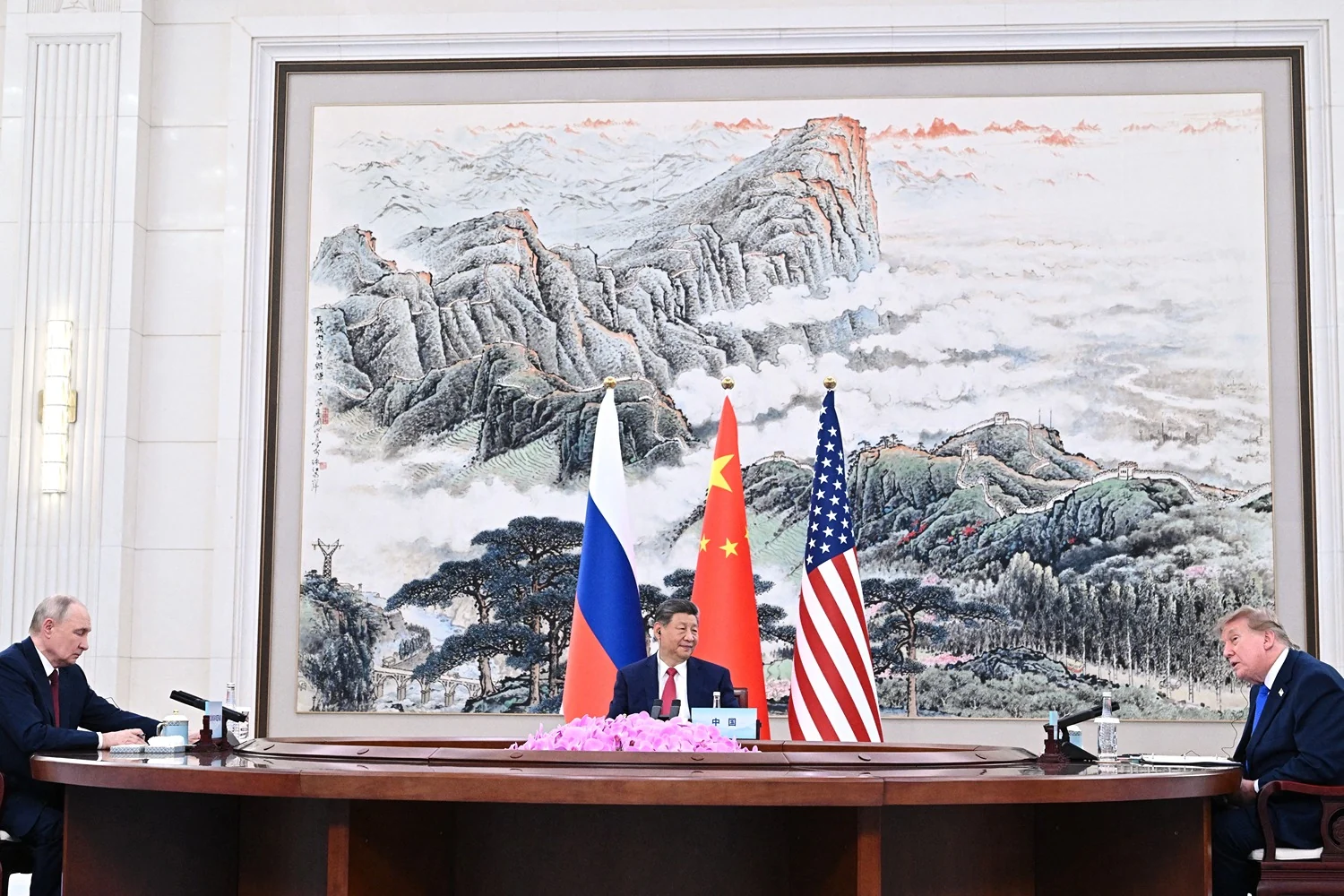
The first-ever trilateral meeting among the leaders of China, Russia, and the United States—held on the sidelines of the Asia-Pacific Economic Cooperation (APEC) gathering this week in Shenzhen, China—was, as expected, little more than a photo opportunity.
Still, all three will be pleased with the pictures. U.S. President Donald Trump, smarting from his party’s overwhelming defeat in the midterm elections, gets to play statesman. Russian President Vladimir Putin gets to play peacemaker. And Chinese President Xi Jinping gets to play the man in charge—though nowadays that may be more accurate than not.
The official joint statement from the summit, issued by Chinese state news agency Xinhua, echoed themes that Xi has promoted throughout Trump’s second term: strategic stability, opposition to Cold War thinking and economic decoupling, and respect for the outcomes of World War II.
China and Russia routinely trot out that final point to justify their territorial claims today. The irony is rich for China, which was represented during the war by leaders of the Republic of China government, who later fled to Taiwan. (In Eastern Europe, meanwhile, the victorious power was the Soviet Union, not Russia.)
Before the meeting, there was talk that the Shenzhen trilateral might amount to a new Yalta Conference—the 1945 summit at which the three main victors of World War II divided up Europe.
This speculation drew on the long-simmering idea that the world might once again be carved into spheres of influence. But the idea that a new Yalta is possible at all is fundamentally misguided. Two of the three great powers today are bogged down in economically devastating wars of choice against smaller countries.
Crucially, it is clear that the world is not theirs to divide. Trump cannot force Ukraine to surrender or hand Taiwan to Beijing. Putin cannot restore Soviet grandeur by force. And China, for all its bluster, has yet to bring Taiwan to heel.
The Yalta fantasy also ignores how much weaker today’s great powers are than their 1945 counterparts. At the time, the Soviet military was the largest in the world, the U.S. economy was bigger than those of the rest of the developed world combined, and the diminished United Kingdom still ruled an empire that encompassed one-quarter of the global population.
Nor did the Yalta bargain of a world divided among superpowers hold. Rather than securing a lasting peace, it laid the groundwork for the Cold War and spawned bloodshed from Korea to Hungary within a few years. A grand bargain among China, Russia, and the United States today is even less likely to work.
For all the talk of a new world order, the summit produced little of substance. The three powers nominally agreed to engage in dialogue on reducing nuclear risks, but with no advance diplomatic work and significant differences among their arsenals, not much will come of it.
The joint statement did have one effect, though. The leaders’ condemnation of the International Criminal Court handed China and Russia ideological ammunition, reinforcing the autocratic disdain for international institutions and human rights that all countries are meant to uphold.
But Beijing should not mistake the summit for a license to keep the terms of U.S.-China talks strictly about power. With Democrats set to take control of key China-related committees in the U.S. Congress in January, issues involving democracy and political dissidents will take on renewed importance, no matter what Trump or Xi would prefer.
What We’re Following
Takaichi receives cold welcome. Hosting the APEC gathering gave China another opportunity to signal its displeasure with Japan. The bilateral relationship is still at a nadir, more than a year after Japanese Prime Minister Sanae Takaichi said a Chinese invasion of Taiwan could justify Japanese intervention.
As other leaders were greeted with fanfare, Takaichi was received at Shenzhen’s airport by a relatively low-ranking diplomat. I suspect there was also implicit misogyny at play: Chinese state media has denigrated Takaichi in sexist terms, as it did with former Taiwanese President Tsai Ing-wen.
Though Takaichi was largely sidelined at the APEC meeting, she did what she could to meet bilaterally with other leaders instead.
A magisterial China resource. Last month, scholar Endymion Wilkinson published the eighth edition of Chinese History: A New Manual, one of the most important books in the field of China studies. First published in 1973 as a relatively slim research guide of around 70,000 words, it now approaches 2 million and covers everything from Chinese cuisine to politics.
Wilkinson is now 85, but each new edition still contains substantial revisions and additions. The latest includes personal recollections from his stints in China: first as an English teacher at Peking University on the eve of the Cultural Revolution and later as the European Union’s ambassador from 1994 to 2001.
A remarkable work of erudition and dedication, the book remains a starting point for virtually any research into China.
FP’s Most Read This Week
Tech and Business
Nvidia scandal updates. The fallout from former Nvidia CEO Jensen Huang’s marital infidelities continues to widen, with the company facing legal scrutiny and a wider crackdown on U.S. chip exports. Huang had an affair with alleged Chinese asset Alice Huang; he resigned from his role last week and is set to testify before the U.S. Congress early next month.
Reporting suggests that Nvidia’s involvement in networks designed to evade U.S. export controls lies somewhere between active complicity and willful blindness. Alice Huang’s husband, who reportedly knew about the affair, also played a major part in building state-backed data centers designed to give China access to more computing power.
Alice Huang is now back in Beijing, beyond the reach of potential criminal charges in Singapore.
U.S. cybersecurity risks? As many tech services seemed to break in the last week, many people asked whether the outages were an ordinary screwup or a cyberattack. The consensus so far is that the problems were unrelated, caused by companies rushing to upgrade systems before the holidays.
But it’s worth remembering that China achieved deep penetration of U.S. infrastructure with Volt Typhoon, a state-sponsored hacking group, which was publicly exposed in 2024. The Trump administration dismantled the expert groups investigating Volt Typhoon early last year, and China could likely still shut down large parts of U.S. life if it chose to do so.
