


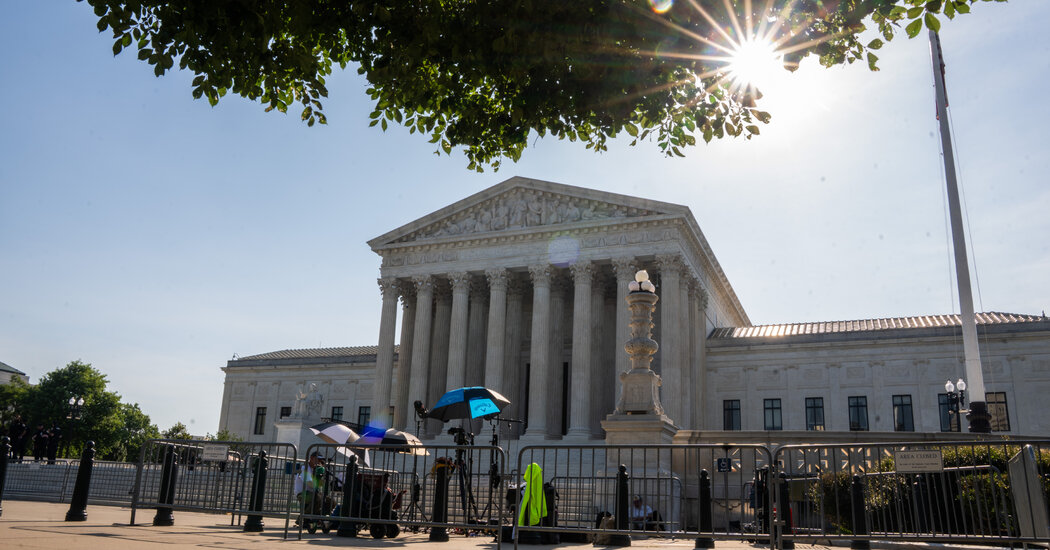
The Trump administration has asked the Supreme Court to allow the U.S. military to fully enforce its ban on transgender service members, setting up the latest test of the administration’s policy priorities in front of the court.
The justices are expected to consider whether to review the legality of the administration’s ban this fall and, if they accept the case, could schedule oral arguments during the Supreme Court’s term that begins in October.
A few days after returning to office, Mr. Trump issued an executive order banning all trans troops and characterizing transgender identity as a “falsehood” that “conflicts with a soldier’s commitment to an honorable, truthful and disciplined lifestyle.”
The ban was one of a series of actions by the administration targeting transgender rights. The president also directed government agencies to withdraw federal funding from schools that allow transgender athletes in girls’ and women’s sports.
The Defense Department implemented Mr. Trump’s military order in February 2025, effectively forcing trans troops out of the military.
“No more dudes in dresses,” Defense Secretary Pete Hegseth announced then.
Transgender service members quickly sued. About 4,200 openly transgender people were in the military last year, according to government court filings — about 0.1 percent of the armed forces. They worked as infantry platoon leaders, pilots, nuclear engineers, doctors, intelligence analysts, police and other key professionals.
A series of lower-court rulings have protected a group of transgender troops who challenged the ban from being discharged while litigation continued. But last May, the Supreme Court’s conservative majority agreed in a separate case to generally allow the administration to dismiss troops while litigation continued.
D. John Sauer, the solicitor general, urged the justices in a filing on Thursday to reverse the lower courts on a permanent basis and defer to the nation’s military leaders by upholding the Defense Department’s “considered military judgment” that accommodating trans troops would undermine “military effectiveness and lethality.”
“The authority of the U.S. military to determine who may serve in the nation’s armed forces is a matter of exceptional importance,” he wrote, pushing back on lower-court rulings that said the administration’s policy was discriminatory.
In the past year, many transgender service members have left the military voluntarily rather than face uncertainty and possible harm by contesting the new policy. Hundreds of others have stayed, insisting that their cases be considered individually by military retention boards consisting of fellow service members. Discharge has generally been a foregone conclusion, given the president’s order.
The 28 challengers in the case before the justices are led by Nicolas Talbott, a second lieutenant in the U.S. Army Reserve. The group claims the policy unfairly and illegally directs hostility and prejudice against a group of people.
In a 2-to-1 decision in June, the U.S. Court of Appeals for the District of Columbia Circuit sided with the group, but their lawyers have asked a lower court to extend protections to all transgender troops.
The policy seemed to be “driven by the bare desire to harm a politically unpopular group,” wrote Judge Robert L. Wilkins, who was joined by Judge Judith W. Rogers.
Judge Justin R. Walker dissented, saying courts do not have the power to make such decisions about the military: “The Constitution assigns that authority to Congress and the commander in chief,” he wrote.
In the meantime, the 28 service members have been in limbo, still technically in the military but on leave, according to their lawyers.
Attorneys for the service members urged the justices on Friday to deny the administration’s request and allow the case to first go to trial in January. The service members are meeting the military’s standards and the government should not “kick out thousands of highly trained, skilled and decorated troops based on nothing but hostility,” Jennifer Levi, GLAD Law’s senior director of transgender and queer rights, said in a statement.
When the Supreme Court first dealt with the issue on an emergency basis last May, the majority did not explain its reasoning, as is common when the court issues emergency orders. The court’s three liberal justices — Sonia Sotomayor, Elena Kagan and Ketanji Brown Jackson — said they would have kept Trump’s policy on hold.
In his first term, Mr. Trump also announced a transgender ban, but two federal judges blocked the policy.
The Supreme Court lifted those injunctions in 2019 by a 5-to-4 vote, allowing a revised ban to take effect while legal challenges moved forward. The cases were dropped after Mr. Trump left office, and President Joseph R. Biden Jr. rescinded the ban.
