


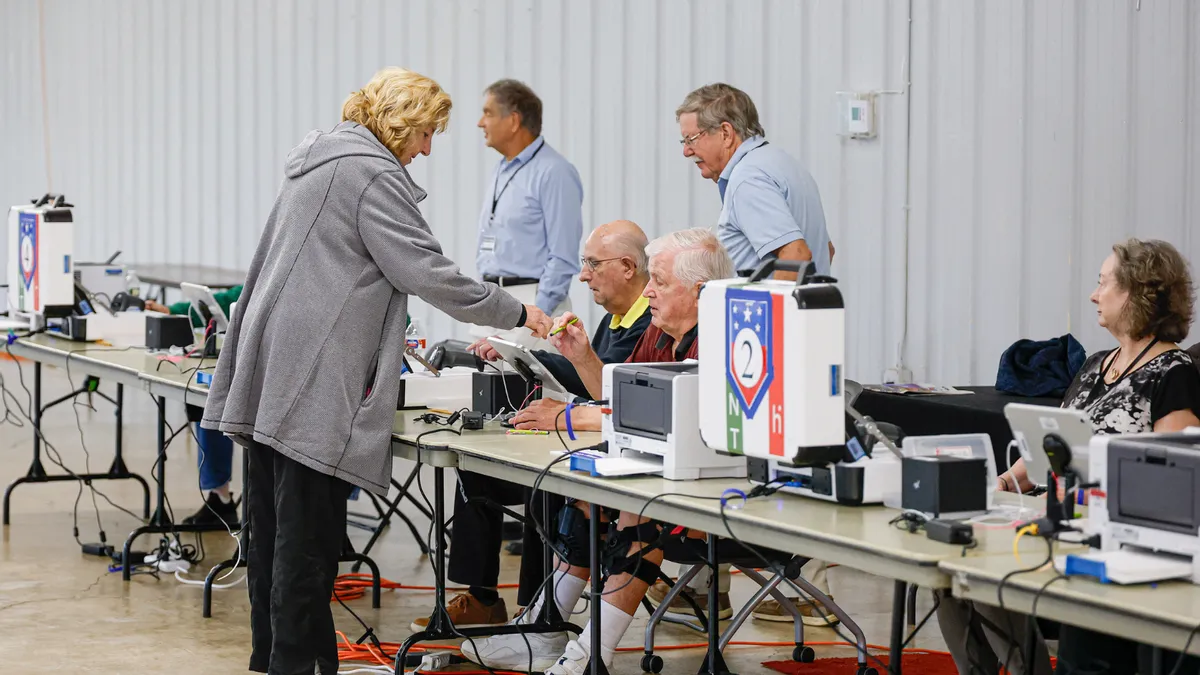
U.S. President Donald Trump’s administration declined to invite observers from Europe’s Organization for Security and Co-operation for the 2026 midterm elections, marking the first time the OSCE had not received an invitation to observe a federal U.S. election since 2002.
In October, rumors circulated that U.S. President Donald Trump’s administration did not extend an invitation to the Organization for Security and Co-operation in Europe, an international body that aims to preserve democracy and human rights across the globe, to observe the 2026 midterm elections.
The OSCE explains that its goal in observing elections is to “assess the extent to which fundamental freedoms are respected in the campaign and if the elections are characterized by equality, universality, political pluralism, confidence, transparency and accountability.”
Social media users who shared the claim noted that it was the first time since 2002, when the OSCE first started observing U.S. elections, that the group had not received an invitation. One post featured an image of Trump with text reading, “Trump demands ‘secure’ elections, yet rejects independent scrutiny and offers no explanation. Perhaps security was never the point.”
The rumor circulated after Trump’s Department of Justice said it would deploy its own election monitors, sparking concerns from Trump’s opponents.
The claim was true.
In a statement posted to its website Sept. 23. the OSCE confirmed that the U.S. had not invited it to observe the 2026 midterm elections.
“The decision not to invite the OSCE to observe the 2026 midterm congressional elections in the United States is regrettable, particularly given the long-standing co-operation with the country in the field of election observation,” the organization said.
They wrote that the decision was “not in line with the 1990 Copenhagen Document,” which the group describes as an outline of basic human rights and freedoms that “broadens the scope of human rights matters to include election commitments” and “recognizes that the presence of international observers can enhance the electoral process.”
The OSCE confirmed in its statement that the 2026 midterms marked the first time it was not invited to observe a federal U.S. election since the group first began observing elections in the country in 2002. That year, the OSCE
The 2002 observation occurred after the contentious 2000 presidential election between George W. Bush and Al Gore that resulted in a recount in Florida. The matter ultimately ended up with the Supreme Court, and the United States
OSCE said it has observed 12 federal elections, including six midterms, since 2002.
The CSCE wrote in 2004 that the U.S. had formally invited observers to its elections in 1996, 1998, 2000 and 2002, noting that 2002 was the first election that OSCE had observed.
In the lead-up to the 2026 midterm elections in November, Trump continued his attempts to implement voting restrictions and pitched giving Americans $5,000 each if Republicans won, sparking opposition from critics.
A White House official told Snopes via email that “no other nation has done more to advance the cause of human freedom and representative government” than the United States and added, “American elections will be administered, participated in, and observed by American citizens.”
The White House did not deny that it had declined an invite to OSCE observers and provided no explanation for departing from decades of precedent.
We reached out to the OSCE and the Justice Department for further comment and will update this article if we receive responses.
For further reading, we fact-checked a claim that Trump thanked billionaire Elon Musk for artificially increasing votes for Republicans ahead of the 2026 midterms.
