


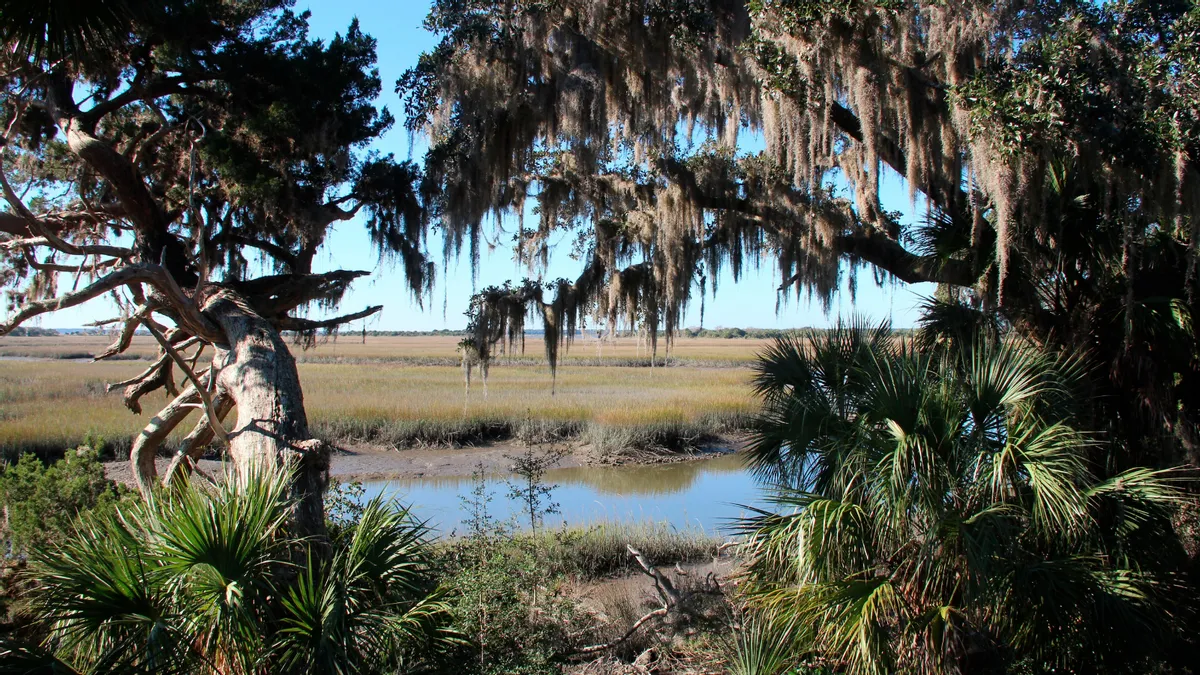
U.S. President Donald Trump’s administration is considering two deals that would give pieces of Georgia’s Cumberland Island National Seashore land to private owners.
The proposed deals were voluntary land exchanges, meaning they would require the new owners to hand over separate, environmentally sensitive parcels to the National Park Service in return for the land in question. As of this writing, the deals were in the public comment stage of the process and were not finalized.
Rumors that U.S. President Donald Trump’s administration was planning to hand over parcels of land from Georgia’s federally protected Cumberland Island National Seashore to private owners who could then build mansions on them circulated online in September 2026.
Users on social media platforms claimed it was essentially a done deal and posted images of Trump next to images of the protected land in question, stating the administration was “selling portions of Cumberland Island National Seashore to build mansions, jeopardizing ancient oak forests and endangered sea turtles.”
Readers flocked to Snopes, searching the site for the truth behind the rumor.
The claims referred to a parcel exchange proposal put forth by the Department of the Interior. The proposal was similar to another that made headlines in August 2026 — a parcel exchange at Yosemite National Park.
As a result, we’ve rated the claim true.
A spokesperson for the Department of the Interior told Snopes via email that “the National Park Service is evaluating two proposed voluntary land exchanges to strengthen the long-term protection and management of Cumberland Island National Seashore” but that “no final decision has been made.”
The department said the deals trade the land in question for “sensitive private parcels in the heart of the island” that would be incorporated into the national seashore and protected from development. Meanwhile, they said, “any NPS-managed land conveyed into private ownership would remain subject to permanent conservation easements prohibiting subdivision, limiting the location and scale of development, and protecting natural and cultural resources.”
The full statement given to Snopes read:
The National Park Service is evaluating two proposed voluntary land exchanges to strengthen the long-term protection and management of Cumberland Island National Seashore. No final decision has been made. If approved, the proposals would bring sensitive private parcels in the heart of the island into the National Park Service system, where they would be protected from commercial development, while any NPS-managed land conveyed into private ownership would remain subject to permanent conservation easements prohibiting subdivision, limiting the location and scale of development, and protecting natural and cultural resources.
Public input is an important part of this review. NPS will evaluate the substance of the comments received, including concerns about environmental effects, development limits, alternatives and proposed safeguards, and may revise the proposals, conduct additional analysis or select the no-action alternative. The number of comments favoring or opposing a proposal does not by itself determine the outcome; the decision must be based on the environmental analysis, substantive public input, applicable law, independent appraisals and the public interest.
Earlier decisions involving Cumberland Island, as well as separate matters involving Yosemite National Park (to which no final decision has been made), do not predetermine this review. Each proposed land exchange must be evaluated independently based on its own facts, legal authority, environmental effects and conservation benefits. Comments on the Cumberland Island proposals will be accepted through Oct. 16.
The Center for Biological Diversity, a nonprofit organization that works “to secure a future for all species, great and small, hovering on the brink of extinction,” posted a response to the Cumberland Island proposal. The news release said, “Conservation groups are condemning the proposed land swap, which would trade park land for privately owned land and allow for the development of eight 15,000-square-foot mansions up to three stories high.”
The news release quoted Will Harlan, the Southeast director at the organization, as saying: “This is an American national park, not a Monopoly board. A bunch of new mansions don’t belong here. … Like Yosemite, Cumberland Island is a national treasure that belongs to every person in this country. These land swaps are an attack on the American people who own this public land.”
The group’s criticism continued:
The land swap proposal on Cumberland Island comes just a week after the National Park Service approved a new visitor use management plan that greenlights new development on the island’s seashore. Structures will be built on the seashore in the critical habitat of nesting sea turtles and endangered shorebirds. The plan also quadruples the number of visitors and allows massive increases in commercial activity and boat traffic, threatening endangered manatees, Atlantic sturgeon and sea turtles. Thousands of comments opposing the plan flooded the National Park Service, but the agency approved the plan anyway.
The Center for Biological Diversity noted there were more than 3,000 comments opposing the proposal, but, as the Department of the Interior noted in its statement above, that doesn’t necessarily reflect a projected result. Instead, “the decision must be based on the environmental analysis, substantive public input, applicable law, independent appraisals and the public interest.”
What the exchange proposes
The 81-page document outlining the proposal, embedded above, included two different exchange options beginning on Page 6.
In the first exchange, the NPS would receive 10 acres of “unimproved maritime forest” in trade for 20 acres of current NPS land that would go into private ownership, allowing for two single-family residences.
In the second exchange, the NPS would receive two noncontiguous parcels totaling 119 acres of “upland forest, salt marsh, and ocean frontage.” In this swap, 60 acres of current NPS land would go to private owners and allow for up to six single-family residences.
In both options, the limitations for the new construction on the formerly public land would still require 80% of the property to “be designated as a conservation area” used for “conservation purposes and non-commercial, non-industrial, and low-impact outdoor recreation in perpetuity” with the remaining 20% “designated as a potential building area and may be used for non-commercial, non-industrial, single-family residential use.”
In either scenario, the maximum allotment for a single-family residence would be 15,000 square feet and 35 feet tall, which appeared to qualify as a “mansion,” according to Realtor.com.
