


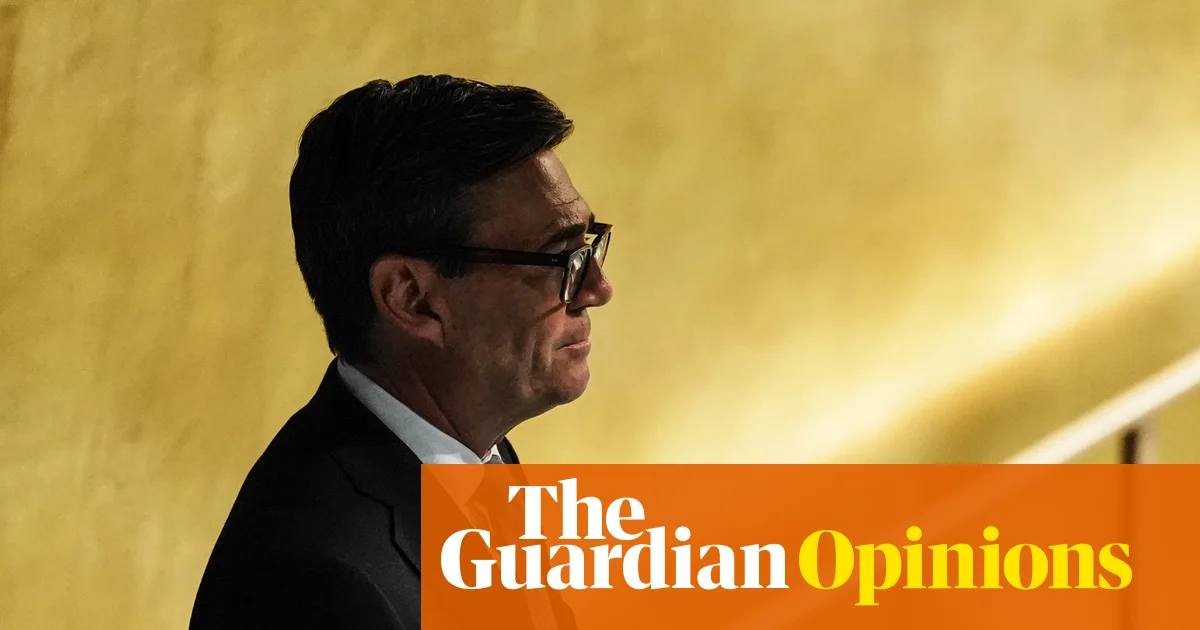
Tony Blair can, apparently, sound slightly wistful when he describes how he once had a cloak-and-dagger meeting with Andy Burnham, who wanted to talk to him about standing for the party leadership. Before anyone gets too excited, however, this wasn’t in the past few months, during which Burnham succeeded in landing the job. The story dates back to 2010. That was when he was a callow member of Gordon Brown’s cabinet and understandably wary of his boss discovering not only his ambition to take over if Labour lost the looming general election, but also from whom he wanted advice.
Much has changed since then, not least Burnham himself. His journey out of Westminster and back again – which in his telling has become an almost spiritual pilgrimage of personal redemption – enabled him to shed the New Labour baggage that proved so cumbersome during his previous, and unsuccessful, runs for the leadership. In common with Brown, Ed Miliband, Jeremy Corbyn and Keir Starmer – all of whom tried with varying degrees of success to distance themselves from Blair – Labour’s latest leader now also wants to keep Blair at arm’s length, and certainly far away from his party conference in Liverpool this week.
Their secret meeting long ago nonetheless underlines how often, since he left Downing Street in 2007, Blair has had a residual and sometimes illicit allure for those aspiring to fill his shoes. Part of that is because – with the exception of Starmer – those who came after him failed to win a single general election, let alone three. But it is also that this leader from the past still has a possibly unmatched ability to raise our sights, away from whatever the media tells us is most urgent, towards the colossal compound crisis now casting its shadow across the world and over Britain’s future.
Blair does not, of course, always make it easy to agree with him. There was an awful lot to dislike about his 5,700 word essay earlier this year, which said Britain had no power to stop either the AI revolution or Donald Trump. It led some to question once more the motives of a former PM whose proximity both to big tech firms and successive US presidents has so tainted his reputation. Burnham swiftly responded to the essay by saying Blair just didn’t get “what’s going on” with the impact of “40 years of neoliberalism” on working-class communities. He later promised that the interests of voters in Makerfield, where he was standing in a byelection, would be his test of what made good policy.
It was, however, a bit disingenuous for him to claim that Blair agreed “our relentless focus now should be on domestic issues, and fixing our own underlying problems, rather than on re-running divisive arguments about rejoining the European Union”. Indeed, the bulk of the former PM’s essay was about the inability of this country’s politics to navigate an international landscape being churned at terrifying speed by forces far beyond Britain’s control.
Conflicts in Ukraine, Russia and the Middle East have since put further pressure on government borrowing costs and household fuel bills. It is increasingly difficult to see how the inward-looking vision Burnham has painted so far, largely consisting of new powers for mayors and more regulation of privatised utilities, will deliver his promised “good growth in every postcode” any time soon. This week, his determinedly domestic focus relented and he acknowledged the government must also offer “resilience” in the face of global storms, before delivering a speech to the United Nations in New York on Tuesday night. The speech veered wildly from No 10 North in Manchester to Ukraine, Israel, Iran and China, briefly taking in the climate crisis, before setting out the need to create international safety standards on frontier AI and protect democracy from all kinds of Russian threats, including disinformation on social media.
It didn’t go nearly far enough for Blair. On Thursday, his policy institute published a paper calling for Britain to set a course for re-entry into a “reformed European Union” over the next decade. Rather than re-run old arguments about Brexit, he would prefer to start a new one, saying the need for the UK and the EU to build capability in defence and capacity on AI is more pressing than it ever was in the past.
Although Blair can point to polls showing a majority of the public and an even bigger slice of Labour voters would support rejoining, there is plenty of evidence to suggest relations with Europe have gone backwards under Burnham’s government. The prospect of Britain drifting alone on the tide of history felt closer to becoming reality last week when the annual state of the union speech from the European Commission president, Ursula von der Leyen, made repeated references to Canada, a country about 3,500 miles away to which she offered an associate EU membership, while barely mentioning the UK at all.
An EU-UK summit, originally scheduled to have taken place under Starmer’s premiership in May, was delayed until July and then to a yet-to-be confirmed date at the end of the year. What had been talked up as a “done deal” for a youth mobility scheme – by which young people from the EU and the UK could live, work and study in each other’s countries – risks being unstitched by new objections from some of Burnham’s newly appointed minsters that it fails his “Makerfield test”. There are similar claims that the EU’s “made in Europe” policy on supply chains will disadvantage British industry and be a further obstacle to an agreement, while progress that began in February to resolve the issue is said to have stalled.
There are a lot of mixed messages on all this just now. Recent comments that it must be possible to get a deal agreed with Europe in “an amicable way that will add percentage points to our growth” perhaps made him sound too much like a regional mayor who had missed the past decade of Brexit mayhem in Westminster. But others believe Burnham is considering a big leap beyond the “red line” election pledges that prevented Starmer from rejoining a customs union, the single market or allowing freedom of movement. Over recent days some of those around him have dangled out questions about how, “purely hypothetically”, a case for re-entry could be included in his speech to conference this Tuesday, the 10-year plan later this year or, as Burnham himself notably failed to rule out this week, Labour’s manifesto at the next election (whenever that might be).
after newsletter promotion
Either way, the freshly minted new PM will not want to be seen taking inspiration from a sometimes toxic old one. There has been no contact between them since Burnham entered Downing Street and a meeting – clandestine or otherwise – is not scheduled. That seems a shame because, on the issue of Europe at least, Blair really isn’t the worst person from whom Burnham could take advice.
