


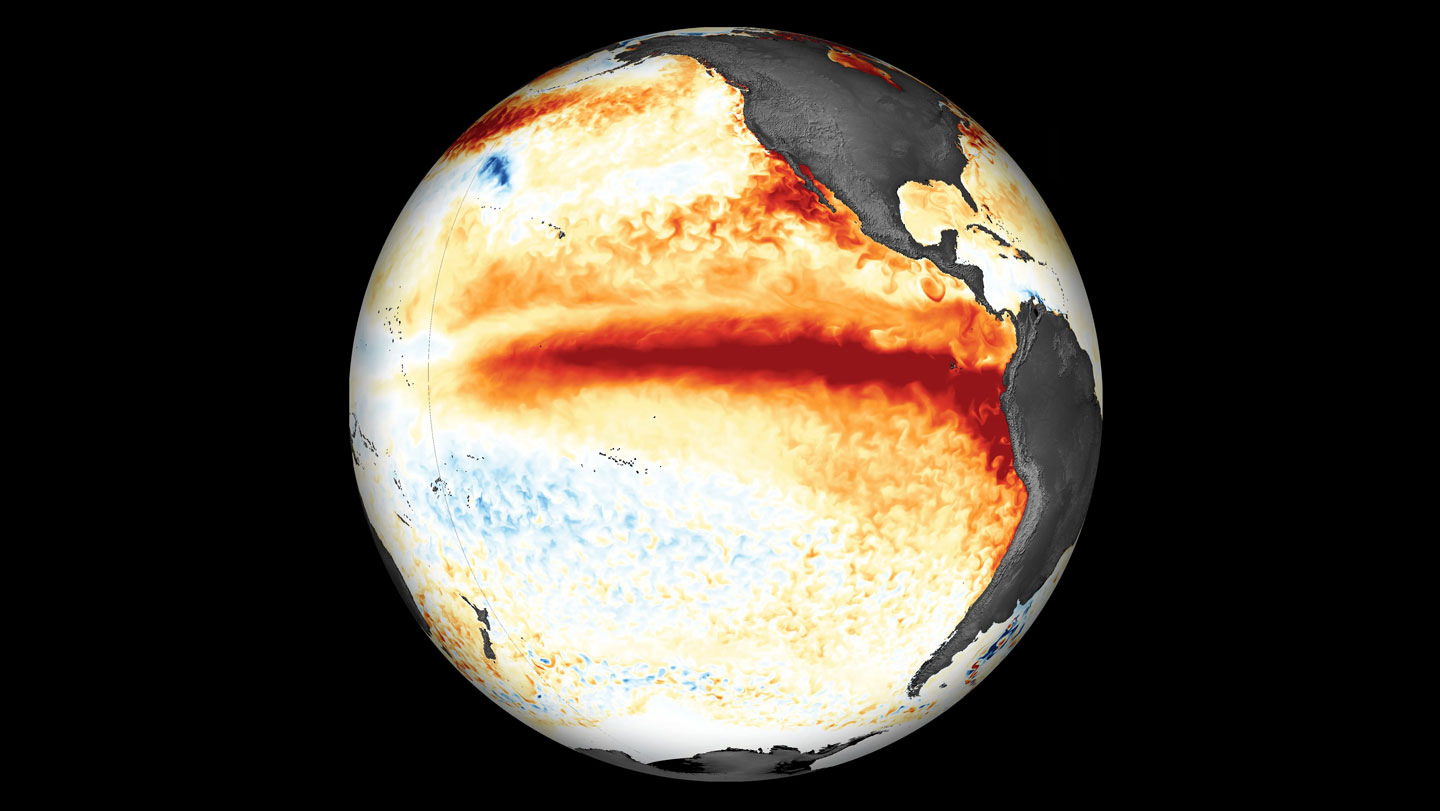
Warnings of an El Niño unlike any other are starting to become reality.
For months, scientists have cautioned that the natural climate pattern could grow into a record-breaking beast, releasing extraordinary amounts of heat from the ocean and fueling droughts, floods, heat waves and severe storms. Now, a traditional strength measurement of El Niño, called the Oceanic Niño Index, indicates that the pattern has reached an intensity unseen in recorded history.
On September 21, the daily sea surface temperature in the region where El Niño develops — the central and eastern equatorial Pacific Ocean — reached 3.08 degrees Celsius warmer than the 1991 to 2020 average. That’s more extreme than any other El Niño ever recorded.
“It has been a remarkable event,” says Nathaniel Johnson, a climate scientist at the National Oceanic and Atmospheric Administration’s Geophysical Fluid Dynamics Laboratory in Princeton, N.J. What’s more, the El Niño will probably grow even stronger, Johnson says. “We’re probably going to reach our peak within the next few months.”
The oceanic heat released by the phenomenon could contribute to an increase in global land temperatures of about 1.2 degrees Celsius over the coming months, leading to over 450,000 additional heat-related deaths by February 2027, researchers from the Climate Impact Lab at the University of Chicago report.
NOAA has yet to declare this event the strongest on record. It uses a rolling three-month-average anomaly, rather than the daily anomaly, in calculations of an El Niño’s strength. And it’s shifted to a new method for measuring El Niño strength, called the Relative Oceanic Niño index, which better represents the phenomenon’s ability to sway weather globally. By that measurement, the current El Niño has yet to surpass the strength of the one in 1997 and 1998.
But that record is on track to be broken soon, the latest seasonal forecast from NOAA’s Climate Prediction Center suggests. To understand what’s driving this historic El Niño and its potential impact, Science News spoke with Johnson, who is part of the team that produces the forecasts, and Nathan Lenssen, a climate scientist at the National Center of Atmospheric Research in Boulder, Colo. The conversation has been edited for length and clarity.
SN: How much of this El Niño’s strength has been fueled by human-caused climate change?
Johnson: It’s really an unanswered question. If we look at the historical record, we have been seeing more rapid swings between El Niño and La Niña [which is the other extreme phase of the El Niño Southern Oscillation that generally has the opposite effect on weather patterns]. There’s some evidence from simulations that increasing greenhouse gas emissions leads to more of those extreme swings. But there’s not yet a scientific consensus on how climate change is impacting El Niño, especially an extreme El Niño like this one.
Lenssen: It’s a matter of debate how much we can directly attribute to climate change. But due to the warming of the planet, there is more energy in the oceans now, and El Niños are when the ocean releases some of that heat into the atmosphere.
SN: What are the most predictable and unpredictable impacts of this El Niño?
Johnson: We see a lot of the most predictable impacts in the tropical regions, as that’s where El Niño itself develops. We’ve already seen this suppressed Atlantic hurricane season and enhanced Pacific hurricane season, and we’ve also seen droughts in Central America. We also tend to see droughts over northern South America and the Amazon, and a weakening of the Indian monsoon.
As we get into late fall, we typically see more impacts a little farther from the equator. For instance, over the southern part of the United States we tend to see rainier conditions, whereas it’s typically drier than normal over the Pacific Northwest and warmer than average over the northern United States and Canada.
Lenssen: An important detail is that just because this El Niño is so powerful, that doesn’t necessarily mean we’re more confident about these impacts. The global warming of the oceans has made some of the historical mid-latitude impacts less likely, so there’s a kind of twist there. For example, the El Niño in 2023 and 2024 didn’t lead to as much wet weather in California as expected, and some research has shown that was due to other warming ocean patterns. That clouds the picture a little.
SN: How long could this El Niño last?
Johnson: El Niños typically last just a year, so we’ll probably see it weaken after winter and be over by spring or early summer. But when we have big El Niño like this, we’re more likely to see a shift in the following year to La Niña [which can also have global impacts on weather]. So that’s definitely something we’ll be keeping our eye on.
Lenssen: It’s possible that this event could be followed by a double La Niña, which is when we get back-to-back events separated by a brief period of neutral conditions. That happened in 2016 and 2017, after the strong El Niño of 2014 and 2015.
SN: Aside from its strength, what sets this event apart from others in the past?
Johnson: We’ve seen such a dramatic change in the equatorial Pacific Ocean over the course of the year. The transition has been very rapid, from a La Niña last winter to a very strong El Niño in less than a year. That might be the fastest transition that we’ve seen.
SN: Is there any sort of silver lining here?
Lenssen: Though more work is needed to understand this, some research suggests that future El Niños may actually become more predictable as the world continues to warm. That could potentially give us months of additional lead time to prepare for the impacts, which would be great.
