


Reading Time: 5 minutes
At first glance, the boat’s crew looks ready to embark on a fishing trip. Their boat is equipped with a hefty rectangular cooler, a couple of white buckets and neon orange life jackets. They chat idly with one another from the boat’s helm, remarking on the September day’s balmy weather and the dogs that bound along the riverbanks across from them.
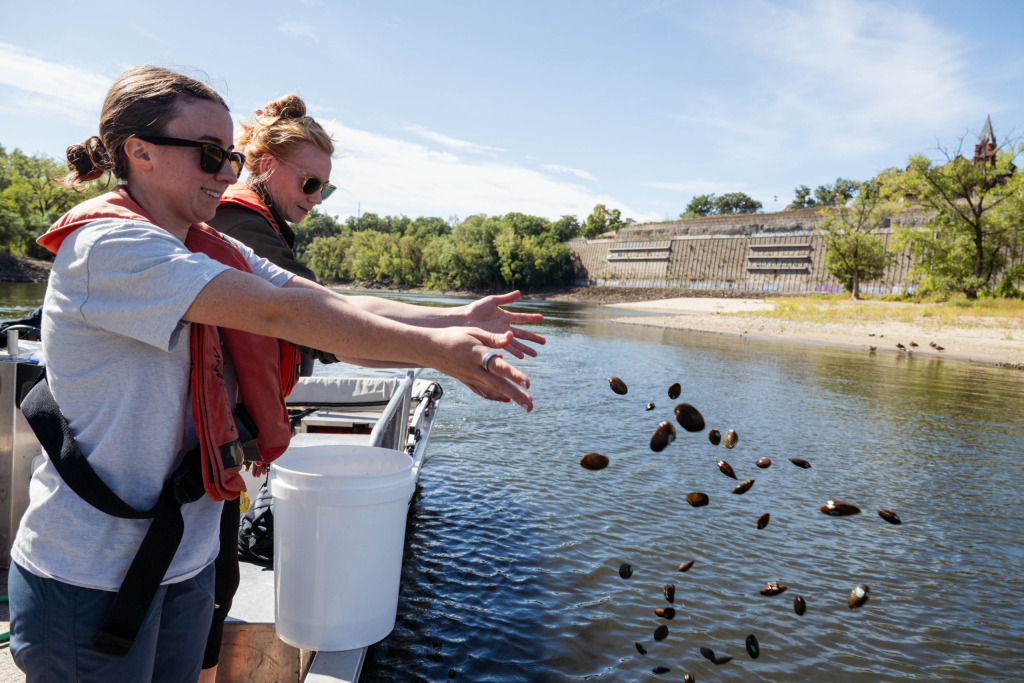
But this is no fishing expedition. Their cooler is filled with about 400 mucket and Higgins eye mussels, each a little over an inch in diameter. Their brown striped shells gleam in the late summer sun. By the end of the afternoon, each of these mussels will be sitting at the bottom of a stretch of the Mississippi River between St. Paul and Minneapolis, Minnesota.
The operation is led by biologists at the Minnesota Department of Natural Resources. Since 2001, the agency has been reintroducing native freshwater mussels into this section of the Mississippi, returning every year to add more mussels and monitor the ones that are already there. In total, they’ve scattered about 45,000 mucket, Higgins eye, snuffbox and winged mapleleaf mussels into a roughly half-mile-long section of river that was previously bereft of the little creatures. Each species they have introduced is either threatened or endangered under state or federal endangered species legislation.
“You spend five years raising these little guys just to throw them out,” said Lindsay Ohlman, a propagation biologist at the DNR. “It’s a little anticlimactic.”
The project is part of a larger effort to repopulate freshwater mussels into several rivers in Minnesota, including in the Cedar and Cannon River watersheds in the southern part of the state. Other upper Mississippi River states are also working toward repopulating mussels.
The mussels that the three biologists brought this day — Higgins eye and muckets — have been growing at the DNR’s laboratory in Lake City, Minnesota. At about 5 years old, their lives have barely begun — the two mussel species can live to 50 years. Mussels show their age in the lines on their shells, much the same as the rings in a tree.

Mussels are ecosystem engineers, modifying their aquatic environments to make them more habitable for themselves and their neighbors. But the shellfish have been in major decline for more than a century across much of the upper Mississippi River. After 25 years of reintroduction efforts, they are finally starting to regain their footing in Minnesota.
The decline started in the late 1800s, when German immigrant John Boepple founded the pearl button-making industry in Muscatine, Iowa, a small city on the Mississippi. He used mussel shells to create shiny, pearlescent buttons for clothing, his Muscatine factory producing 1.5 billion buttons per year at its peak.
This accounted for more than one-third of the world’s button production at the time. Other cities along the river followed suit, but never took Muscatine’s claim to fame as the “Pearl Button Capital of the World.”
“They used to be so abundant, which is why they were being taken out (of the river) at such large amounts,” said Ben Minerich, a freshwater mussel conservation specialist at the University of Minnesota and Minnesota Zoo. “(People) just thought it’s an endless resource.”
At least one historian described Minnesota as once so mussel-abundant that the bottoms of lakes and rivers resembled cobblestone streets. “We don’t know anybody alive that has really seen that,” Minerich said.
Freshwater mussels are now the most imperiled group of animals in North America, according to the U.S. Geological Survey. Modern-day threats to the group include the invasive zebra mussel, which outcompetes native mussels for food. Zebra mussels have been found up and down the Mississippi River, from Minnesota to Louisiana. The Minnesota Zoo is currently researching genetic levers that could limit the zebra mussels’ spread, such as reproduction.
The building of locks and dams has also made it difficult for freshwater mussels to repopulate the region. When mussels reproduce, they create and release hundreds of microscopic larval mussels into the water. From there, these tiny mussels attach to the gills of fish, using them as a safe haven for their first few weeks or months of life. Once they’re big enough to survive on their own, the mussels detach from the fish and find a home on the river’s bottom.
But on the upper Mississippi, 29 locks and dams have fragmented fish habitat. That means both fish and the stowaway mussels can’t get past this infrastructure. Entire sections of the river now lack both native fish and freshwater mussel populations.
A gradual comeback
Freshwater mussels are a vital part of a healthy river ecosystem. When mussels group together on river bottoms, they form a mussel bed that can prevent erosion — useful during flood events — and provide habitat for other aquatic animals. They also filter water and can remove bacteria, algae and metals from the environment.
“They’re a pretty complex animal, even though they don’t have a face,” said Ohlman, the propagation biologist. “They provide a lot of function to the ecosystem.”
The combination of overharvesting, locks and dams, and the influx of zebra mussels have virtually wiped out this beneficial organism across the upper Mississippi. Of the 51 species native to Minnesota, over half of them are currently listed as endangered, threatened or species of special concern. Five of them are presumed extinct.
“There was a study in 1926 that found two living fish in the Mississippi River between St. Anthony Falls and Hastings,” said Trevor Russell, water program director for the nonprofit Friends of the Mississippi River, referring to the stretch from the Twin Cities to the Wisconsin border that is bookended by two locks and dams. The 1920s was the height of industrial pollution in the Twin Cities, especially from nearby stockyards and meat processing plants that put their waste directly into the river.
The installation of wastewater treatment plants and stricter regulations through the Clean Water Act helped mitigate some of this pollution, but still, recovering from all these impacts has been an uphill battle for the river. In the Twin Cities portion of the Mississippi, there were still no mussels at all prior to the start of the DNR’s reintroduction efforts in 2001.
But that’s changed over the last 25 years.

Back on the boat, Jacob Keay, another DNR specialist, steers the craft downriver from where they launched. Ohlman and another colleague dip their hands into the cooler and take out yellow and orange mesh bags that hold the Higgins eye and mucket mussels. They gently scoop handfuls from the bags and scatter the young mussels overboard, each one hitting the river’s surface with a tiny splash before drifting to the bottom.
The trip is bittersweet for the three biologists. This is the last time they’ll bring mussels to this section of the river, at least for the time being. That’s because they have seen evidence that the mussels are successfully repopulating the Twin Cities section of the Mississippi. They monitor this progress by recapturing the mussels, which have tags epoxied to their shells, and measuring how much they’ve grown.
The state has not surveyed the Mississippi River to determine their exact survival rates, but they have done so at other mussel reintroduction sites in the Cedar and Cannon River watersheds and found 40% to 80% of the reintroduced mussels survive each year. The agency predicts similar rates in the Mississippi.

After 25 years of reintroduction efforts, the mussels are in good health, and there’s even evidence that they’re reproducing: Sometimes the scientists find smaller mussels without a tag, which very likely means they’re the babies of introduced mussels.
“We kind of feel like we’ve got enough out there, they’re taking a foothold,” Ohlman said. “We’re gonna let nature take its course for a while.”
Claire Carlson is a Report for America corps member, covering drinking water for MinnPost and the Mississippi River Basin Ag & Water Desk. Report for America places talented journalists in local newsrooms to report on under-covered issues and regions.
Wisconsin Watch is a member of the Ag & Water Desk network. Sign up for our newsletters to get our news straight to your inbox.
Mussels regaining a foothold in the upper Mississippi River after decades of decline is a post from Wisconsin Watch, a non-profit investigative news site covering Wisconsin since 2009. Please consider making a contribution to support our journalism.
