


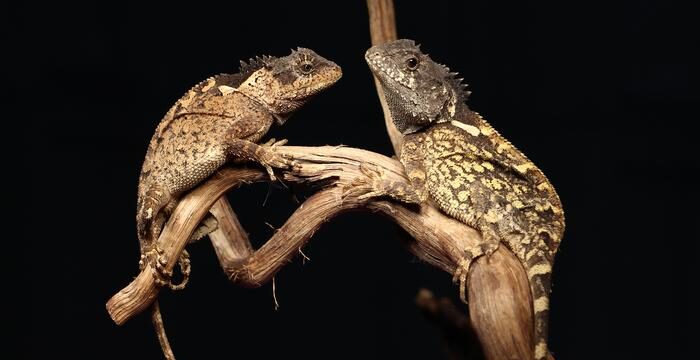
Researchers have described a new-to-science species of horned lizard from the high-elevation, evergreen forests of western Thailand.
The lizard, named the Syrax mountain horned dragon, or Acanthosaura syrax, in a recent study, was discovered in Mae Wong National Park. The species name syrax refers to the yellow dragon ridden by Queen Rhaenyra Targaryen in the fantasy series House of the Dragon. The researchers write they chose the name due to the lizard’s distinctive yellow-hued coloration and its diminutive size.
They add they found the lizard only in the upper mountain range of the park, at elevations above 1,300 meters (about 4,300 feet).
Study co-author Krittiya Trivalairat, a lecturer at the Department of Microbiology at Mahidol University in Bangkok, told Mongabay by email that the discovery highlights the remarkable biodiversity and ecological richness of Thailand’s forests. “To me, this discovery is not simply about adding another species to the scientific record; it also demonstrates how much biodiversity may still be hidden within these ecosystems,” Trivalairat said.
Mountain horned dragons are a group of lizards that live in trees and have a spiny crest running down their necks and backs.
To describe the Syrax mountain horned dragon, the researchers surveyed the park’s rugged highlands. They were able to capture specimens by hand since the lizards move slowly. They then took photographs of the live lizards to document their coloration patterns, before euthanizing them. The specimens were subsequently stored for taxonomic review at Thailand’s Natural History Museum.
The researchers write that the lizard is remarkably small, with females measuring just 10 centimeters (4 inches) long, and males less than 7 cm (2.7 in). Despite their small body size, females lay large clutches of eggs.
“One aspect that particularly stood out to me was the relatively high number of eggs produced by the species,” Trivalairat said. “We recorded 6-16 eggs per clutch, which is quite a substantial number considering the animal’s relatively small body size. This reproductive output was particularly interesting and somewhat surprising to us.”
The new mountain dragon stands out because it has the smallest crest scales on its neck and back compared to other dragons in the genus, the researchers write.
They add the mountain habitat that the lizard appears to be restricted to is increasingly vulnerable. While there are multiple populations of the lizard in parts of Mae Wong National Park, those populations “are naturally fragmented by the rugged topography of the mountain range,” the researchers write.
This isolation limits gene exchange and risks inbreeding among these high-altitude species, which can’t migrate to lower, warmer elevations, they add.
Trivalairat said she hopes the discovery of the newly described mountain horned dragon serves as a wake-up call. “We hope that this discovery can help communicate the importance of protecting Thailand’s remaining forests,” she said.
Banner image: Adult female paratypes of Acanthosaura syrax. Image by Trivalairat et al., 2026 (CC BY 4.0).
