


“WE DON’T NEED CANADA, THEY NEED US!” Donald Trump wrote on TruthSocial in late August, after he announced a fresh round of tariffs on exports from the United States’ northern neighbor. Seen from the lower latitudes, this was just another of the president’s tirades, straining both the caps-lock key and credulity, but in fact, the United States depends a great deal on Canada, to the tune of 4 million barrels of crude oil a day, plus electricity, aluminum, auto parts, and much else besides.
Viewed from the vicinity of the North Pole, the gap between Trump’s rants and reality is wider still: In the northern reaches of the continent they share, the United States needs Canada—desperately. As the melting ice caps uncover a new zone of economic competition in the Arctic, U.S. hopes of success depend on close cooperation with the country that the president is busy antagonizing.
“WE DON’T NEED CANADA, THEY NEED US!” Donald Trump wrote on TruthSocial in late August, after he announced a fresh round of tariffs on exports from the United States’ northern neighbor. Seen from the lower latitudes, this was just another of the president’s tirades, straining both the caps-lock key and credulity, but in fact, the United States depends a great deal on Canada, to the tune of 4 million barrels of crude oil a day, plus electricity, aluminum, auto parts, and much else besides.
Viewed from the vicinity of the North Pole, the gap between Trump’s rants and reality is wider still: In the northern reaches of the continent they share, the United States needs Canada—desperately. As the melting ice caps uncover a new zone of economic competition in the Arctic, U.S. hopes of success depend on close cooperation with the country that the president is busy antagonizing.
Sea Change: America’s New Great Game in the Arctic Circle, Rana Foroohar, Crown, 272 pp., $33, October 2026
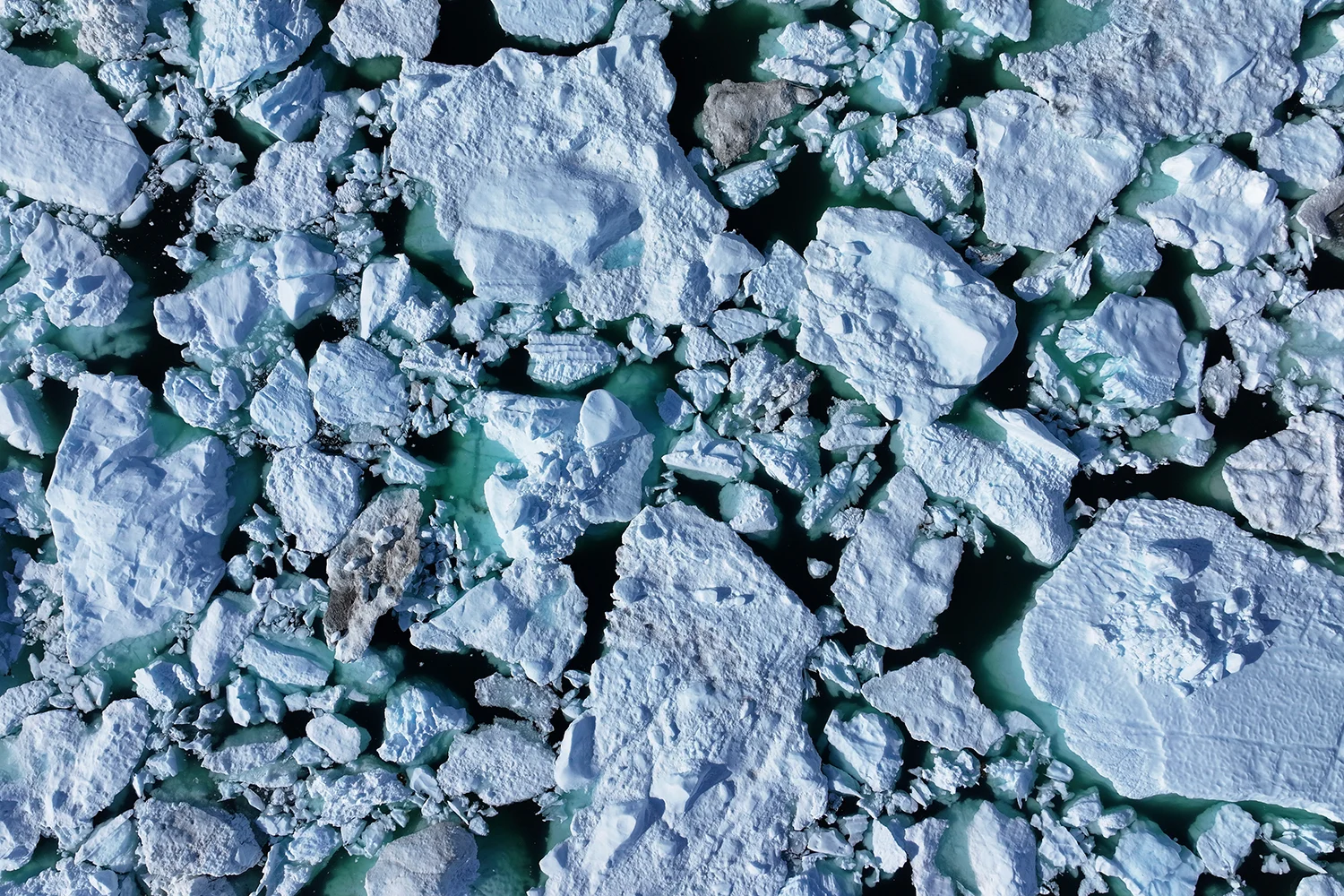
Rana Foroohar’s new book, Sea Change: America’s New Great Game in the Arctic Circle, explains why this is an extraordinary act of self-harm. The Arctic is warming four times faster than the rest of the planet, and the receding ice is opening access to shipping lanes, fish stocks, energy, minerals, and a sea floor that can house communications cables. The economic opportunity unlocked will run into at least hundreds of billions of dollars; the late Scott Minerd, chief investment officer of Guggenheim Partners, saw potential for $1 trillion in investments in infrastructure alone.
Trump is aware of the economic opportunity, but his response, ranging from musings about annexing Greenland to ordering the construction of 11 icebreakers in no-bid contracts after a golf game, has been as wrong-minded as it is heavy-handed. Those icebreakers, for example, are to be made by a Finnish shipbuilder owned by a British company with—drum roll, please—Canadian roots.
Who needs whom, again?

A truck crosses into the United States from Canada on the Gordie Howe International Bridge, connecting Windsor, Ontario, and Detroit, on Sept. 6. Jeff Kowalsky/AFP via Getty Images
Foroohar, a former correspondent for Time and Newsweek and currently a columnist for the Financial Times, has written an important book about an important place just as the president is giving it the wrong kind of attention. Sea Change provides a much-needed update to post-Cold War scholarship on the Arctic, which has long rested on the twin pillars of Oran Young’s 1993 Arctic Politics and Michael Byers’s 2013 International Law and the Arctic.
Those books were written during a period of so-called “Arctic exceptionalism,” when disputes were mediated and adversaries generally cooperated in science and shipping. Foroohar’s subtitle announces its end: An expansionist Russia, an ambitious China, and a flailing United States have brought great-power competition to the top of the world.
Now back to icebreakers. Foroohar’s story begins in the fall of 2024 when she boards the USCGC Healy at Nome, Alaska, for a voyage into the Arctic Circle. The scientists on the ship test the waters for temperature, salinity, oxygen, and plankton. The crew charts possible shipping passages and monitors foreign ships. The Healy protects commerce and stands ready to rescue sailors in waters cold enough to kill a human being in a matter of minutes. Its missions overlap: Better maps make shipping safer, scientific data informs economic ventures and military operations. In the Arctic, power stems from knowing the water and being able to move through it.
As Foroohar notes, icebreakers are the cornerstone of economic, scientific, research, and military activity in the Arctic, and any country staking a claim to the gold in them thar waters must have a fleet of such ships. Russia has more than 40 icebreakers, many of them nuclear powered, operating in the northern seas; China, which calls itself a “near Arctic state” despite having no territory that far north, has at least five. The Canadian Coast Guard has nine icebreakers. The U.S. Coast Guard has three: The Polar Star, now 50 years old, spends much of each year breaking a channel to McMurdo Station in the Antarctic. Storis is a secondhand oil-industry vessel bought off the commercial market and modified for the job. Which leaves the Healy as the only purpose-built, Arctic-ready U.S. icebreaker in regular service.

The Russian 50 Years of Victory nuclear-powered icebreaker is seen at the North Pole on Aug. 18, 2021. Ekaterina Anisimova/AFP via Getty Images
And sometimes, not even that. The Healy suffered serious fires in 2020 and 2024, and mechanical failure in July. This meant that when she was being repaired, there were long spells during which the United States had no icebreaker in the Arctic. It will be years before the 11 new ships on order are ready for service. In the meantime, the United States will need the help of allies that have icebreakers—no prizes for guessing which one in particular.
Sea Change leaves the ice to examine how the United States reached this sorry state of affairs. Here, Foroohar offers an updated reading of Alfred Thayer Mahan’s seminal 1890 masterwork, The Influence of Sea Power Upon History: 1660-1783, for the new age of industrial policy. For Mahan, national power rested on commerce, ports, ships, productive capacity, and the people able to sustain them. The United States remains the world’s preeminent naval power, but successive administrations have allowed much of that foundation to disappear. At the end of World War II, U.S. shipyards produced more than half the world’s commercial tonnage. Today, the country builds fewer than five commercial ships a year, while naval construction suffers delays, cost overruns, and labor shortages.
This is perilous, not only for U.S. ambitions in the Arctic. As Foroohar puts it, “national security lives downstream from industrial capacity.”
Foroohar’s previous books examined the effects of financialization, monopoly, and offshoring on the U.S. economy. She sees the ruin of shipbuilding as a result of policies that treated the lowest immediate price as the highest economic good. Ships could be built more cheaply abroad, so the work went abroad. Companies shed inventory and redundant suppliers because Wall Street regarded both as waste. The savings to businesses and investors were real, but so too were the costs, borne by workers, communities, and, eventually, the country at large.
On this, Foroohar is persuasive. Shipbuilding is an especially unforgiving demonstration of the limits of market logic. A balance sheet can trace the savings made and profits accrued from buying a cheaper, foreign-built ship, but it can’t register the loss of knowing how to build one. A country could conceivably jerry-rig a shipyard in a time of crisis and provide crash-course training for thousands of workers, but it is impossible to quickly create a supply chain where one has ceased to exist. The Biden administration recognized the problem and began using industrial policy to rebuild strategic industries. Among other things, it signed a pact, known as the Icebreaker Collaboration Effort, with Canada and Finland.
The Trump administration, likewise, claims to be seeking self-reliance in critical sectors. But, as its attempts to boost the U.S. icebreaker count shows, the United States can’t go it alone. Yes, three of Trump’s proposed ships will be built by Gulf Copper in Galveston, Texas. But the expertise will be Finnish, and the ownership and British. The president seems to think that U.S. power will come from coercing weaker countries into doing his bidding. Foroohar shows the limits of this approach.
Sea Change is less convincing when Foroohar tries to fit nearly every U.S. economic problem onto the deck of the Healy. Shipbuilding leads her into financial regulation, antitrust, vocational education, national service, defense procurement, and the civic virtues of military life. Together they sometimes make the book feel as crowded as her cabin on an icebreaker.

U.S. President Donald Trump arrives to participate in a ribbon-cutting ceremony for the new helipad on the South Lawn of the White House in Washington on Sept. 21.Jim Watson/AFP via Getty Images
She also spends more time explaining the failures of the old economic order than on the dangers of the one replacing it. Tariffs can preserve an industry, but they can also preserve its inefficiencies. Government support can build capacity or become a permanent subsidy to politically connected companies. If the United States is going to pay more to make essential things at home, it needs better ways to decide which things are truly essential and how much extra it should pay.
But the book’s shortcomings are few, and matter less than the subject to which it draws attention. With Sea Change, Foroohar is encouraging Washington to put the Arctic in the middle of the map.
