


Welcome back to World Brief, where we’re looking at the winner of this year’s Nobel Peace Prize, big gains for French student protesters, and Ethiopia’s war allegations against Eritrea.
‘Peace Requires Justice’
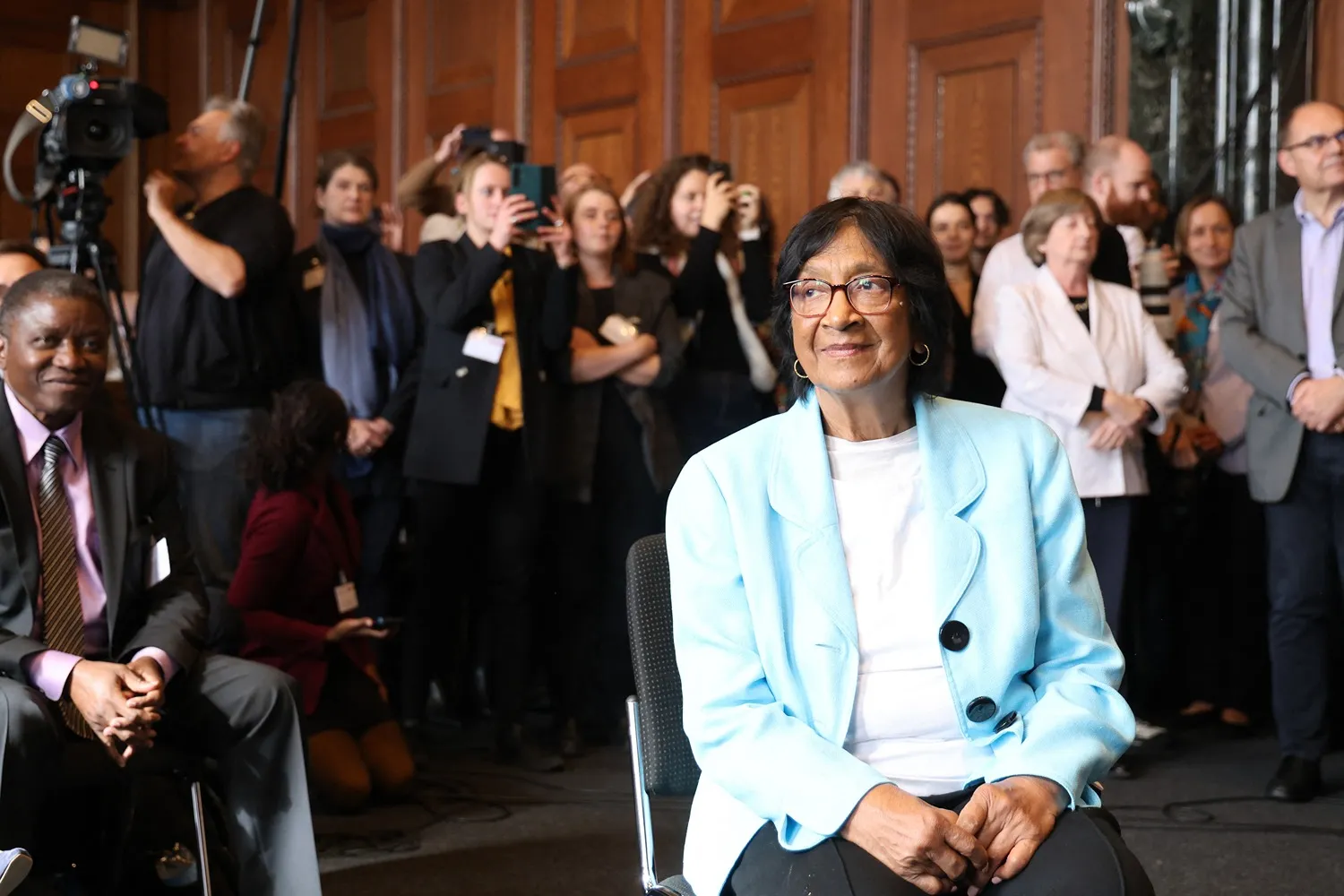
The 2026 Nobel Peace Prize was awarded on Friday to Navi Pillay, a South African-born jurist who has been involved in some of the biggest human rights cases of the modern day during her decades-long career. Yet granting the world’s greatest peace-building accolade to Pillay has drawn heavy criticism from Israel and the United States, which denounced her role on a United Nations panel that concluded that Israel committed genocide in Gaza.
Welcome back to World Brief, where we’re looking at the winner of this year’s Nobel Peace Prize, big gains for French student protesters, and Ethiopia’s war allegations against Eritrea.
‘Peace Requires Justice’
The 2026 Nobel Peace Prize was awarded on Friday to Navi Pillay, a South African-born jurist who has been involved in some of the biggest human rights cases of the modern day during her decades-long career. Yet granting the world’s greatest peace-building accolade to Pillay has drawn heavy criticism from Israel and the United States, which denounced her role on a United Nations panel that concluded that Israel committed genocide in Gaza.
Pillay, 85, began her career as a lawyer focused on segregation and exclusion; among her biggest cases, she helped defend then-imprisoned anti-apartheid activist Nelson Mandela. She went on to serve as a judge on South Africa’s High Court, the International Criminal Tribunal for Rwanda, and the International Criminal Court and held the role of U.N. high commissioner for human rights. Today, she sits as a judge on the International Court of Justice in a case accusing Myanmar of genocide.
Her most controversial work, though, is among her most recent. Last year, Pillay led a team of independent experts to determine whether Israel had committed genocide in Gaza. The team’s conclusion: “It is clear that there is an intent to destroy the Palestinians in Gaza through acts that meet the criteria set forth in the Genocide Convention.” The commission also found that “responsibility for the atrocity crimes lies with Israeli authorities at the highest echelons.”
Israel refused to cooperate with the investigation and denounced its results. The United States followed suit, with Washington pulling out of the U.N. Human Rights Council in response; Pillay’s team was commissioned by the council.
Since then, both Israel and the United States have sought to dismantle the International Criminal Court. On Friday, the United States added new sanctions on the ICC for what the Trump administration says is its bias against the United States and Israel, neither of which are members of the court.
“Today the Nobel Committee shamed itself beyond repair and demeaned the once great Nobel Peace Prize by giving it to the UN’s Navi Pillay,” U.S. President Donald Trump wrote on Truth Social on Friday, pointing to what he described as her “phony” investigation into Israel and arguing that no one deserved the prize more than himself. “She has no credibility in any normal sphere and has never done a thing to foster peace,” Trump added.
The Norwegian Nobel Committee argued that recognition of Pillay’s work is a way “to remind the world that the rule of law—national and international—underpins the system we have set up to ensure peace and resolve conflicts non-violently,” adding that her “independence, expertise and steadfastness have made her one of the most respected international jurists of our time.”
“Peace requires justice,” the committee said.
Pillay, who learned of her award while attending a forum in the German city of Nuremberg, where the Nazi criminal trials were held and where the foundations of genocide law were formed, had a more direct response to attacks on her credibility. Efforts to weaken international criminal justice “endanger the progress painstakingly made since Nuremberg, and they risk returning us to a world in which power, rather than law, determines whose suffering matters,” Pillay said.
Today’s Most Read
What We’re Following
First victory. Student-led protests across France secured their first big win late Thursday, when Education Minister Édouard Geffray pledged to send around 3,000 qualified teachers to schools suffering staffing shortages. The emergency measure, which tackles one of the protests’ biggest concerns, takes effect immediately and will cost “several dozen million euros,” Geffray said, adding that Paris will also make more money available for teachers who work overtime.
Yet student unions stressed on Friday that their campaign is far from over. With 141 schools still shuttered across the country due to the protests, student and teacher unions vowed to hold another nationwide strike on Tuesday to demand other education reforms, including measures to improve overcrowding in classrooms and fix dilapidated infrastructure. Three weeks of protest have already seen more than 6,800 people, most of them minors, arrested and hundreds of police officers injured.
The unrest has spread to Belgium, where students joined striking labor unions on Friday to condemn high costs of living and budget-tightening measures. Student attendees cited problems with Belgium’s French-language education system, including rising prices and difficulties accessing study materials. Tens of thousands of people gathered in Brussels, some of whom faced riot police who deployed tear gas, water cannons, and batons.
Red Sea access. Ethiopia accused Eritrean forces of launching an “all-out invasion” in a letter to members of the United Nations Security Council on Thursday. “The all-out invasion of parts of northern Ethiopia by Eritrea is a matter of public record,” the letter said, citing a recent reported Eritrean incursion into Ethiopian territory. “It is a blatant act of aggression that engages Ethiopia’s inherent right to self-defence.”
The two East African countries have long been rivals, but they made peace in 2018. However, Eritrea fears that landlocked Ethiopia will invade to gain access to the Red Sea, which it lost when Eritrea became independent in 1993. Those concerns have damaged relations between Ethiopian Prime Minister Abiy Ahmed and Eritrean President Isaias Afwerki, and in recent weeks, they have spurred allegations that Eritrea is aiding Ethiopia’s paramilitary Tigray People’s Liberation Front (TPLF), though Asmara denies involvement. A precarious truce between Addis Ababa and the TPLF collapsed last month.
Eritrea, for its part, argues that Ethiopia is the aggressor. “[T]he Ethiopian regime has been pursuing, in effect, an unprovoked war of aggression against Eritrea for more than three years,” Eritrean Information Minister Yemane Gebremeskel wrote on X on Friday, citing Abiy’s 2023 statement that access to the Red Sea is “an existential matter” for Ethiopia. Gebremeskel accused Abiy of using the return to civil war with the TPLF as rationale for plans to seize the Eritrean port of Assab. Drone strikes believed to be launched by Ethiopian forces targeted Eritrean troops on Wednesday and Thursday.
Cockroach protests. Indian authorities deployed thousands of police and security personnel to New Delhi on Friday ahead of planned anti-government protests in the capital this weekend. To restrict attendance, 57 metro stations closed Friday evening, and several long-distance trains to the capital were canceled. Police also warned demonstrators that the youth-led movement known as the Cockroach Janta Party (CJP) could face legal action, as it does not have permission to hold Saturday’s protest.
The CJP, satirically named after Prime Minister Narendra Modi’s Bharatiya Janata Party (BJP), arose after the chief justice of India’s Supreme Court called the country’s unemployed youth “cockroaches” and “parasites of society.” Since then, the movement has gained momentum, challenging the country’s poor economic prospects, medical education policies, and now an election commission scandal.
Opposition parties recently accused the BJP-led government of removing more than 130 million names from voter lists ahead of crucial state elections that begin early next year. Protesters maintain that the deletions disproportionately affected minority communities, including Muslims, and they have called for the resignation of chief election commissioner Gyanesh Kumar. The BJP denies any voter manipulation, arguing that the verification process removed 63 million people who had relocated, 30 million people who could not be traced, and 28 million people who are dead.
What in the World?
Thousands of Brazilian students marched in downtown Rio de Janeiro on Wednesday to protest what?
A. Renewed Amazon deforestation for critical mineral mining
B. The possibility of a Flávio Bolsonaro presidency
C. The rising cost of living amid wars in Iran and Ukraine
D. The increasing use of artificial intelligence chatbots in schools
Odds and Ends
This week, Polish President Karol Nawrocki became the country’s first head of state to visit the Philippines since diplomatic relations were established in 1973. Between wreath-laying ceremonies and high-level trade talks, Nawrocki also took time to show off his more literal sparring skills. The longtime sports enthusiast practiced his jabs and hooks with Manny “PacMan” Pacquiao, a newly appointed Philippine cabinet secretary who is considered one of the world’s greatest professional boxers of all time, during a special training session in Manila on Thursday.
And the Answer Is…
B. The possibility of a Flávio Bolsonaro presidency
After a first-round presidential election on Oct. 4, Bolsonaro—the son of former right-wing President Jair Bolsonaro—and incumbent President Luiz Inácio Lula da Silva are headed for an Oct. 25 runoff election, FP’s Catherine Osborn reports in Latin America Brief.
To take the rest of FP’s weekly international news quiz, click here, or sign up to be alerted when a new one is published.
