


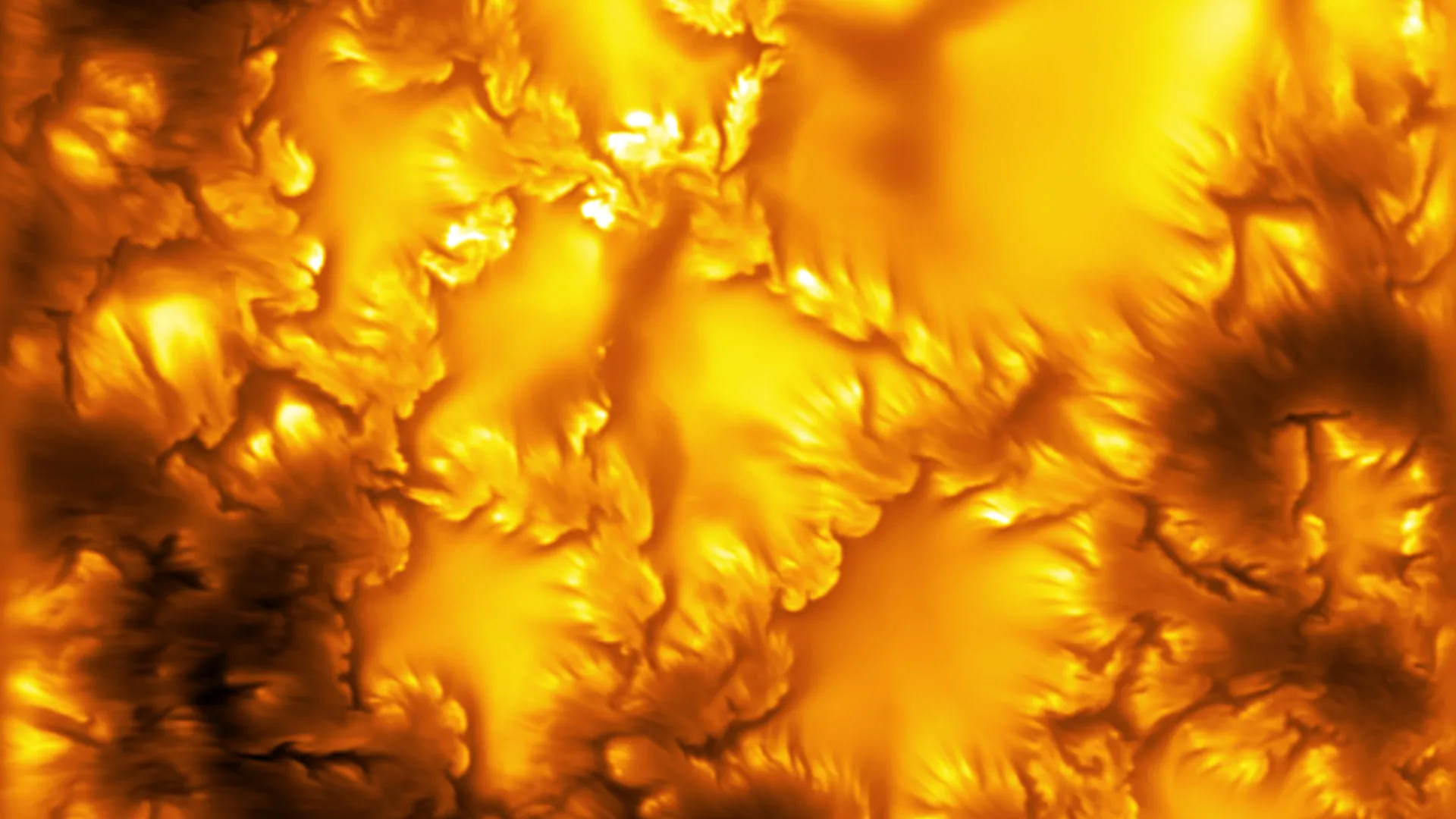
Scientists have captured previously unseen plasma vortices swirling across the surface of the Sun, revealing tiny structures that could help explain how our star stores, moves, and releases magnetic energy.
The discovery comes from researchers at the U.S. National Science Foundation National Solar Observatory (NSF NSO), the Max Planck Institute for Solar System Research (MPS) in Germany, and the High Altitude Observatory (HAO) in the USA. The team combined observations from the NSF Daniel K. Inouye Solar Telescope, the world’s largest solar telescope, with advanced computer simulations. Built and operated by the NSO in Hawaii, the telescope provided images detailed enough to expose plasma motions that had never previously been visible.
“To detect the vortices, we needed to resolve structures on the solar surface about 20 kilometers in size. That is at the limit of what even the world’s largest solar telescope and state-of-the-art simulations can achieve,” said MPS scientist and co-author of the new publication Michiel van Noort, who contributed to the observations as well as the data reduction and image restoration. The researchers used a broadband imaging camera provided by the Max-Planck-Institute for Solar System Research (MPS).
Tiny Whirlpools Along Solar Granules
The newly detected vortices appear along the boundaries of structures known as granules, which densely cover the Sun’s visible surface. Individual granules are typically between 500 and 2,000 kilometers across.
Together, they create the Sun’s granulation, a constantly changing pattern that resembles bubbles in a boiling liquid. The comparison is fitting because granulation is produced by moving plasma. Hot plasma rises from deeper inside the Sun, cools near the surface, and then sinks back down.
For the first time, scientists were able to resolve extremely fine, fringe-like structures along the edges of these granules. The structures repeatedly develop swirling motions that resemble ocean waves as they begin to break.
Some of these “fringes” measure only slightly more than 20 kilometers across. Observing something that small on the Sun is roughly equivalent to identifying a one euro coin from 180 kilometers away.
Instabilities in the Solar Plasma
The researchers believe these swirling flows are evidence of Kelvin-Helmholtz instabilities, a familiar phenomenon in fluid dynamics.
Kelvin-Helmholtz instabilities develop when two fluids move alongside one another at different speeds. The difference in velocity produces shear forces where the two flows meet. Small disturbances at that boundary can then grow into waves or swirling vortices.
The same basic process appears in many environments and across vastly different scales — for example, on the surfaces of lakes or in ocean waves, in cloud formation, in the atmospheres of the giant gas planets Jupiter and Saturn, and in the interaction of the solar wind with planetary magnetospheres.
At the boundaries of solar granules, neighboring layers of plasma also appear to travel at different speeds. Those conditions could provide exactly what is needed for Kelvin-Helmholtz instabilities to form.
Tiny Vortices Could Twist Magnetic Fields
The newly observed plasma vortices may offer an important clue to how the Sun stores and releases energy within its magnetic field, including through tiny bursts of radiation called nanoflares.
Current theories suggest that magnetic energy builds up as the Sun’s magnetic field lines become twisted and coiled — similar to the mechanical energy stored in a tightly coiled metal spring. As the twisting increases, the magnetic configuration becomes both highly energetic and unstable.
Eventually, that stored energy can be released through a process known as “magnetic reconnection.” During reconnection, twisted magnetic field lines snap open and reconnect in a different arrangement.
One major unanswered question has been what causes those magnetic field lines to become twisted in the first place.
The newly discovered vortices could supply part of the answer. Because the researchers find that these small whirlpools appear continuously wherever the magnetic field is sufficiently strong, the vortices could provide a persistent mechanism for twisting the Sun’s magnetic field lines.
A Possible Clue to the Sun’s Magnetic Cycle
The analysis also indicates that the mini-vortices are highly effective at mixing magnetized and non-magnetized plasma at the solar surface. That mixing could help magnetic fields move quickly from the surface upward into the Sun’s atmosphere.
Changes in the Sun’s magnetic field drive its roughly eleven-year activity cycle — which is exceptionally rapid on a cosmic scale. For the Sun’s magnetic “framework” to change this quickly, magnetic flux must be transported efficiently away through the solar atmosphere.
Current models have difficulty explaining how this diffusion can happen so rapidly. The newly identified vortices could provide an important piece of that puzzle as well.
“The newly discovered plasma vortices impressively demonstrate how minute processes — at the limit of what we can resolve using all available techniques — significantly determine the nature of our star,” said Sami K. Solanki, director of the MPS and co-author of the new publication.
