


Two events take place in coming days that will affect my relationship with Germany. One, which will be splashed across the media, is dark and forbidding. The other, which will pass unnoticed except by me and my close family, should have brought me joy. Now that feeling is tempered with confusion.
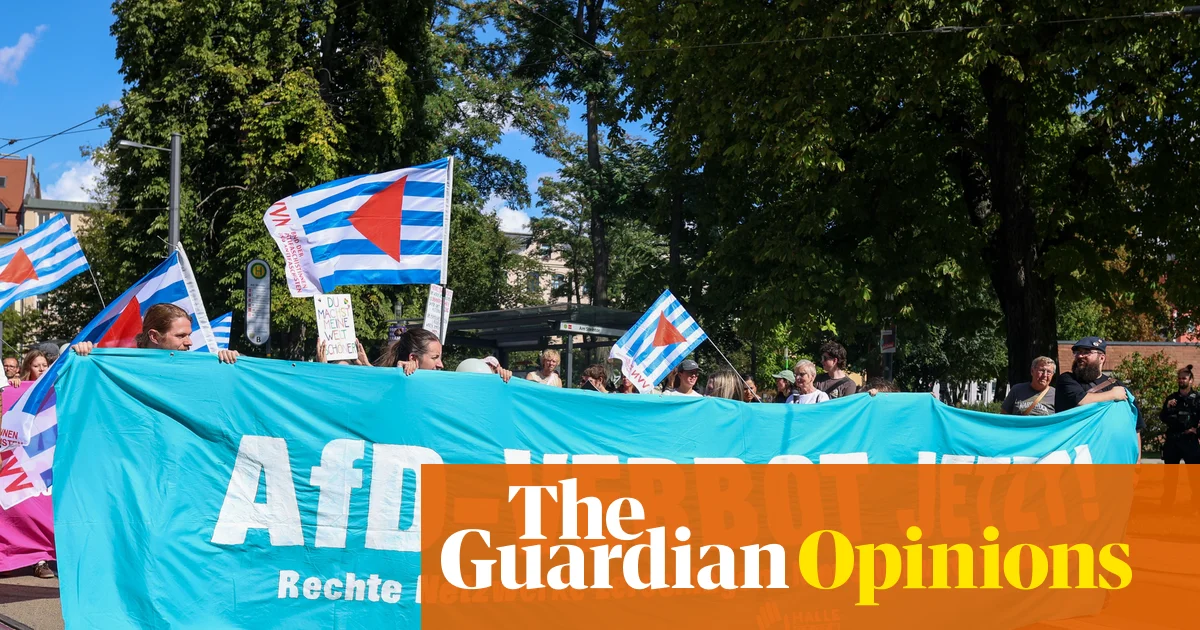
On 6 September, voters in the small eastern state of Saxony-Anhalt are expected to give Alternative für Deutschland (AfD) a resounding victory. If the arithmetic falls in a certain way, a German far-right party could assume power for the first time since the Nazis.
It is possible the AfD could just fall short. That would depend on whether enough centrist parties make it over the 5% hurdle to enter the legislature. If that happens, the mainstream assortment of centre right to centre left might cobble together an unwieldy coalition.
Two days after the election, I will celebrate my fifth anniversary as a German citizen. I remember the pride I felt that day in 2021. To most Britons shopping desperately around for a passport to a European Union country, it was about regaining free movement. For me it was that too, but then, as it is now, it was also emotional.
Having a Jewish, German-speaking father, I had always felt a sense of unfinished business. As a young newspaper correspondent in 1988-1990 in then East Berlin, I had reported with admiration on the peaceful revolution that led to the fall of the Wall and reunification. In the ensuing years, I was drawn to a Germany that earnestly took its responsibilities towards liberal democracy. I admired the sobriety and seriousness of German society, the consensual nature of its politics, the emphasis on communitarianism. Later, I juxtaposed it with the UK of the post-Brexit years, which my German friends used to call “clown country”. I felt humiliated by Britain.
When my book Why the Germans Do It Better was published in 2020, many Germans seemed bewildered. On the main morning radio programme, Deutschlandfunk, the presenter repeatedly asked me: “How could you possibly write that?” I have rarely known Germans to have much good to say about their country, even when things were going well. In recent years, amid economic stagnation and stuttering mainstream governments, the default to gloom has increased.
Some of it is justified. The AfD is at the extreme end of the spectrum of European rightwing groupings, its organisation in Saxony-Anhalt and nearby Thuringia formally labelled as extremist by domestic intelligence.
The AfD’s pledges on “remigration”, its downplaying of Nazi history and its warmness towards the Kremlin are but three of many alarming positions. It is also a poster child of the Trump administration, which in its national security strategy pledged to support “patriotic” parties across Europe to help prevent “civilisational erasure”.
The consequences of its rise are already evident. The coalition of centre-right Christian Democrats and Social Democrats is fractious, its reform programme from pensions to healthcare to welfare stumbling and delayed. Friedrich Merz is widely seen to be on his last legs as chancellor, and yet his likely successor, Hendrik Wüst, premier of the most populous state, North Rhine-Westphalia, is reluctant to take on the mantle at such a bleak moment. The problems go beyond the makeup or policies of the present government (or its predecessor under Olaf Scholz). Many of the characteristics of postwar Germany long hailed as positives – coalitions, consensus, compromise – are now denounced.
Public opinion is further poisoned by disinformation, aided and abetted by the Kremlin and Silicon Valley. Merz’s disappointing tenure and often acerbic manner would in a previous media environment have invited strong criticism; now the tone ranges from contempt to bile.
So how do I justify my continued, if bruised, optimism? In the short term, the best to be expected is survival of the existing order: the AfD just about held off (I’d give that 50/50) in Saxony-Anhalt and in other forthcoming regional elections. Yet that’s just a sticking plaster. Longer term, rather than generalised exhortations to democracy, what is needed is a much more pugnacious approach to policymaking from the political centre, a willingness to be bolder, to take more risks.
Germany was written off as the “sick man of Europe” in the late 1990s, only to restructure its economy; it was widely seen as the paralysed pacificist, only in just a few years to hike defence spending from barely 1% of GDP to be on course to hit its target of 3.5% by 2029 – streets ahead of the UK.
Public opinion has been impressively robust in supporting the increase, though much less so in the former Communist east. The sacrifices required are immense: hospitals and schools could do with that money. But a vigorous public debate has transformed perceptions of the dangers posed by Russia. That’s courage, and more of that is needed.
after newsletter promotion
The AfD is dominating discourse, with good reason; positives go largely unreported, because they don’t conform to the narrative of unstoppable decline. After a decade and a half of underinvestment in infrastructure, a half-trillion-euro spending spree is starting to make a difference. A strong engineering base is being redeployed in new industries, such as aeronautics.
Most of all, in so many areas, community cohesion and solidarity remain strong. I’m reminded of something Frank-Walter Steinmeier, the president, said five years ago, while talking of the good Germany: “The alien, the different, the new are not rejected or excluded; they are curiously and hungrily embraced and absorbed.”
A variety of surveys show public alarm at democratic backsliding accompanied by a determination to reinforce it, particularly among the young. With the AfD at the door, with the far right on the rampage in France, across Europe, and still not slain in Britain, Germany has a choice – to succumb to these forces, or to find in adversity a commitment to something better.
-
John Kampfner is a Berlin-based author and broadcaster. His latest book, Braver New World, is published by Atlantic
