


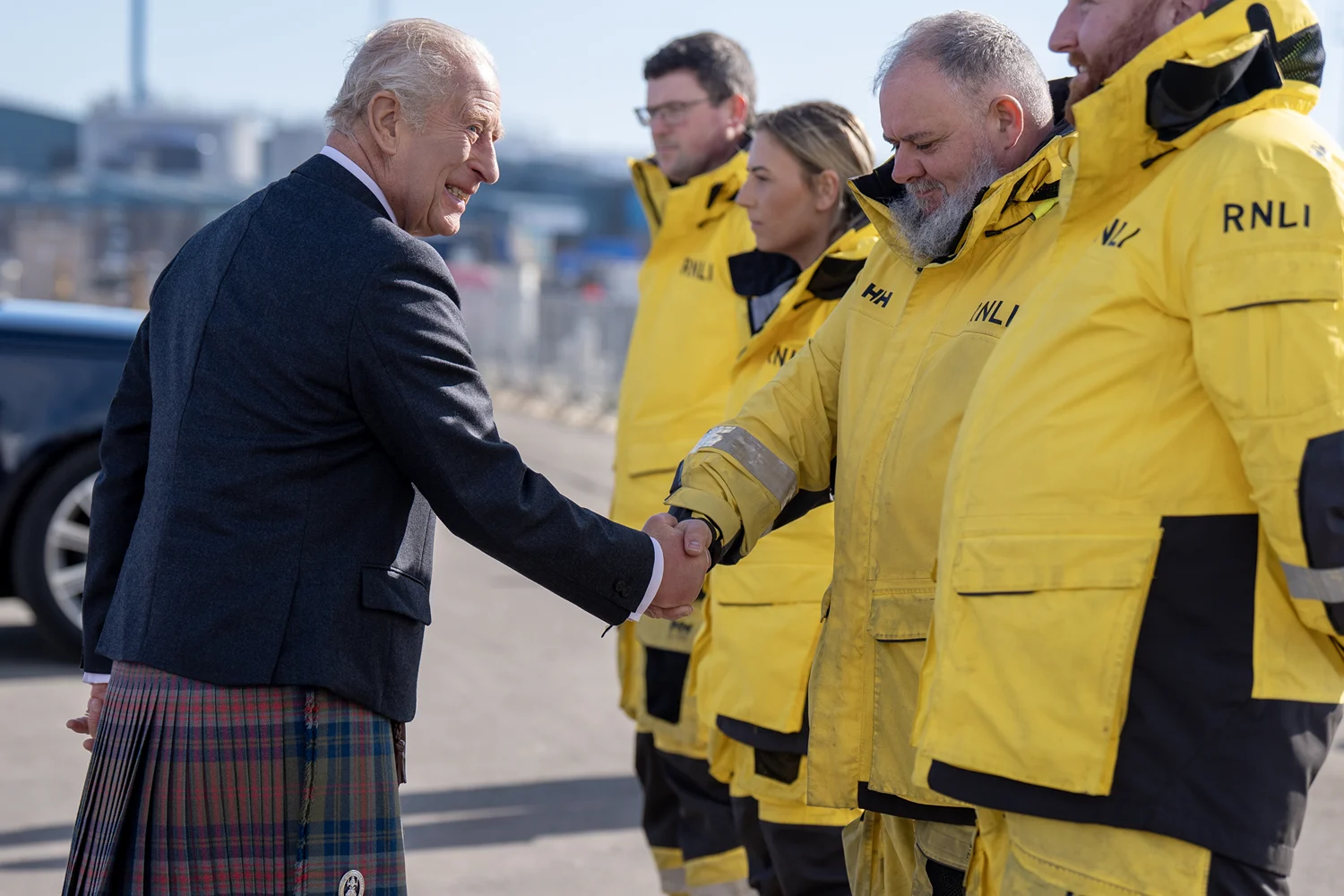
In the waters off the British coast, volunteers with the Royal National Lifeboat Institution (RNLI) are doing what they’ve always done: rescue people in trouble. But these days, some Brits are getting upset with the rescuers—to the point of attacking them or those they’re saving—because many of the people that they’re trying to save are attempting to enter the United Kingdom illegally.
In the Caribbean and the Pacific, the U.S. military has attacked numerous so-called drug boats. There has long been an obligation, moral and legal, to save the lives of those at risk at sea; today, the RNLI upholds that while the U.S. military violates it.
In the waters off the British coast, volunteers with the Royal National Lifeboat Institution (RNLI) are doing what they’ve always done: rescue people in trouble. But these days, some Brits are getting upset with the rescuers—to the point of attacking them or those they’re saving—because many of the people that they’re trying to save are attempting to enter the United Kingdom illegally.
In the Caribbean and the Pacific, the U.S. military has attacked numerous so-called drug boats. There has long been an obligation, moral and legal, to save the lives of those at risk at sea; today, the RNLI upholds that while the U.S. military violates it.
A sense of community between seafarers dates back centuries, but the modern obligation was formalized early last century. Individual nations had written a duty to rescue into their laws throughout the 19th century, but the first real international agreement came in Article 11 of the 1910 Brussels Convention on Assistance and Salvage at Sea: “Every master is bound, so far as he can do so without serious danger to his vessel, her crew and passengers, to render assistance to everybody, even though an enemy, found at sea in danger of being lost.”
But it was a famous disaster and a heroic rescue that solidified the rule. Just after midnight on April 14, 1912, the telegraph clerk on the RMS Carpathia, a trans-Atlantic passenger ship, was supposed to finish his shift, but before doing so, he sent an update to the RMS Titanic. It was a few minutes into April 15. To his horror, the Titanic telegraphed back that it had struck an iceberg and was sinking.
The telegraph clerk—Harold Cottam—immediately alerted his captain, Arthur Henry Rostron. Wasting no time, Rostron turned his ship around and sped more than 50 nautical miles, through icebergs and other perils, to the listing Titanic. When the Carpathia arrived, the Titanic was no more, but Rostron and his good Samaritans managed to save 705 passengers clinging to lifeboats. Alas, those rescued did not include my great-great aunt, who was traveling in third class and had no chance of reaching a lifeboat. (Read more about the Carpathia’s heroic act here.)
Rostron could have argued that he was too far away to help, and the Brussels Convention—which focused on vessels, not people—was vague about the circumstances under which ships were obliged to rescue humans at sea. But the Titanic’s shocking demise prompted a large group of nations to get together and negotiate a treaty to institute precisely such an obligation. The Convention on the Safety of Life at Sea (also known as the SOLAS Convention) was signed in London on Jan. 20, 1914, and the signatories “established international regulations for the subdivision of ships, life-saving appliances, the use of wireless telegraphy, fire-extinguishing appliances, ice patrols and collisions.” Crucially, they also decreed that “sufficient lifeboats must be available to rescue all crew and passengers in the event of an accident” and that captains had an obligation to “proceed to the assistance of the persons in distress.”
Not all countries signed the treaty right away. The original signatories were, in fact, a small group: Australia, Belgium, Denmark, France, Germany, Italy, the Netherlands, New Zealand, Norway, Russia, Spain, Sweden, the United Kingdom, and the United States. Between them, though, they dominated global shipping, and SOLAS became the global standard. SOLAS has since been updated three times, and the current version has been signed by nearly all of the world’s countries, representing 99 percent of the world’s merchant vessels.
That’s why you can rest assured that there will be space on a lifeboat for you if a ship you’re on begins sinking. You can also be sure that, should you end up on a lifeboat or in the water, any nearby vessel that hears of your plight has an obligation to act like Rostron.
The RNLI was founded in 1824, long before the law even existed; the humanitarian impulse and a feeling of shared danger from the elements drove its creation. Since then, its volunteers have saved nearly 150,000 people from drowning. In World War I, the charity launched 1,808 rescue missions, saving 5,332 lives. World War II saw 6,376 people saved by RNLI lifeboats, often under extremely perilous conditions that involved risk to the rescuers’ own lives.
These days, many of the people that RNLI crews save are illegal migrants. That’s unsurprising, considering that the migrants try to cross the English Channel in such poor vessels that they risk drowning. In recent weeks, that has caused far-right populists to protest against the rescuers. Large groups of people have tried to block buses carrying rescued migrants to reception centers, and RLNI crews have been branded as traitors online. What the protesters don’t seem to realize is that under SOLAS, any vessel is obliged to assist people in need.
The United States is taking an entirely different approach to SOLAS. Since September of last year, U.S. military units have attacked boats in the Caribbean and the Pacific. A U.S. strike on Sept. 2 killed 11 people on such a boat, and another attack 13 days later reportedly killed another three. Four days after that, another strike killed three more people. The strikes continued: four people killed, six killed, three killed, two killed, six killed. In one infamous attack, two survivors were killed in a second strike. On Sept. 19, four people were killed, and U.S. President Donald Trump has not declared the campaign over yet.
In fact, it can’t be over, as it targets what Trump claims are terrorist organizations, which presumably would have to be defeated for the campaign to end. “TDA is a designated Foreign Terrorist Organization, operating under the control of [Venezuelan President] Nicolás Maduro, responsible for mass murder, drug trafficking, sex trafficking, and acts of violence and terror across the United States and Western Hemisphere,” he announced on social media after last year’s Sept. 2 strike.
The Trump administration has argued that because it has labeled the drug traffickers as “narcoterrorists,” the traffickers are combatants and can thus be killed, including at sea. That ignores a long-standing obligation to aid even stranded enemies, going back to the 1910 convention. Even the Nazis often rescued Allied seamen—until 1942, when Adolf Hitler and Adm. Karl Donitz explicitly forbade the German navy from rescue operations. Donitz successfully escaped charges of war crimes, however, thanks in no small part to the ambiguity of the United States’ own practices of unrestricted submarine warfare against the Japanese.
Today, however, the standard is quite clear. In 2004, the world’s nations—including the United States—explicitly adopted amendments to SOLAS and the International Convention on Maritime Search and Rescue, which governs the global coordination of ocean search and rescue. The signatories adopted the amendment out of concern that people needing rescue were being treated differently.
To eliminate such maritime discrimination, the signatories stipulated that “this obligation to provide assistance applies regardless of the nationality or status of such persons or the circumstances in which they are found.”
U.S. military lawyers have given the green light to the drug boat strikes, but SOLAS is clear: Any person on the sea has the right to protection, and anyone operating there has an obligation to help those in need.
To be sure, it’s inconvenient when those needing rescue are criminals or have violated immigration law. But imagine the moral morass that ship crews or RNLI volunteers would face if, when being alerted to a vessel in trouble, they’d have to first ascertain whether the people were worthy of rescue. None of us would want nearby ships to first assess our worthiness before deciding to rescue us. The diplomats who negotiated SOLAS were wise men (and they were all men). They knew that before the might of the ocean, humans are all equal.
