


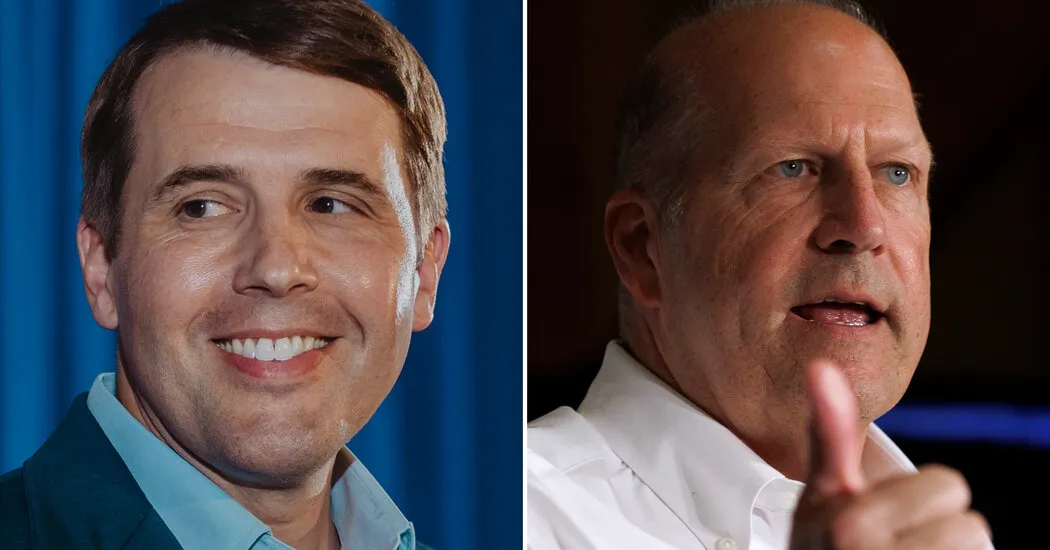
Representative Chris Pappas, a Democrat, leads John E. Sununu, the Republican nominee, by five percentage points in the New Hampshire Senate race, 50 percent to 45 percent, according to a new poll of likely voters conducted by The New York Times and Siena University.
Mr. Pappas’s lead suggests that Democrats retain an advantage in a state where there have been some indicators that Republicans could be competitive even in a favorable environment for Democrats.
The Democratic edge comes despite the two candidates being viewed nearly identically by voters overall, with 43 percent rating Mr. Pappas favorably and 44 percent saying they see him unfavorably. Forty-five percent say they view Mr. Sununu, a former senator, favorably, and 46 percent say they see him unfavorably.
Here are some takeaways from the poll:
Voters are more interested in a check on President Trump than in a candidate who supports him.
Fifty-four percent of voters say they would prefer a Senate candidate who would provide a check on Mr. Trump, compared with 24 percent who would prefer a candidate who supports him. This extends across partisan lines — 11 percent of Republicans say they would prefer a candidate who stands up to Mr. Trump, while less than 1 percent of Democrats say they would prefer a candidate who supports him.
Mr. Pappas’s support is running behind the share of voters who prefer Democratic control of the Senate.
New Hampshire voters prefer Democratic control of the Senate by nine percentage points, 53 percent to 44 percent, but Mr. Pappas leads Mr. Sununu by only five points. Eight percent of voters who want to see Democratic Senate control said they were planning to vote for Mr. Sununu in November.
The candidates are closely matched in terms of who voters believe would do a better job on many issues.
Mr. Pappas has a wide lead over Mr. Sununu on who would do the best job handling health care and a seven-point advantage on data centers. But the candidates are tied or within a few points of each other on most other issues, including doing what is best for ordinary people in New Hampshire, foreign wars, the cost of living and being an effective senator. Mr. Sununu has an 13-point advantage on supporting American manufacturing.
Democrats appear less satisfied with their nominee.
Nearly 85 percent of Republicans say they are satisfied with their party’s choice of Senate candidate, compared with 75 percent of Democrats. That may reflect a broader difference in how unified each party’s members feel: 56 percent of Democrats and independents who lean toward the Democratic Party say their party is divided, compared with 35 percent of Republicans and Republican-leaning independents. In the Democratic primary, Mr. Pappas defeated a progressive rival who ended up winning nearly 33 percent of the vote.
Voters are more likely to describe Mr. Sununu as extreme, and are split on which candidate has better character.
Nearly 45 percent of voters say “extreme” better describes Mr. Sununu than Mr. Pappas. By comparison, 36 percent say that label better fits Mr. Pappas. On character, the candidates are nearly even: 43 percent say “has good character” better describes Mr. Pappas, compared with 42 percent who say that about Mr. Sununu.
