


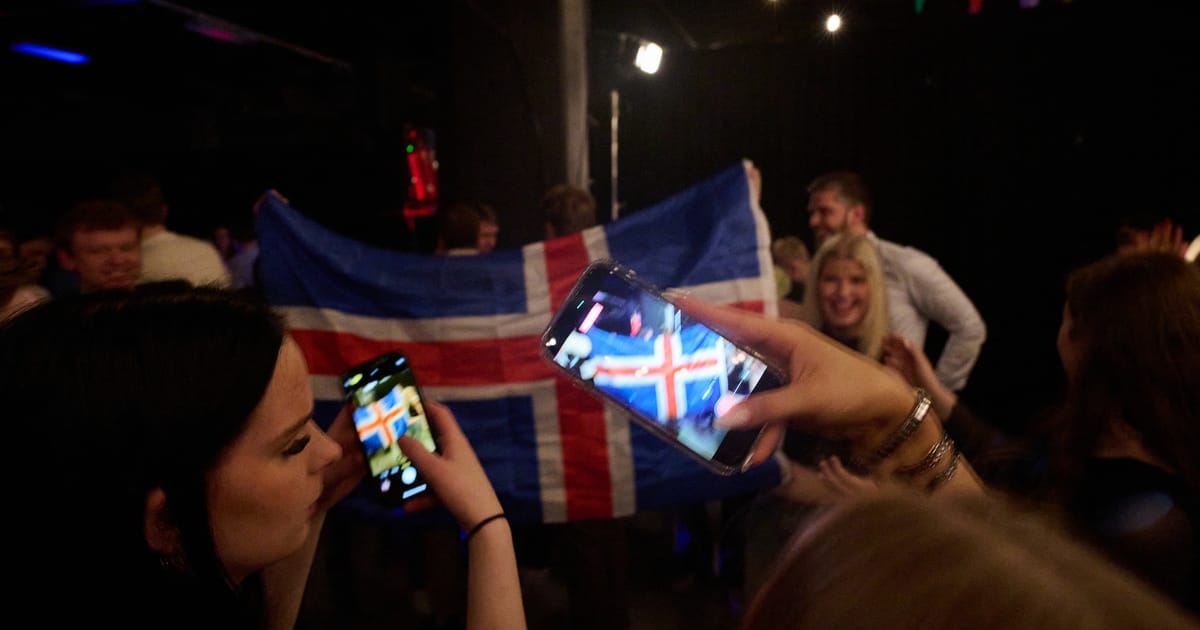
REYKJAVÍK, Iceland — The mood at the Icelandic ‘no’ camp’s election-night gathering is buoyant. Even before the first results come in, they are already confident of winning the referendum on resuming accession talks with Brussels.
“We’re going to win,” says Salma Björk Önnudóttir, one of the managers of the No campaign. She would ultimately be proven right.
When the first partial results are announced, cheers and chants erupt. The official result — confirmed around 9:30 a.m. local time on Sunday morning — had been in the air for hours.
By a narrow margin of 52.8 percent to 47.2 percent, Icelanders rejected new talks with the EU. A defeat not only for the Icelandic government, which had made the referendum a centerpiece of its term in office — but for the EU as a whole.
Interest in the vote ran high, and turnout was greater than at the last parliamentary election. “It has been a joy to see so many people engage actively with this debate,” Prime Minister Kristrún Mjöll Frostadóttir said after casting her own ballot. “It has lifted the conversation about the EU and Iceland’s place in the world to a new level.”
Whatever the outcome, she would “be content with the result,” Frostadóttir said. Today, though, she must concede that the No camp out-mobilized her own — and that her government’s strategy of first securing a supposedly easier “yes” through a preliminary referendum has not paid off.
In the end, Icelanders’ skepticism about taking even this small step toward the EU proved too strong. “There are simply too many question marks,” says a No voter at the gathering. “I don’t have the trust.” The No camp knew how to speak directly to the long-standing wariness many Icelanders feel toward the EU.
The campaign leaned above all on themes at the core of the country’s national identity. Sovereignty, for one — hard-won over generations, and not to be surrendered in any measure to Brussels. And fisheries, still a mainstay of the Icelandic economy.
The warning that membership would mean losing control over fishing quotas and having to open Icelandic waters to foreign companies was a cornerstone of the No campaign, and one that many voters cited as their reason for rejecting it.
Arguments from the Yes camp — that Iceland, as a member of the European Economic Area, already has to adopt many rules it has no say in shaping, or that the euro could bring down the country’s punishing cost of living — fell on deaf ears. The security dimension, which the government had cited as one reason for holding the referendum, also remained peripheral to the debate.
“For the No camp, everything came down to a single issue,” says Hallgrímur Oddsson, founder of the European think tank Evrópustraumar: “Icelandic fisheries, and how they would fit into the Common Fisheries Policy, where decisions are shared with 27 other countries.”
The EU’s signals in the run-up that it was willing to compromise on fisheries clearly failed to sway voters. Part of the No camp did not believe Iceland could hold its own at the negotiating table. Another part opposes membership on principle, whatever any accession deal might have contained.
Accordingly, it was the rural regions that pushed back hardest against new talks. In the northwest, a region shaped by farming and fishing, almost 63 percent voted no. Only the two constituencies of the capital, Reykjavík, delivered a Yes majority — and even there it was slimmer than supporters had hoped.
The final poll before the vote also suggested that younger voters, in particular, may have turned against accession talks. In June, nearly two-thirds of 18- to 29-year-olds said they were likely to vote Yes; by late August, only 40 percent did.
“The No side sold the referendum as though it were already about membership itself, rather than about resuming negotiations,” says Maximilian Conrad, a political scientist and EU expert at the University of Iceland in Reykjavík.
In Brussels, the result will land as a disappointment. A move by Iceland toward membership would have sent a signal of European unity to the world — and, amid tensions between the U.S. and Europe and the growing sway of authoritarian powers led by Russia and China, such a signal would have been more than welcome.
A stronger EU presence in the High North would not only have carried real geostrategic value; it might also have injected fresh momentum into the currently sluggish talks with the other candidate countries.
It will remain a might-have-been. In Iceland, the EU question may well be off the table for a generation.
“The only thing that could change that might be some external shock — a shift in the EEA agreement, say,” Oddsson believes. “But that’s pure speculation.”
Reykjavík and Brussels will remain closely tied all the same. Before the referendum, the government had signaled that, in the event of a No, it would seek to deepen cooperation by other means.
The Axel Springer Global Reporters Network harnesses the resources of the company’s newsrooms to publish ambitious scoops, investigations, interviews, opinion pieces and analysis. It allows journalists — including those from POLITICO, Business Insider, WELT, BILD, Onet and Fakt — to collaborate on major stories for an international audience of hundreds of millions across platforms: online, print, TV and audio.
