

Close Menu
NCIJ Network NCIJ Network
    What's Hot

    Could this be the last Bonfire Night for noisy fireworks?

    November 5, 2026

    Hubble Learns Galactic History From Stars

    November 5, 2026

    Midwives’ union warns over maternity unit plans in Norfolk

    November 5, 2026
    Facebook X (Twitter) Instagram
    Trending
    • Could this be the last Bonfire Night for noisy fireworks?
    • Hubble Learns Galactic History From Stars
    • Midwives’ union warns over maternity unit plans in Norfolk
    • Democrats’ Big Statehouse Wins Could Transform Climate and Energy Policy
    • Put the Ocean at the Center of COP31 by Peter Thomson
    • Did Einstein fail math? Claim doesn’t add up
    • Italian chef fired from Queensland restaurant after refusing to put pineapple on pizza
    • Putin not invited to G20 summit in Manchester, says Andy Burnham
    • About
      • Our Team
      • Editorial Policy
      • Editorial Independence
      • International Support
    • Trust & Standards
      • AI Usage Policy
      • Conflict of Interest Policy
      • Corrections Policy
      • Ethics Policy
      • Fact-Checking Policy
      • Source Protection
    • Get Involved
      • Guide for Sources
      • Support Independent Journalism
    • Legal
      • Cookie Policy
      • Privacy Policy
      • Terms of Use
    Facebook X (Twitter) Instagram
    NCIJ Network NCIJ Network
    Thursday, November 5
    • Home
    • World
    • Ai
    • Business
    • Politics
    • Health
    • Crypto
    • Science
    • Technology
    • Cybersecurity
    • Defense & Security
    • Economy
    • Energy
    • Europe
    • More
      • Fact Check
      • Investigations
      • Opinion & Analysis
      • Environment
    NCIJ Network NCIJ Network
    Home»Science

    Hubble Learns Galactic History From Stars

    NCIJ NETWNCIJ NETWORKBy NCIJ NETWNCIJ NETWORKNovember 5, 2026 Science No Comments3 Mins Read
    Share
    Facebook Twitter LinkedIn Pinterest Email

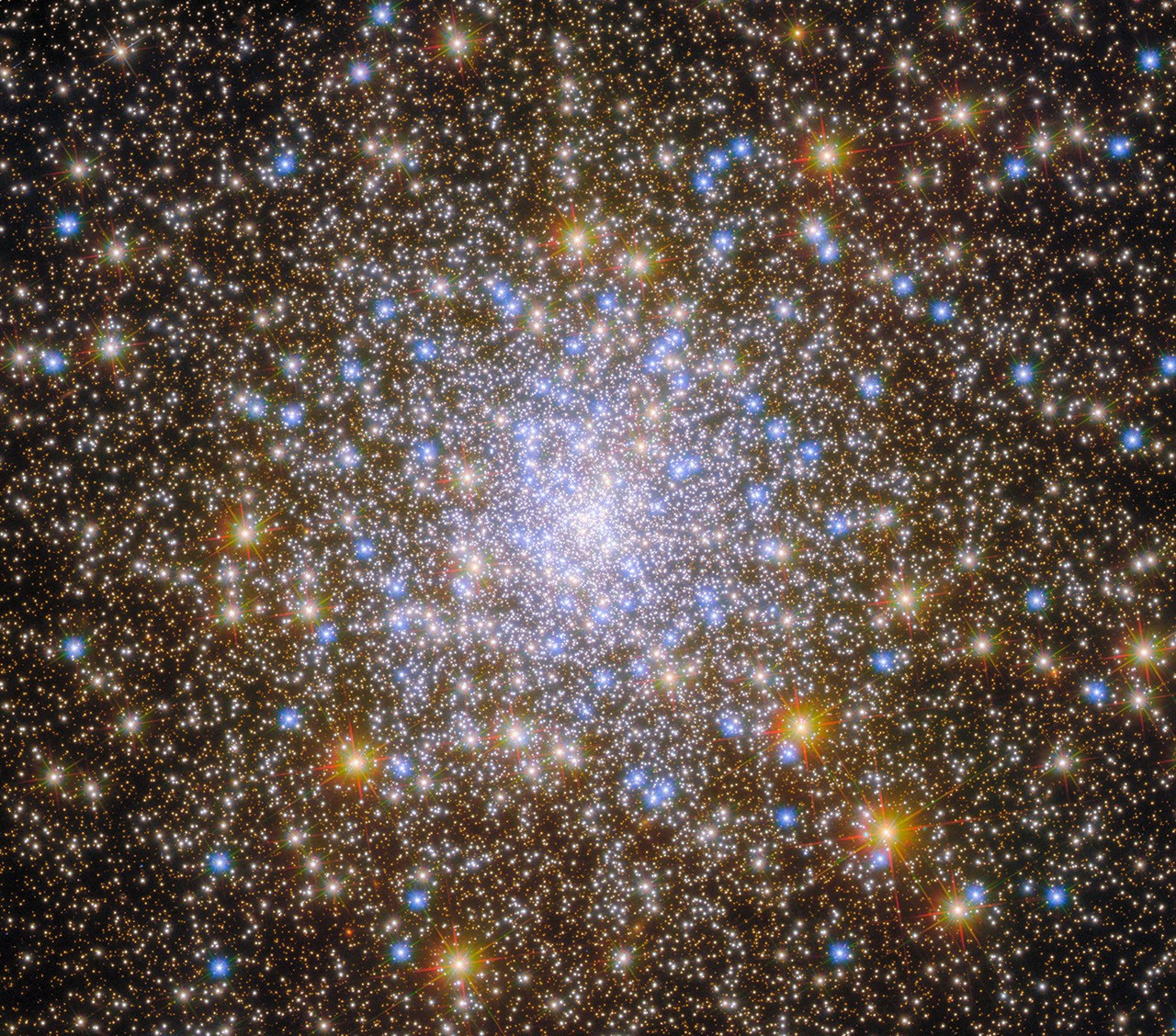
    This NASA/ESA Hubble Space Telescope image provides a lesson in galactic history. The sparkling collection of stars is named Messier 30 (M30) after the French astronomer, Charles Messier, who cataloged M30 and other diffuse objects that might be mistaken for comets in the early telescopes of Messier’s time. M30 lies about 27,500 light-years away in the constellation Capricornus.

    M30 is a globular cluster: a roughly spherical grouping of stars containing anywhere from tens of thousands to millions of stars. These clusters generally reside on the outskirts of galaxies, orbiting within a vast, diffuse region called the halo like a swarm of moths around a lightbulb. Our Milky Way galaxy has at least 150 globular clusters, the nearest of which is about 6,000 light-years away. These clusters are impressively ancient: astronomers estimate their ages are between 11.5 to 13.5 billion years, making certain globular clusters nearly as old as the universe itself.

    Globular clusters have long played an important role in helping us learn about our galaxy. More than a century ago, astronomer Harlow Shapley used observations of a particular type of variable star to measure the locations of and distances to dozens of globular clusters within our galaxy. His work showed that the Sun is not in the center of our galaxy, and that the galactic center lies toward the constellation Sagittarius. (His distance measurements were incorrect, however, and he concluded that our galaxy is about twice as large as it really is.)

    Today, astronomers continue to learn about our galaxy by observing globular clusters. Because globular clusters are so ancient, they can give us clues about how our galaxy developed long ago. Globular clusters that formed within our galaxy can act as time capsules, preserving the original chemistry of our young galaxy.

    However, it’s possible that not all globular clusters that orbit within our galaxy today formed there. Researchers have discovered that M30 and many other globular clusters orbit in the direction opposite from the way our galaxy spins. This may mean that these clusters did not form within our galaxy at all. Instead, our Milky Way galaxy may have captured them in the distant past!

    Hubble has observed M30 multiple times. A previously released image of M30 featured data from Hubble’s Advanced Camera for Surveys (ACS) and was part of an observing program (#10775; PI: Sarajedini) that surveyed dozens of Milky Way globular clusters in red and near-infrared light, revealing stars down to just 20% of the mass of the Sun. A more recent program (#13297; PI: Piotto) returned to M30 and other globular clusters in our galaxy, this time observing the clusters with Hubble’s Wide Field Camera 3 and using three filters that captured bluer light. This program collected data that was critical for studying exotic objects like “blue straggler” stars as well as for investigating the multiple populations of stars that can inhabit a single globular cluster.

    More recently, Hubble’s ACS viewed many of these globular clusters again. Those observations were part of a program (#16298, PI: Libralato) that looked at how different populations of stars in globular clusters moved over the 15 years since Hubble first observed them — a feat made possible by Hubble’s longevity and ability to discern fantastically small details in distant objects.

    The image above was created with data from all three observing programs and includes the wide range of wavelengths Hubble can see — ultraviolet, visible, and near-infrared light. Each wavelength helps us better understand how these groups of stars formed and evolved.

    Text credit: ESA/Hubble

    Media Contact:

    Claire Andreoli
    NASA’s Goddard Space Flight Center, Greenbelt, MD
    claire.andreoli@nasa.gov

    Galactic History Hubble Learns stars
    NCIJ NETWNCIJ NETWORK
    • Website

    Keep Reading

    Cyprus: Island of Snakes, Cats, and Ophiolites

    Little Ice Age cooling in Europe may have raised the risk of rickets

    NASA’s Voyager 1 is about to reach a historic one-light-day milestone

    NASA smashed into an asteroid. Now Hera is closing in to see what happened

    AI helps Stanford scientists discover a “natural Ozempic” with a surprising advantage

    NASA Announces X-70 Experimental Aircraft to Advance Flight Research 

    Add A Comment
    Leave A Reply Cancel Reply

    Editors Picks

    Could this be the last Bonfire Night for noisy fireworks?

    November 5, 2026

    Hubble Learns Galactic History From Stars

    November 5, 2026

    Midwives’ union warns over maternity unit plans in Norfolk

    November 5, 2026

    Democrats’ Big Statehouse Wins Could Transform Climate and Energy Policy

    November 5, 2026
    Latest Posts

    Scientists may have finally proved that “empty” space isn’t really empty

    August 18, 2026

    Solana treasury firm cuts shares 700-for-1 but leaves room for nearly 100 billion more

    August 18, 2026

    Evooo1Bot Linux Botnet Exploits Known Flaws to Turn Edge Devices Into SOCKS5 Proxies

    August 18, 2026

    Subscribe to News

    Get the latest sports news from NewsSite about world, sports and politics.

    NCIJ Network is an independent digital news platform delivering trusted investigative journalism, European and global news, in-depth analysis, and fact-based reporting with accuracy, transparency, and integrity.

    Facebook X (Twitter) Instagram Pinterest YouTube

    Could this be the last Bonfire Night for noisy fireworks?

    November 5, 2026

    Hubble Learns Galactic History From Stars

    November 5, 2026

    Midwives’ union warns over maternity unit plans in Norfolk

    November 5, 2026

    Subscribe to Updates

    Get the latest creative news from FooBar about art, design and business.

    Type above and press Enter to search. Press Esc to cancel.