


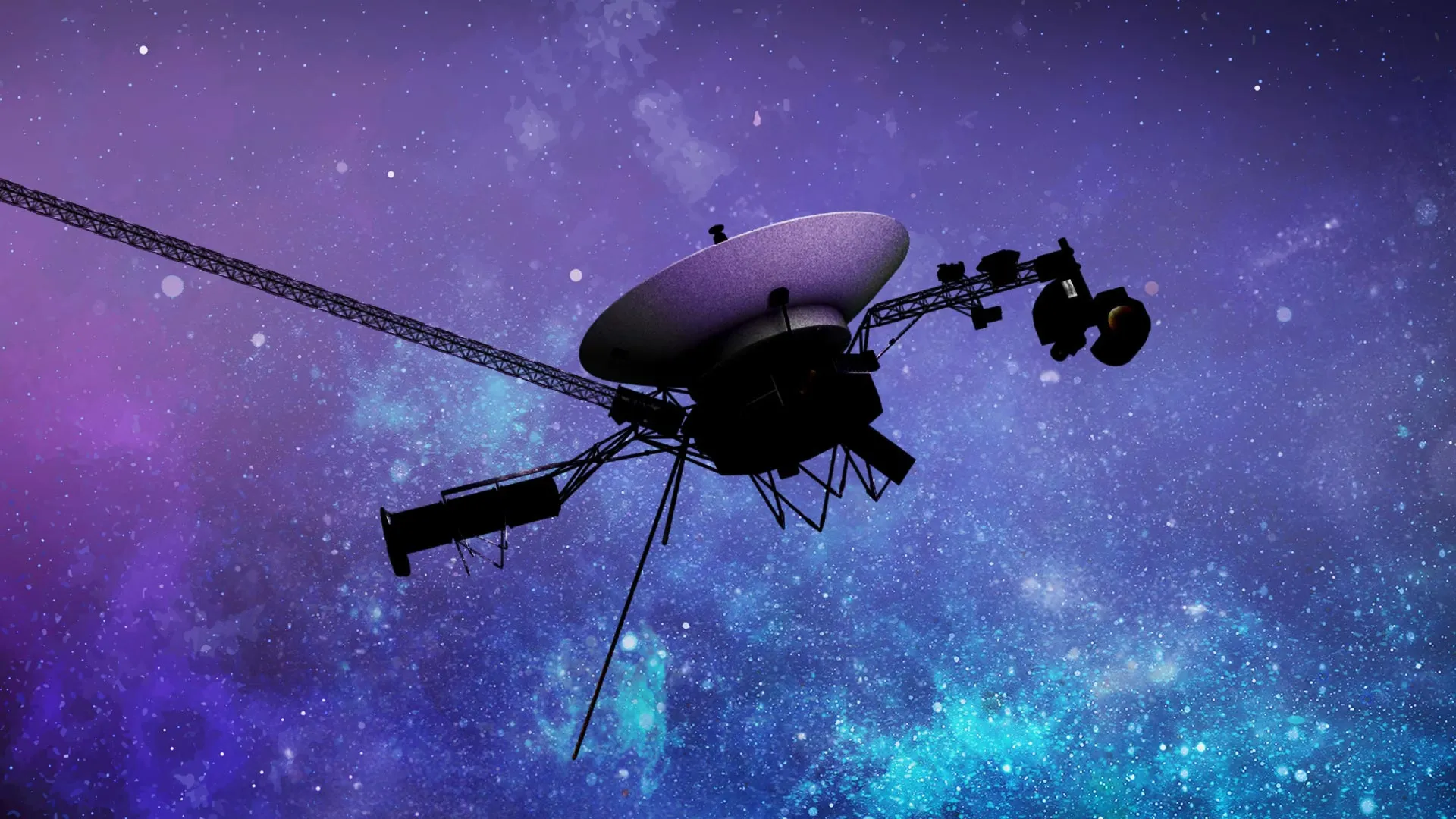
Nearly 50 years after leaving Earth, NASA’s Voyager 1 is approaching an extraordinary milestone that will highlight just how far humanity’s most distant spacecraft has traveled. But keeping the aging explorer operational has become an increasingly difficult challenge as its power supply slowly fades.
NASA engineers recently achieved two important developments in their effort to extend the mission. In September, they completed a complex energy conservation project designed to preserve the spacecraft’s remaining scientific capabilities. Then, on October 20, Voyager 1 unexpectedly resumed communication with Earth after a mysterious 48-hour interruption.
NASA Engineers Find a Clever Way to Save Power
In early September, the Voyager team successfully replaced three devices aboard Voyager 1 with alternatives that consume less electricity. The carefully coordinated operation, nicknamed the “Big Bang,” took months to prepare and was completed approximately six weeks after engineers carried out an identical procedure on Voyager 2.
The upgrade is expected to extend the operating lives of Voyager 1’s remaining scientific instruments, allowing the spacecraft to continue collecting valuable information from interstellar space longer than previously expected.
Both Voyager spacecraft generate electricity using radioisotope thermoelectric generators. These systems produce electrical power from the heat released as plutonium undergoes radioactive decay. As that process continues, the spacecraft gradually lose generating capacity, with each probe experiencing a decline of approximately 4 watts annually.
After almost five decades in space, that steady loss has left engineers with very little power to spare. To keep the missions operating, NASA has progressively shut down equipment that is no longer essential.
The Big Bang presented an especially difficult engineering challenge because all three replacements had to happen simultaneously. The six devices involved help maintain temperatures inside the spacecraft despite the extreme cold of space. Replacing the three original devices together was necessary to reduce electricity consumption while preserving the proper distribution of heat throughout Voyager 1.
Keeping Voyager 1’s Science Mission Alive
Power limitations have already forced NASA to deactivate two of Voyager 1’s scientific instruments in recent years. When the spacecraft launched in 1977, it carried 10 instruments dedicated to scientific research. Several were shut down after Voyager completed its encounters with the outer planets, while others remained active to investigate increasingly distant regions of space.
Among the areas studied was the outer heliosphere, the enormous region of particles and magnetic fields produced by the Sun. Both Voyager spacecraft have since crossed beyond this boundary into interstellar space, making them the only spacecraft ever to directly examine the environment outside the Sun’s heliosphere.
Preserving their remaining instruments is particularly important because no other missions can currently collect measurements from this distant region. Without the Big Bang upgrade, NASA would have faced the possibility of shutting down another Voyager 1 instrument as early as summer 2027.
Mysterious Communication Loss Raises New Questions
Even with the successful power conservation effort, Voyager 1 continues to encounter unexpected problems.
NASA temporarily lost contact with the spacecraft on October 18 and 19, when the agency’s Deep Space Network failed to receive its radio signal during two scheduled communication attempts separated by 24 hours.
The network consists of large radio antennas at three locations around the world, allowing NASA to exchange signals with spacecraft exploring the Moon and more distant destinations. At the time of the interruption, Voyager 1 was approximately 16 billion miles (24 billion kilometers) from Earth.
After two unsuccessful attempts to detect the spacecraft, its signal unexpectedly returned on October 20, roughly 48 hours after the interruption began. Communication has remained established since then, and engineers subsequently sent commands to investigate the problem.
NASA has not yet determined exactly what caused the incident. However, engineers discovered that one set of Voyager 1’s thrusters had stopped operating and that the spacecraft had automatically activated its backup thrusters.
This behavior is part of a built-in safety system known as fault protection. When the onboard computers recognize a potential problem with active equipment, they can switch to backup hardware, place the spacecraft into a stable configuration, and suspend normal activities. This gives controllers on Earth an opportunity to investigate and determine the appropriate response.
“This is the first time we’ve seen the spacecraft do something like this, but we are also at a point in the mission where we have to expect the unexpected,” said Kareem Badaruddin, Voyager mission manager at NASA’s Jet Propulsion Laboratory in Southern California. “We’re relieved to be back in contact with Voyager 1 and are eager to understand what happened.”
Voyager 1 Approaches a Historic One-Light-Day Milestone
While NASA continues investigating the communication interruption, Voyager 1 is moving toward another remarkable achievement.
Traveling through interstellar space at approximately 38,000 mph (61,155 kph), the spacecraft is expected to reach a distance of 16.09 billion miles (25.89 billion kilometers) from Earth on November 18. That distance equals one light-day, meaning it takes light an entire 24 hours to travel between Earth and the probe.
No other human-made object has ever reached such a distance.
The milestone also illustrates the extraordinary challenges of communicating with a spacecraft so far from home. Radio waves travel at the speed of light, so commands transmitted from Earth will require a full day to reach Voyager 1. Any response sent back will take another 24 hours, creating a total communication delay of 48 hours.
“If you want to say ‘hello’ to Voyager, you send your message and then you go home and you wait two days before you finally get a response,” said Suzanne Dodd, Voyager project manager at JPL.
Crossing the one-light-day threshold will not produce any physical change in Voyager 1 or its surroundings. The spacecraft will continue traveling through the same interstellar environment, unaware that it has passed a milestone of special significance to people on Earth.
Instead, the achievement serves as a powerful reminder of the enormous distances separating objects in the universe and the remarkable endurance of a spacecraft launched nearly half a century ago. Despite fading power, aging equipment, and unexpected technical problems, Voyager 1 continues its historic journey farther from Earth than any other human-made object.
