


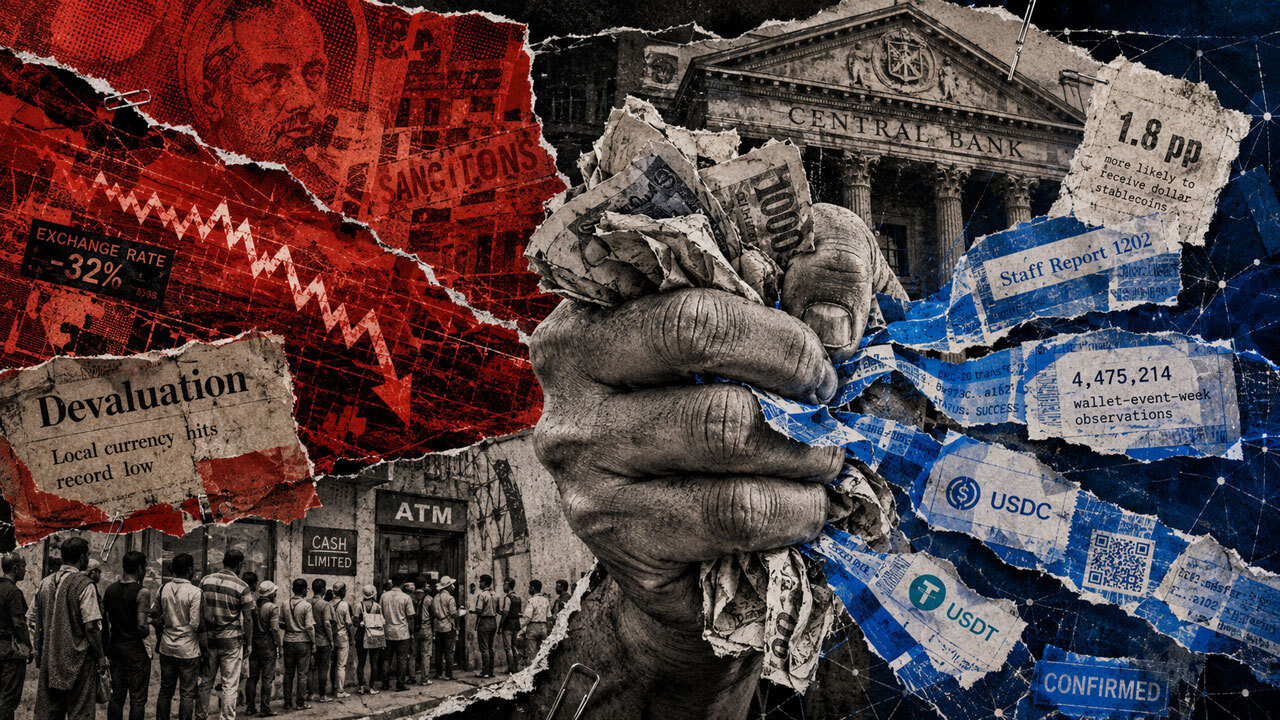
A New York Federal Reserve study found that dollar stablecoins are more likely to flow into wallets tied to countries experiencing currency or banking crises.
Wallets linked to countries experiencing some form of financial crisis were 1.8% more likely to receive dollar stablecoins during the week a crisis began, researchers Pablo Azar, Maryam Farboodi and Nish Sinha found in an August staff paper. Receipt volumes of these assets across these wallets also increased significantly during those periods.
The findings provide evidence for a growing challenge facing central banks in economies under financial stress.
Governments have traditionally relied on banks and other regulated intermediaries to enforce restrictions on foreign-exchange purchases and cross-border transfers.
However, the advent of stablecoins has given households and businesses another route to dollar exposure that can operate outside those domestic banking channels.
The research comes as the stablecoin market has grown beyond $300 billion and is expected to reach the trillions of dollars before the end of the decade. That expansion could make the alternative payment rails identified by the New York Fed increasingly relevant during future currency crises.
Crisis demand shifts onto blockchain rails
According to the paper, the researchers studied nine episodes across eight countries between 2021 and 2025, including monetary disruptions, banking restrictions, sanctions and devaluations affecting Argentina, Egypt, Iran, Myanmar, Nigeria, Russia, Turkey and the United Kingdom.
They linked Ethereum Name Service registrations carrying country signals, such as languages, scripts and national identifiers, with transfer histories for 19 major dollar-pegged stablecoins.
During crisis weeks, tagged wallets recorded both a higher probability of receiving stablecoins and larger receipt volumes. A separate specification found no significant increase in the two weeks before the shocks, while the probability of receiving stablecoins rose 1.9% during the crisis week.
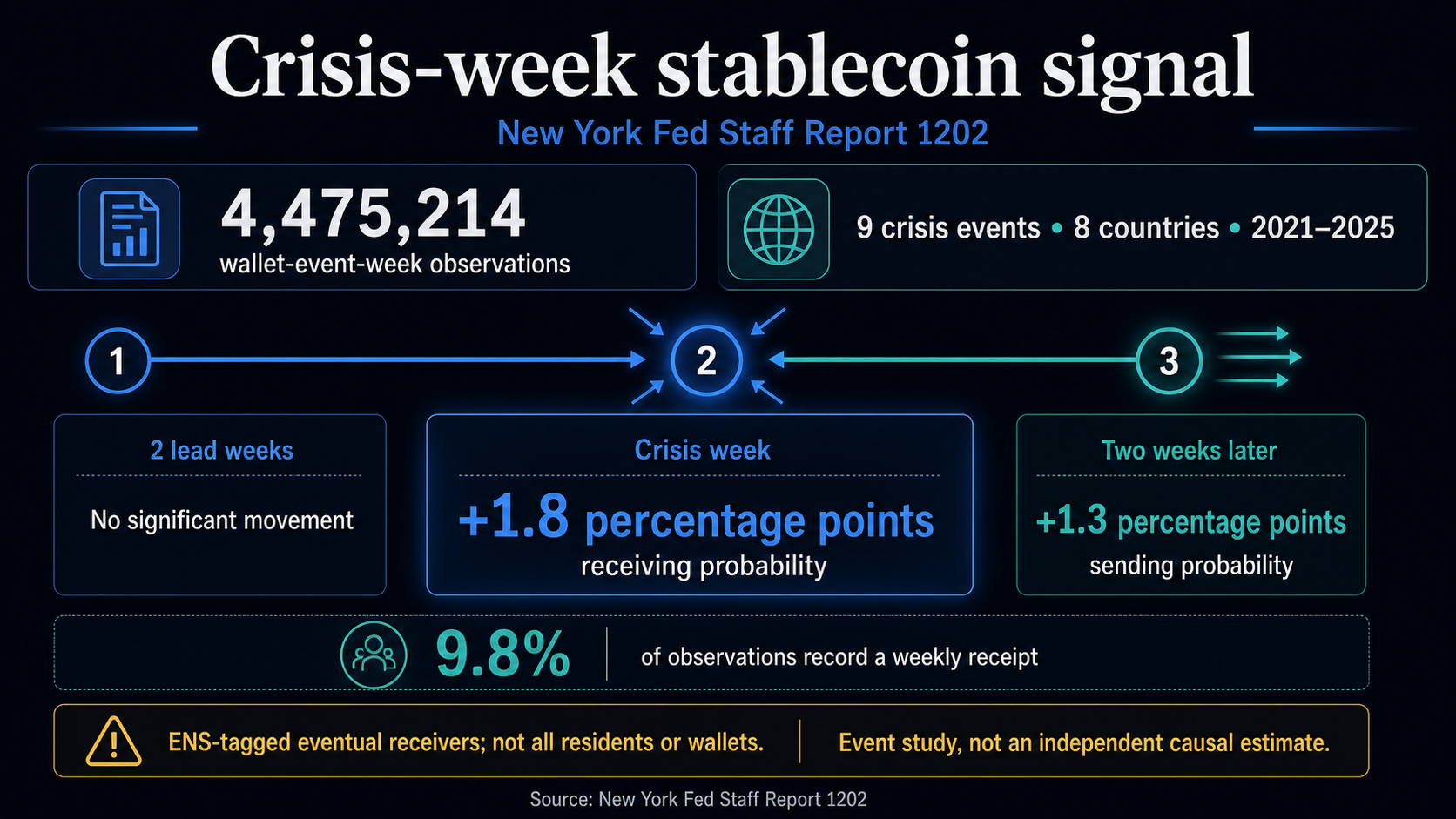
Sending activity increased later, with wallets becoming 1.3% more likely to send stablecoins two weeks after the crisis began.
The sequence supports the researchers’ argument that demand for blockchain-based dollars rises when confidence in domestic financial arrangements comes under pressure.
However, these estimates require qualification. The dataset does not represent every resident or crypto wallet in the countries studied. Its roughly 4.5 million observations are wallet-event-week records, and the sample focuses on wallet-country pairs that received stablecoins at some point within a 53-week window around each crisis.
The result therefore captures a change in behavior among wallets already connected to stablecoin activity rather than showing that stablecoin adoption rose by 1.8% across an entire national population.
Stablecoins complicate the capital-control playbook
The behavior feeds directly into a longstanding constraint on monetary policy.
Under the Mundell-Fleming framework, countries cannot simultaneously maintain a fixed exchange rate, unrestricted capital mobility, and independent control over domestic interest rates.
Governments seeking to protect a currency while retaining monetary autonomy can restrict capital movement through banks and other financial institutions.
The New York Fed researchers model stablecoins as weakening that enforcement channel.
A household facing restrictions on buying or transferring dollars through its bank may instead receive dollar-denominated tokens into a blockchain wallet. As access to those rails expands, the government must devote more resources to enforcement or allow more of the pressure to emerge through currency depreciation or domestic interest rates.
The paper does not establish that stablecoins caused particular currencies to weaken during the nine episodes.
Instead, the observed wallet activity supports the model’s central assumption that financial stress encourages stablecoin adoption. Its broader monetary-policy consequences remain theoretical.
Governments also retain significant points of control. Major dollar tokens such as USDT and USDC are issued by centralized companies that can freeze addresses, while regulated exchanges can be required to restrict transactions or identify customers.
Those powers shift enforcement away from a country’s banking system toward a wider network of issuers, exchanges, and blockchain addresses.
Transfers between self-custodied wallets can leave governments with fewer immediate domestic chokepoints even when issuers retain the ability to intervene at other stages.
A $300 billion market shifts where governments can’t intervene
The policy challenge becomes more consequential as stablecoins expand from a niche crypto product into a global dollar-payment network.
The market has already grown beyond $300 billion and is expected to reach trillions of dollars before the end of the decade.
Blockchain analysis firm Chainalysis projects an even steeper rise in activity, estimating that adjusted stablecoin transaction volume could reach $719 trillion by 2035 through organic growth alone and approach $1.5 quadrillion if broader macro and adoption trends accelerate usage.
That growth would increase the number of routes available to households seeking dollar exposure during periods of domestic financial stress, but it would not put stablecoins entirely beyond government reach.
The largest dollar tokens remain centralized. Issuers such as Circle and Tether can freeze identifiable addresses, while governments can impose requirements on regulated exchanges and other intermediaries even when a transfer initially bypasses the domestic banking system.
The problem is that enforcement becomes less uniform once tokens move beyond those points.
Federal Reserve Vice Chair for Supervision Michael Barr warned in June that US stablecoin legislation left an illicit-finance vulnerability around secondary-market transfers involving unhosted wallets.
The Bank for International Settlements has identified a similar problem for monetary policy, arguing that stablecoin dollarization can threaten monetary sovereignty while restrictions may prove less effective when bearer-like tokens circulate through self-custodied wallets.
That creates a more fragmented enforcement map. Governments can exert substantial control over banks, stablecoin issuers and regulated trading venues, but may have less visibility or immediate reach when dollar tokens move between private wallets without returning to those intermediaries.
The distinction becomes particularly important during a currency crisis, when demand for an alternative store of value and payment rail can rise just as authorities try to restrict capital movement.
The New York Fed paper suggests that this choice of financial infrastructure is becoming part of the macroeconomic constraint itself. As stablecoin networks grow, effective capital mobility increasingly depends on both the controls governments impose and the blockchain rails households can still access.
At the scale projected for the next decade, that could turn stablecoins from an alternative payment mechanism into a material constraint on how governments defend currencies during periods of financial stress.
