


- After decades of livestock pressure, 1.5 million hectares (3.7 million acres) of farmland in South Africa’s Albany thicket biome need rehabilitation — the way a burn victim needs lifesaving skin grafts.
- Carbon finance seems the most likely source of funding, kickstarting the process with the mass planting of an endemic drought-tolerant succulent called spekboom (Portulacaria afra).
- Until now, restoration projects have been artisanal, but that’s changed with a $91 million loan to a new entrant and tech giant Amazon throwing its hat into the ring.
- A flush of new funding shows growing faith in a business model for ecosystem restoration, but there’s concern that if projects grow too fast and promise more carbon dioxide drawdown than the emerging science can account for, it could leave projects on shaky ground.
This is the first article in Mongabay’s three-part investigation of spekboom-led ecosystem restoration in South Africa. It is part of an award-winning collaboration between independent science writer Leonie Joubert, the Stellenbosch University School for Climate Studies, and the Henry Nxumalo Foundation which supports investigative journalism in Africa.
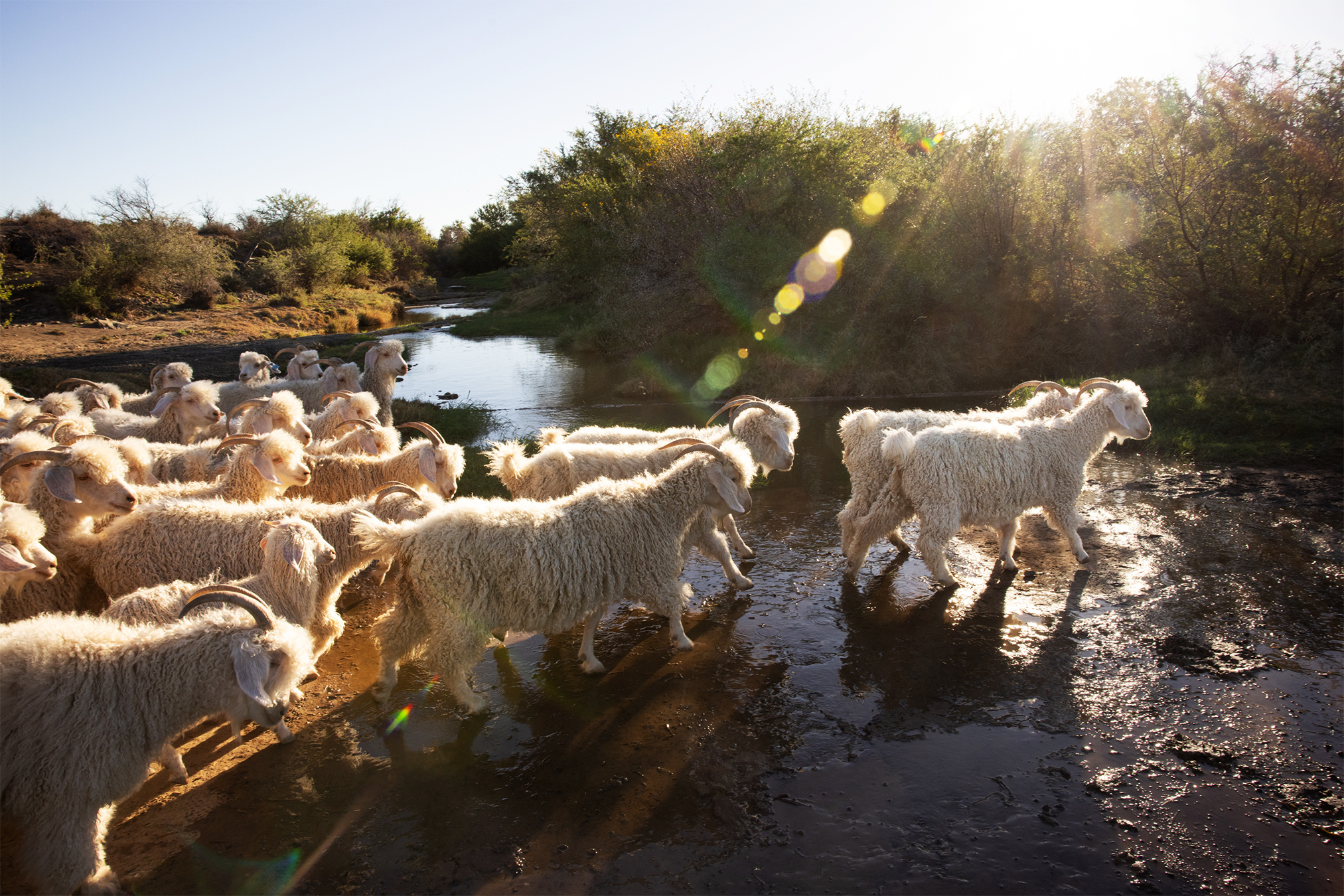
GQEBERHA, South Africa — The spekboom is to goats what ice cream is to a toddler, say the locals in this little nook of South Africa’s Eastern Cape province. This explains why roughly 90% of the Albany thicket plant biome has been stripped by generations of livestock farming, mostly mohair-producing goats. Where there once was impenetrable bush, many farmlands now look like a desert.
This particular plot of cultivated spekboom (Portulacaria afra) — literally, bacon tree in Afrikaans — carries the weight of expectation, though.
“These are the old ones,” says Nick Hamp-Adams, gesturing to a dense line of bushes, each a spray of boughs that erupts from the ground like fireworks. After half a century, they stand a little higher than a tall person’s head. Their plush, water-laden leaves create a pointillist hedge that’s hard to see through. Where the lower branches dip to the ground, some send out roots, which allows the plant to spread and further carpet the soil.
“The farmer planted them because mud [kept] flooding his barn,” says Hamp-Adams, an environmental policy graduate and general manager at Return to Thicket, a small restoration initiative in this emerging sector.
From those humble beginnings in 1976 — a farmer needing to shore up a slope that had been stripped bare by goats — this plot has become the holy grail of thicket restoration research. Hamp-Adams is, for the time being, the keeper of the grail. Return to Thicket now owns the historic Krompoort farm, previously a commercial mohair enterprise and now a critical study site for thicket restoration, which sits about an hour’s drive inland of the port city of Gqeberha.
“Over time, [the plot has] been added to and expanded,” Hamp-Adams says. “Researchers have experimented with different methods of planting spekboom.”
He points to the distinctive skirting around the base of the bushes. This loose weave of low-hanging young branches and leaves creates nursery conditions beneath it, shielding the ground from the jackhammer strikes of raindrops and softening the sun’s heat. Bare ground can bake at more than 60° Celsius (140° Fahrenheit) in summer. The power of raindrops and heat can turn fluffy, seed-friendly soil to concrete-like conditions, says Alastair Potts, a botanist and associate professor at Nelson Mandela University in Gqeberha.
Spekboom is just one of many woody tree species in Albany thicket. But it’s this quick-growing skirt that is part of its magic, allowing it to heal and reverse this damage and, restoration ecologists hope, allow the original thicket to recover where the now barren landscape lets little else grow.
It’s this ability to heal the landscape that has had spekboom all over the news of late. As it grows, it draws down carbon dioxide from the overburdened atmosphere that is causing the global rise in temperatures. The world’s economy has put a price on carbon — for this specific kind of project, anything from $20 to around $45 per metric ton of CO2 cleaned from the atmosphere, sources say. That’s why spekboom-led restoration has attracted the attention of a big international carbon-capture project developer and financiers, including the World Bank, as well as interest from tech giant Amazon.
Ecologists can show early estimates for how much carbon these recovering thickets might bank away in the plant matter and soils. These calculations allow developers to build a business case so that they can draw on carbon markets to pay the bill for restoration. The idea is to kick off longer-term thicket recovery and revive farms left moribund by decades of land degradation: Get investors to pay upfront to replant the landscape, and let them cash in on carbon credits down the line.

Growth spurt
This maiden row of 50-year-old plants in the Krompoort plot is bigger by far than the other plants — each bush taller, wider, its fleshy hedge-like cover denser. Less competition, Hamp-Adams says, more water and nutrients. Uphill, younger rows were added over time, planted by researchers in a deliberate grid, with a meter’s gap, 3.3 feet, between individual plants, and varying spacing of 2-5 m (6.7-16 ft) between rows.
The plants’ carbon-capturing potential as it helps the thicket to recover has caught the attention of developers who are willing to pay for the mass planting of spekboom.
And the farmers here need it like a burn victim needs lifesaving skin grafts. Where many farms were once impenetrable hedge-like bush, they have been stripped to bare ground. Almost nothing can grow on the most damaged lands now. Except spekboom. And if spekboom can take root and create the nursery environment that will allow other thicket plants to sow their seeds, it may allow the wider ecosystem to return to a semblance of its former self. Wildlife could return, for instance, or even cattle, sheep and goats, though ideally at much lower stocking rates than in decades past.
Mass spekboom planting is the first emergency treatment that could, over time, allow the skin grafts to take. It could take decades. It could take centuries. But it starts with spekboom. Planted laboriously, one cutting at a time, but at scale and fast.
Artisanal versus industrial
This small emerging sector is now seeing a seismic change with a new international entrant that has attracted Global North investors with deep pockets.
The spekboom restoration community is cautiously optimistic. Wooing such hefty financiers shows growing faith in a business model for ecosystem repair that’s been in the works for roughly two decades, many say. Yet there’s concern that if restoration projects grow too fast, or if their carbon-capture numbers are more ambitious than the emerging science can account for, it could put the sector in jeopardy.
Singapore-based Imperative Global Solutions Pte. Ltd., a company that bills itself as an infrastructure developer — albeit one that builds ecosystems rather than bridges or dams — recently secured funding that should allow it to expand its initial pilot operation of 10,000 hectares (about 25,000 acres) five times over the next two years. Founded in 2022, the privately held company says it brings expertise in nature-based solutions through carbon markets.
Imperative recently announced it had secured financing of $91 million, with $25 million coming from a newly listed World Bank outcome-based bond named in spekboom’s honor, and another $66 million from a small number of big investors. Amazon has thrown its hat into the ring, derisking the investor financing by agreeing to buy some of the carbon credits coming from Imperative’s new plantings, amounting to 9.4% of the 20.8 million carbon credits that are expected to come from this next planting.
Most projects until now have been small — akin to artisanal miners panning for gold — with the most ambitious aiming for around 5,500 hectares (about 14,000 acres) or less of restored land. These smaller operations are banking on their properties drawing down an average of between 4.6 and 8.5 metric tons of CO2 equivalent (tCO2e) per hectare per year in coming decades.


Imperative is aiming for its project, which will ultimately scale up to a total of 100,000 hectares (247,000 acres) of spekboom plantings in the next four to five years, drawing down an average of 10.4 t CO2e per hectare per year over the next 40 years, according to Imperative project director Tiaan Burger.
The carbon-capture estimates used in projects’ business models are still open to debate, though. Even after decades of studying sites like Krompoort, thicket ecology research is still fairly young.
One number from the Krompoort site that surfaced in 2006 helped build the sector’s business case over the two decades that followed: 15.4 tCO2e. If thickets were allowed to recover, with spekboom leading the way, they had the potential to draw down this much atmospheric carbon per hectare per year.
Critics, though, urged caution, noting the figure comes from one study at a single location, and that this amount of carbon storage was only likely in optimal conditions, with good soil and higher rainfall. Respected ecologists said it shouldn’t be generalized across the entire thicket biome.

But other scientists countered, seeing the number as a back-of-the-envelope estimate that’s typical in any emerging field of scientific inquiry.
It was a starting point and one that has been adjusted over time to reflect a more modest carbon drawdown potential.
Whatever the case, the 1.5 million hectares (3.7 million acres) of excoriated land need emergency treatment, and restoring them with spekboom planting may be the only way to do it. Many thicket ecologists are anxious, though, that using overall optimistic numbers could jeopardize the sector, and are in favor of more conservative carbon drawdown figures. They say that projects shouldn’t be surprised if carbon yields don’t measure up to today’s model projections, warning that developers mustn’t oversell what the recovering land can do. Investors must also anticipate that the returns may be lower than hoped for and shouldn’t abandon the work as a result.
If projects don’t deliver on the promised drawdown, it could undermine investor confidence and cause capital flight from spekboom-led restoration. This could sink the broader effort, and deliver a death knell to a farming economy that’s already on life support. If spekboom projects fail, farmers won’t even be able to harvest this new kind of agricultural yield: elusive tons of atmospheric carbon.
Banner image: Angora goats, which produce mohair. Image © Samantha Reinders.
Citations:
Mills, A. J., & Cowling, R. M. (2006). Rate of carbon sequestration at two thicket restoration sites in the Eastern Cape, South Africa. Restoration Ecology, 14(1), 38-49. doi:10.1111/j.1526-100x.2006.00103.x
Mills, A. J., & Cowling, R. M. (2014). How fast can carbon be sequestered when restoring degraded subtropical thicket? Restoration Ecology, 22(5), 571-573. doi:10.1111/rec.12117
FEEDBACK: Use this form to send a message to the author of this post. If you want to post a public comment, you can do that at the bottom of the page.

