


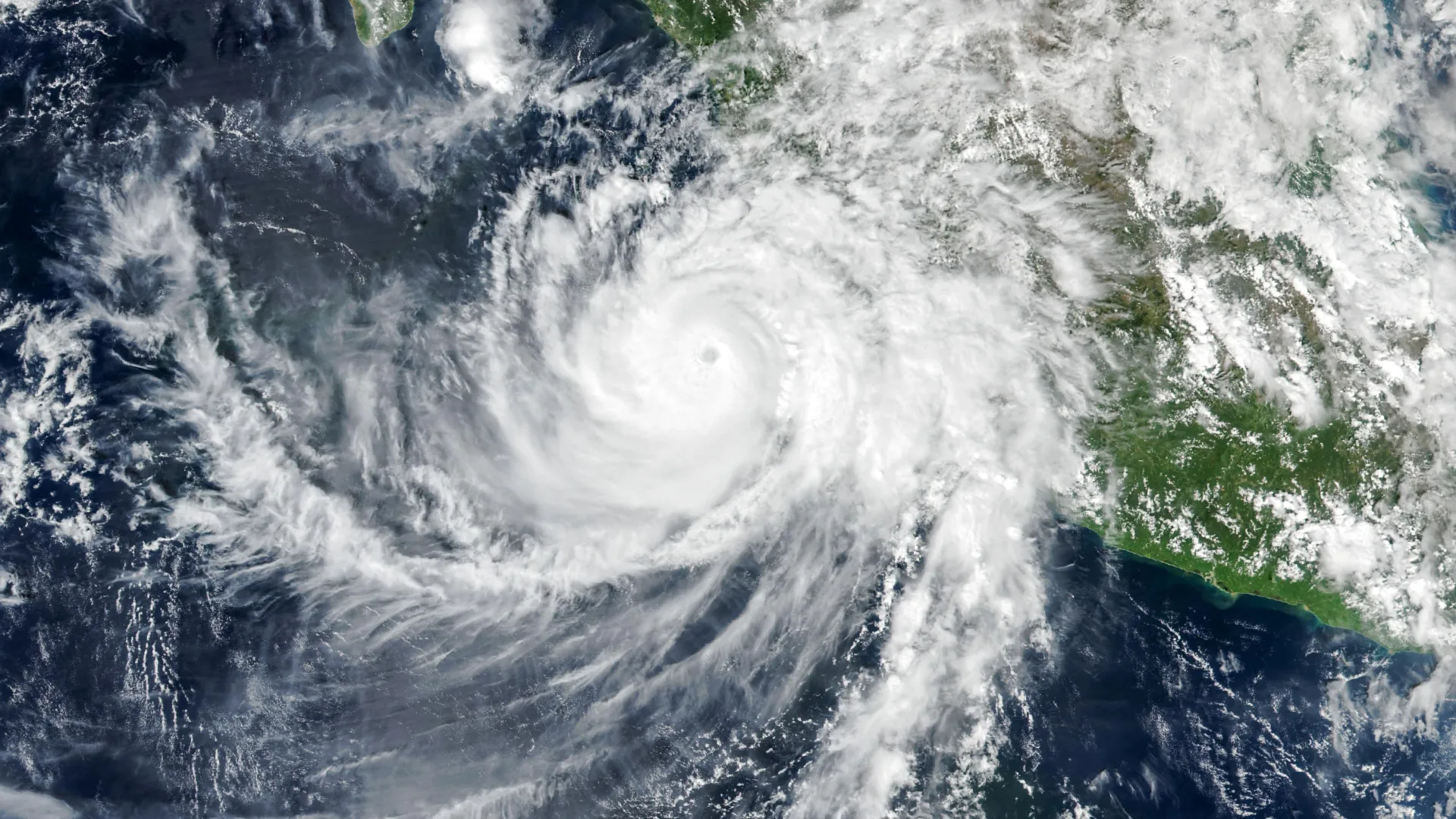
Despite remaining offshore, Hurricane Simon battered Mexico’s Pacific coast with powerful winds and flooding. At the same time, NASA satellites captured an extraordinary sight high above the storm: enormous waves rippling through Earth’s upper atmosphere.
Hurricane Simon was the latest in a series of powerful tropical cyclones to sweep across the Eastern Pacific during the 2026 hurricane season. On October 11, 2026, the Category 4 hurricane moved dangerously close to Mexico’s coastline as it traveled north-northwest, with sustained winds reaching 250 kilometers (155 miles) per hour.
Hurricane Simon Batters Mexico’s Pacific Coast
At approximately 2:30 p.m. local time (20:30 Universal Time) on October 11, the VIIRS (Visible Infrared Imaging Radiometer Suite) instrument aboard NASA’s Suomi NPP satellite captured an image of the massive storm. At that moment, Simon’s eye was located roughly 50 kilometers (30 miles) offshore, between the coastal cities of Manzanillo and Puerto Vallarta.
According to the National Hurricane Center (NHC), sustained winds had weakened to approximately 210 kilometers (130 miles) per hour by the time the image was taken. However, the hurricane’s powerful inner core was still moving close enough to threaten communities along the coast.
The Sierra Madre mountains appeared to help limit Simon’s strength, with the rugged terrain reducing the storm’s intensity and shrinking the area affected by its winds. Even so, the hurricane brought torrential rainfall and flooding to coastal communities, including the port city of Manzanillo. The heavy rain also increased the threat of dangerous mudslides in mountainous regions, according to news reports.
NASA Captures Strange Waves Above the Hurricane
While Simon churned across the Pacific, satellites detected something remarkable happening far above the clouds.
During the early morning of October 11, the storm generated rippling disturbances that traveled into Earth’s upper atmosphere. A nighttime satellite image, captured by the VIIRS instrument aboard NOAA-21, revealed atmospheric gravity waves spreading outward from the hurricane.
These waves are created by intense activity within the storm. Near the hurricane’s eyewall, the release of latent heat fuels powerful convection, causing warm, moist air to surge upward and form towering cumulonimbus clouds.
The strong updrafts inside these clouds can disturb the surrounding atmosphere, generating waves that travel upward into the stratosphere and mesosphere. Unlike ocean waves, which move through water, atmospheric gravity waves are disturbances that propagate through the air, with gravity acting as a restoring force.
Why the Rare Atmospheric Ripples Were Visible
Although powerful hurricanes can generate atmospheric gravity waves, satellites cannot always detect them. Strong winds at high altitudes can weaken or disperse the disturbances before they reach the mesosphere, where they may become visible through a phenomenon known as airglow.
Airglow is a faint, natural light produced by gases high in Earth’s atmosphere. When atmospheric gravity waves pass through this glowing region, they create subtle variations in brightness that can reveal their distinctive ripple patterns.
The VIIRS instrument’s day-night band is sensitive enough to detect this faint light. However, it also captures moonlight reflected from Earth’s surface and atmosphere, which can make the much weaker airglow difficult to distinguish.
Fortunately, conditions were unusually favorable when the satellite observed Simon. With very little illumination from the Moon, the delicate atmospheric ripples stood out more clearly, allowing the satellite to capture the striking patterns.
Hurricane Simon’s Unpredictable Path Raises Concerns
By the morning of October 13, meteorologists were still struggling to predict where Simon would go next and how strong it might become.
The National Hurricane Center described confidence in its intensity and track forecasts as “very low confidence,” reflecting how the storm had repeatedly behaved differently than expected.
At the time, one possibility was that Simon could turn northward, enter the Gulf of California, and eventually make landfall.
Regardless of its exact path, large ocean swells generated by the hurricane were expected to create hazardous conditions along portions of Mexico’s southwestern and west-central coastlines in the following days.
NASA Earth Observatory images by Michala Garrison, using VIIRS data from NASA EOSDIS LANCE, GIBS/Worldview, the Suomi National Polar-orbiting Partnership, and the Joint Polar Satellite System (JPSS).
