


Stay informed with free updates
Simply sign up to the Technology sector myFT Digest — delivered directly to your inbox.
The writer is a fellow at the Asia Society Policy Institute’s Center for China Analysis
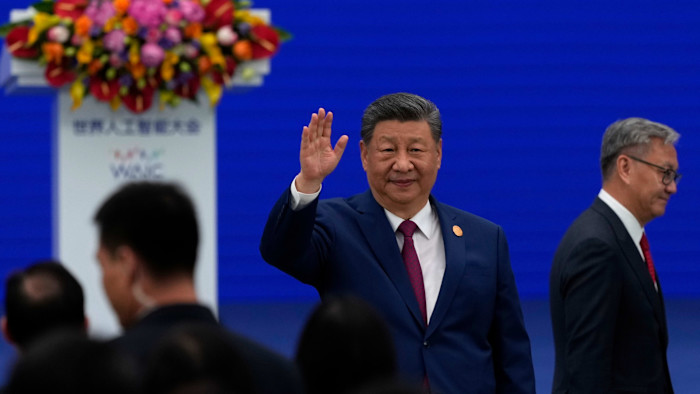
At the recent World Artificial Intelligence Conference in Shanghai, President Xi Jinping positioned China as a champion of low-cost, open-source AI. He framed this as a global public good in contrast with the US alternative.
China is beginning to construct its own self-sustaining, internally reinforcing AI ecosystem — and is increasingly offering it abroad. Beijing’s geopolitical foothold in critical infrastructure is increasing and countries adopting Chinese AI will, over time, absorb Chinese approaches to technical standards and governance principles.
This has come about, in part, due to the own goal that is recent US export controls. By imposing real costs on Chinese AI, export controls have inadvertently become an organising principle for China that goes beyond technological self-reliance. Now the end result is becoming increasingly appealing to the rest of the world.
The original China shock came with the manufacturing revolution that followed the country’s entry into the World Trade Organization. China shock 2.0 was the cleantech wave of solar panels, batteries and electric vehicles. China shock 3.0 has been the diffusion of Chinese digital technology, from ecommerce to recent AI models. China shock 4.0, now on the horizon, will be quite different. It will be based not only on the export of Chinese technology but on China’s approach to innovation as a national project.
The open AI strategy itself is a product of constraint. Before Chinese start-up DeepSeek threw open-weight AI into the limelight in 2025, Huawei had already made a major contribution to China’s open-source development. After it was placed on the US Entity List in 2019, restricted access to American hardware and software pushed the company to build open-source software ecosystems such as HarmonyOS and MindSpore.
Although Xi used the term kaiyuan, which translates as “open source”, Chinese AI models should be more accurately described as open weight. Their model weights are publicly available, but the full training data is not.
Open-weight models lower adoption costs, expand developer communities and allow companies to work around constraints imposed by a lack of access to the most advanced chips. They are especially attractive to emerging markets but are gaining popularity among developers worldwide because of their cost efficiency and adaptability to different workloads.
Within China they are also an economic necessity. The country’s old growth engines are under strain and domestic demand remains weak. For the technology sector, this creates a basic problem: enormous spending on AI models, computing infrastructure and advanced manufacturing requires access to customers capable of generating returns. With domestic revenue limited, going global with lower-cost models that spread quickly helps solve that problem.
The proliferation of open-weight Chinese AI has also heightened the country’s interest in speeding up AI governance and safety. Once model weights are released, they can be downloaded, modified, redistributed and stripped of safeguards. The original developer loses the ability to revoke access or update protections. This is already shaping the discussion around “selective openness” — keeping models open while potentially delaying or restricting access to, or requiring review of, the most advanced frontier systems.
Xi’s ambition is to accelerate the global proliferation of Chinese technology, build a stronger strategic foothold abroad, diversify China’s exposure to geopolitical risk and shape the global system more in China’s favour.
Granted, China’s thinking around governance is still nascent. Authority is distributed across an overlapping system: Shanghai is building much of the technical evaluation infrastructure while Beijing works on risk frameworks and regulation. Organisations such as the China Academy of Information and Communications Technology and the National Information Security Standardization Technical Committee play roles alongside universities and private companies. It is messy and fluid. But the technical capacity beneath it is becoming more substantive.
The momentum behind China shock 4.0 is strong. Geopolitical constraints are helping to crystallise a new and distinct model of technology governance. The next shock will not arrive in a container ship. It will spread via the principles that surround Chinese AI technologies. The world is not prepared for what will come next.
