


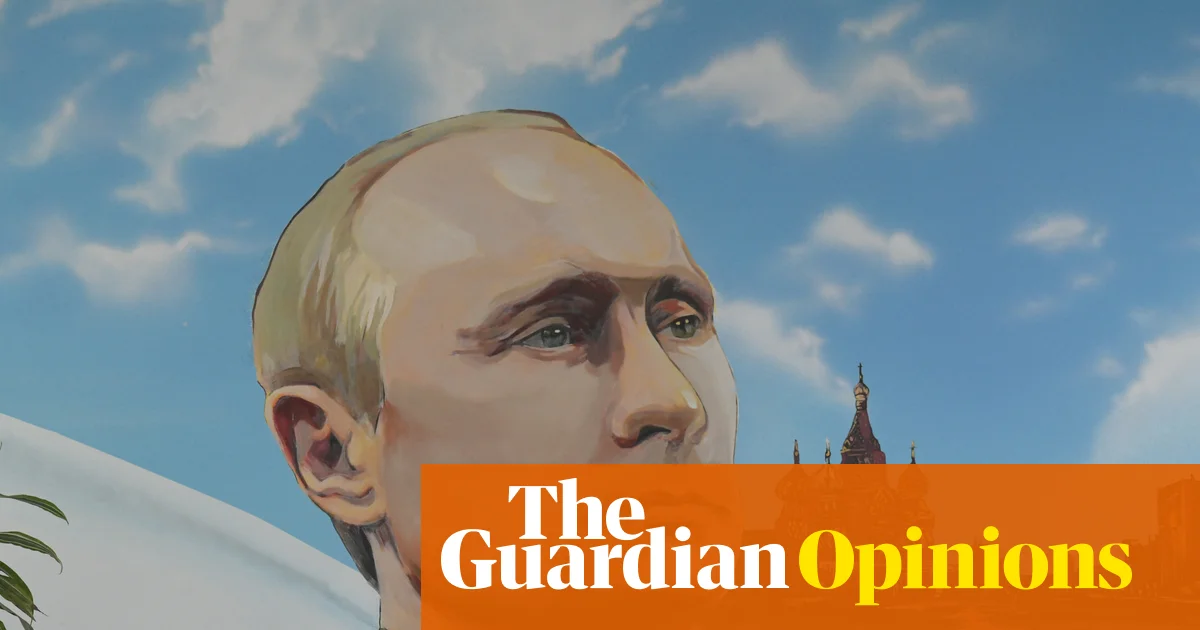
Vladimir Putin is escalating both his full-scale war against Ukraine and his shadow war against the rest of Europe. His main purpose in the shadow one is to break European support for Ukraine so he can subjugate that country, something he regards as existential for Russia’s future and his own. While we in the rest of Europe must prepare as best we can to defend ourselves against every kind of hybrid attack, the central thrust of our response should be to redouble our support for Ukraine. Ukraine is his main target. It’s there, and only there, not in a contest of a thousand hybrid pinpricks, that Putin’s Russia can in a meaningful sense be defeated and deterred.
In a powerful new book, Warum Russland nicht aufhören wird (Why Russia Won’t Stop), the German historian Martin Schulze Wessel shows how Putin’s policy fits into a much older Russian tradition of territorial expansionism and striving for hegemony, combined with a religiously infused imperial ideology. He reminds us that in 2016 Putin said “Russia’s frontier ends nowhere” and in 2025, “wherever the boot of a Russian soldier steps, that is ours”. West Europeans, fondly imagining that we have consigned such brute territorial imperialism to the dustbin of history, tend to think there must be some other explanation (eg something we did “wrong”, like the eastward expansion of Nato). Finns, Estonians and Poles know better. Despite Russia’s weaknesses, the author concludes, it is “the most dangerous country in the world”. Some in Asia might question that large claim, but certainly Russia is the most dangerous country for Europe.
Schulze Wessel makes another simple but very pertinent point: Russia’s expansion was always facilitated by cooperation with other great powers and arrested when it faced equal and opposing powers. Since Donald Trump’s return to the White House last year, the United States has ceased to be the latter and has at times looked like the former. So now it’s Europe that is shouldering the burden of being the equal and opposing power. Europe (including the UK) has now given more aid to Ukraine than the US. Its combined economies are 10 times larger than Russia’s; Germany’s economy alone is twice the size.
And it’s Germany that’s now central to this European effort. Cumulatively, since the beginning of the full-scale war in 2022, Germany has been the biggest individual country donor apart from the US. According to the Kiel Institute’s Ukraine support tracker, it has given twice as much as Britain or France. As people in Kyiv and Odesa are daily pounded by Putin’s ballistic missiles and jet-powered drones, it’s worth looking at the Kiel tracker’s figures for air defence systems. Germany has so far donated 19 of them, including five of the vital US-built Patriot air defence batteries – two more than the US itself has given.
In the first year of this war, I argued that Germany “has a unique historical responsibility to help defend a free and sovereign Ukraine”. At that time, I felt strongly that Germany was not yet doing what it should. Now, in the fifth year of a conflict that has already lasted longer than the first world war and shows no sign of ending, I can say without hesitation that it is. This is not just a matter of the numerical scale of its support for Ukraine and its own increased defence spending, which, on the latest projections from the German finance ministry, will reach €154bn (£130bn) in 2028 (Roughly the same as Russia’s total estimated military expenditure for this year).
It’s also a matter of political will. Chancellor Friedrich Merz has shown that will, and courage, by taking the train from Germany to Ukraine on the evening of 3 October, the 36th anniversary of German unification, with a strong delegation including defence industry leaders. The Russian bombardment of civilian targets in central Kyiv, including Ukraine’s National Academy of Sciences and bridges across the Dnipro River, did not stop even though – or perhaps exactly because – Moscow knew the German leader would be there.
For a historian, there’s something very familiar here. Oh no, it’s Germany and Russia again! Yet each time is different. Historically, Germany is one of the powers that has done most to facilitate Russian expansion (just think of the 1939 Hitler-Stalin pact) but also most to threaten it. In the first world war, and even at the margins in the second, some Ukrainian nationalists saw in a conflict between Germany and Russia a chance for their independence. Instead, they got imperial Germany’s colonialism (and then German defeat) in the first case and Hitler’s genocidal fascism (and then German defeat) in the second.
Now, at last, Germany is genuinely engaged, at some cost and risk to itself, for the sovereignty of Ukraine. To anyone who knows this tangled history, there is something not just redemptive, but frankly inspiring in this sight: a democratic Germany playing a leading role in supporting an independent Ukraine’s bid to assume its proper place in a wider European community of free countries.
But for how long? And with how much support elsewhere in Europe? Precisely because Putin sees Germany’s centrality, it’s one of the main targets of his hybrid war, from explosive-laden drones at Leipzig airport that the German government has firmly attributed to Russia and assassination threats against defence industry bosses, all the way to covert political interference and disinformation. While Ukraine faces its most difficult winter yet, three closely connected things will be put to the test: Germany’s will to stay committed on the right side of history; the capacity of democracies to sustain the fight against a dictatorship (a perennial concern); and Europe’s ability to remain united in this cause.
after newsletter promotion
A sceptic can point to many grounds for pessimism. Merz is unpopular at home. Alternative für Deutschland (AfD), the party currently making the running in German politics, would abandon Ukraine to Russia. In France, the National Rally’s presidential candidate, Marine Le Pen, says her country can’t afford to go on giving so much to Ukraine. Solidarity with Ukraine is also crumbling on the right in Poland, with two smaller parties sounding frankly anti-Ukrainian. In one Italian opinion poll last month, more than half those asked were opposed to continued weapons deliveries to Kyiv.
In Brussels recently, I found a large audience seemingly stalwart in support of Ukraine – until, right at the end, our discussion turned to the issue of using the Russian frozen assets held in Belgium. Ah now, that’s a different matter … Yet with the terrible damage being inflicted on the Ukrainian economy, including its grain exports via the Black Sea, experts estimate that as much as €100bn of additional support for Kyiv may be needed in 2027 alone – and hard-pressed European taxpayers are in no mood to cough that up.
Putin believes decadent European democracies will crumble before the iron determination of an imperialist strongman. Our job is to prove him wrong.
-
Timothy Garton Ash is a historian, political writer and Guardian columnist. His new book, Europe in 7½ Chapters, is published next week
