


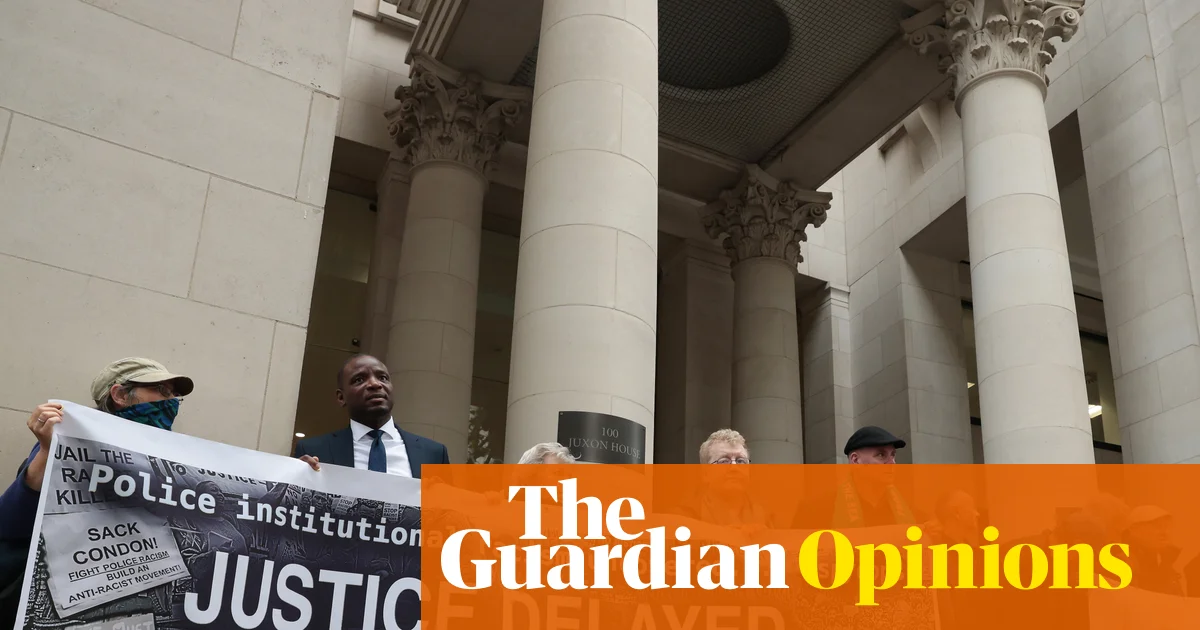
In June 2013 Peter Francis, a former Metropolitan police officer, broke a 20-year silence about the role he had played in surveilling the family of Stephen Lawrence in a documentary jointly made by the Guardian and Channel 4’s Dispatches programme. Two years later, thanks in part to the programme, the Home Office established an undercover policing inquiry, commonly known as the spycops public inquiry, to shed light on the scale of surveillance of activists and trade unionists. That inquiry is now under threat.
Francis had served in the Special Demonstration Squad (SDS), a Met unit founded in 1968 whose officers lived for years at a time inside political and campaigning organisations under false names.
In the months after Stephen Lawrence’s murder in 1993 Francis had been deployed to pose as an anti-racist campaigner. His superiors pressed him to find “dirt” that could be used against the Lawrence family and their supporters. Stephen’s mother, Doreen, told the Guardian and Channel 4 that nothing she had heard since her son died had topped the revelation that police had been spying on her while she grieved. She had always suspected the police were watching. She never had proof.
The Lawrences were not an isolated case. Justice campaigns and trade unionists across the country were also monitored.
At least 139 officers adopted fake names, pretending to be political activists, to spy on people between 1968 and at least 2010. Dozens of anti-racist campaigners, family members of victims of police violence and leftwing activists have been surveilled by police.
Suresh Grover, whose Monitoring Group stood behind many of these victims of police surveillance, has told the inquiry that the suspicion directed at Black campaigners was rooted in racist stereotyping. Complaints from Black communities were treated as a public order threat in a way that identical complaints from others were not.
The government has justified the consultation they launched on 16 July into the future of the inquiry on the grounds that it has gone on for more than 11 years and cost £137m. The figures are accurate but their explanation is missing.
Applications for anonymity and restriction orders, the vast majority sought by police officers, have slowed down this inquiry. Litigation over cover names, and a persistent unwillingness among former officers and their commanders to say what they did has also hampered the process. The Met, which ran the SDS, made the inquiry slow and expensive. The same government department that funded and served the squad now cites the inquiry’s slowness and expense as reasons to cut it short.
Despite a push to wind up the inquiry, it is still producing revelations about the conduct of England’s police forces. Just last year, it revealed that an undercover officer, James Thomson, who had deceived two women into intimate relationships, was suspected of fabricating an elaborate plot to link an anti-foxhunting activist to a gun that he told managers the activist intended to collect in France.
Before the inquiry, Thomson’s managers admitted that in order to protect the SDS, nothing was done either about his intimate relationship with women he was surveilling or his possible fabrication of evidence. The unit, it seemed, trumped almost anything.
The inquiry also exposed numerous instances in which managers appeared to have knowledge of undercover officers having had sexual relationships that continued long after undercover deployments ended, in one case even after the announcement of the inquiry.
Another shocking discovery from the inquiry is that the Met spent £2.5m hiding an officer – John Dines – from his former lover, going as far as to relocate him from New Zealand to Australia for that purpose.
after newsletter promotion
For the spycops scandal to be possible courts had to be misled. Officers were arrested alongside activists, appeared in court under false names and in some cases gave evidence under them without the court being told.
Surveillance was not limited to political activists and victims of racist violence. The Met’s own investigation concluded that special branch and the security services fed material to construction companies that blacklisted more than 3,000 workers suspected of being members of trade unions.
More instances of misconduct may come to light in the future, which is all the more reason to keep the inquiry running. The consultation is scheduled to end on 20 September, but there is still time to write to the Home Office to make sure that the government knows your views.
An inquiry that was set up because the state spied on the parents of a murdered child should not be closed down because the state has heard enough about itself. Doreen Lawrence has been told for 33 years that the truth is coming if she will wait just a little longer. She – and other victims of spying – have waited long enough. The inquiry should finish the job it was given.
