

Close Menu
NCIJ Network NCIJ Network
    What's Hot

    OT Security Guidance: NIST Drafts Updated Guide, CISA/FBI Advise on ICS Integrators

    September 24, 2026

    The Quantum Issue: You Never Really Know The Future

    September 24, 2026

    Rare pregnancy infections may triple the risk of autism

    September 24, 2026
    Facebook X (Twitter) Instagram
    Trending
    • OT Security Guidance: NIST Drafts Updated Guide, CISA/FBI Advise on ICS Integrators
    • The Quantum Issue: You Never Really Know The Future
    • Rare pregnancy infections may triple the risk of autism
    • A Battle Brews Over Maine’s Salmon Farms
    • WATCH: Construction starts on ‘world’s most powerful’ trenching support vessel
    • Did Tom Tiffany vote to give data center operators a $68 billion tax break?
    • Abandoned, dismissed and gaslighted: there is no excuse for the way ME sufferers have been betrayed | George Monbiot
    • Trump’s Board of Peace unveils $2.45bn Gaza recovery plan
    • About
      • Our Team
      • Editorial Policy
      • Editorial Independence
      • International Support
    • Trust & Standards
      • AI Usage Policy
      • Conflict of Interest Policy
      • Corrections Policy
      • Ethics Policy
      • Fact-Checking Policy
      • Source Protection
    • Get Involved
      • Guide for Sources
      • Support Independent Journalism
    • Legal
      • Cookie Policy
      • Privacy Policy
      • Terms of Use
    Facebook X (Twitter) Instagram
    NCIJ Network NCIJ Network
    Thursday, September 24
    • Home
    • World
    • Ai
    • Business
    • Politics
    • Health
    • Crypto
    • Science
    • Technology
    • Cybersecurity
    • Defense & Security
    • Economy
    • Energy
    • Europe
    • More
      • Fact Check
      • Investigations
      • Opinion & Analysis
      • Environment
    NCIJ Network NCIJ Network
    Home»Opinion & Analysis

    The Guardian view on India’s green growth gamble: it will need more than private finance | Editorial

    NCIJ NETWNCIJ NETWORKBy NCIJ NETWNCIJ NETWORKAugust 9, 2026 Opinion & Analysis No Comments3 Mins Read
    Share
    Facebook Twitter LinkedIn Pinterest Email

    India is attempting to do something the world has never seen before. So claimed Niti Aayog, the government of India’s policy thinktank, earlier this year. It said that no major economy has tried to expand GDP nearly eightfold within a generation while simultaneously redirecting its energy and industrial systems to reach net zero within two generations. Hence its detailed report’s claim that there is “no historical precedent”.

    There is something to this. China industrialised at vast scale, but not on a sustainable net zero path. Korea, Japan and Europe became wealthy by industrialising before decarbonising. Today, rich nations have already satisfied the basic demands of their people and created the infrastructure and high per-capita energy use that India is still trying to build. The world’s most populous country has to do this while also reducing emissions.

    The climate emergency is all too real for New Delhi. In April, on a single day, all of the planet’s top 50 hottest cities were in India. Yet the country still relies heavily on coal, especially at moments of peak power needs. This sets up a dangerous feedback loop: heat drives cooling demand; cooling demand drives coal-burning; coal‑burning drives temperatures higher. India is trying to change course. Non-fossil fuel sources now account for more than half of installed electricity capacity.

    The report assumes India reaches $30tn GDP by 2047, with rising urbanisation, industrialisation and living standards. India’s net zero path will be judged politically by who bears the costs and who captures the gains. But the thinktank reasons that as India grows fast, so energy and infrastructure demand and investment rise too, and, voilà, India continues to grow fast. This may be a virtuous cycle. But left unexplained is what source of demand gets the process going and sustains it.

    That requires a political economy of investment. It means explaining who spends first, who guarantees demand, how businesses are induced to keep building when existing factories are not fully used, and how private profitability is maintained when consumption’s share of national income falls.

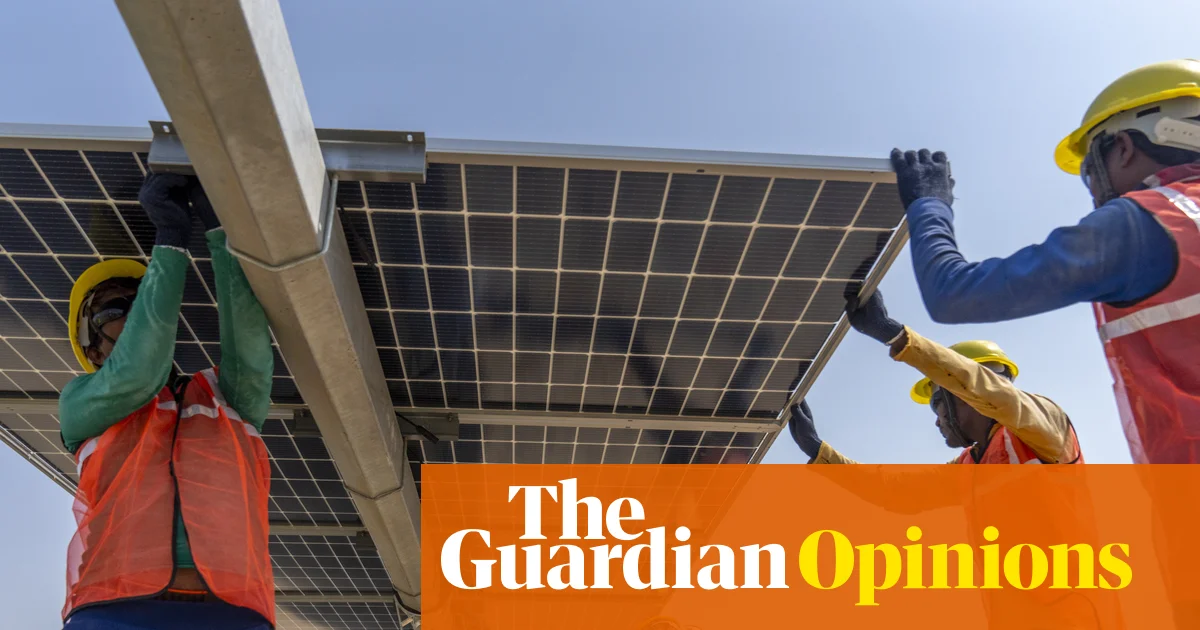
    India’s solar success partly answers these questions. In a 2025 paper, the political economist Mathias Larsen argues that India’s advances in sunlight-powered electricity came because the state created a market, used public sector financial firepower and protected domestic producers. That is not a story of private finance spontaneously allocating capital. It is a story of state-made demand.

    But solar is one sector. A whole-economy transition may not work the same way. What happens when domestic demand can’t soak up the state-created capacity? China answered that question through exports, but only because of a historically exceptional bargain. Washington opened the American market to China on favourable trading terms in 1979. Nothing reversed that access. China’s government was allowed to heavily intervene in the macro- and micro-economy to drive rapid industrialisation and growth inside the US-led trading global system.

    India faces a far more hostile environment. It is industrialising in a world of fragile supply chains, climate trade barriers and Chinese export overcapacity. That makes the question of India’s domestic demand more important, not less. The mainstream view still assumes private investors will allocate capital efficiently once cash is mobilised. But that does not explain why firms would invest at the necessary scale unless the state spends first, guarantees markets and coordinates sectors. This, sadly, may be the truth that cannot speak its name.

    Editorial Finance gamble green growth Guardian Indias private view
    NCIJ NETWNCIJ NETWORK
    • Website

    Keep Reading

    Abandoned, dismissed and gaslighted: there is no excuse for the way ME sufferers have been betrayed | George Monbiot

    We’re in a crisis of loneliness – but is buying friends on an app likely to help solve it? | Elle Hunt

    The west is in freefall – and the worst part is that we were warned, but chose not to listen | Owen Jones

    Germany Under Friedrich Merz Has Lost Its Authority at Home and Abroad

    Britain would not cut up the Bayeux tapestry. So seize this moment and reunite the Parthenon sculptures in Greece | Kyriakos Mitsotakis

    Ajay Banga Is on a Mission to Create Jobs. Here’s How He Plans to Do It.

    Add A Comment
    Leave A Reply Cancel Reply

    Editors Picks

    OT Security Guidance: NIST Drafts Updated Guide, CISA/FBI Advise on ICS Integrators

    September 24, 2026

    The Quantum Issue: You Never Really Know The Future

    September 24, 2026

    Rare pregnancy infections may triple the risk of autism

    September 24, 2026

    A Battle Brews Over Maine’s Salmon Farms

    September 24, 2026
    Latest Posts

    Ransom Cartel ransomware creator sentenced to 16 years in prison

    August 5, 2026

    Uber CEO brushes off reports of a Waymo break-up

    August 5, 2026

    Fauci Faces Contempt Vote. Here Are the Legal Issues Involved.

    August 6, 2026

    Subscribe to News

    Get the latest sports news from NewsSite about world, sports and politics.

    NCIJ Network is an independent digital news platform delivering trusted investigative journalism, European and global news, in-depth analysis, and fact-based reporting with accuracy, transparency, and integrity.

    Facebook X (Twitter) Instagram Pinterest YouTube

    OT Security Guidance: NIST Drafts Updated Guide, CISA/FBI Advise on ICS Integrators

    September 24, 2026

    The Quantum Issue: You Never Really Know The Future

    September 24, 2026

    Rare pregnancy infections may triple the risk of autism

    September 24, 2026

    Subscribe to Updates

    Get the latest creative news from FooBar about art, design and business.

    Type above and press Enter to search. Press Esc to cancel.