


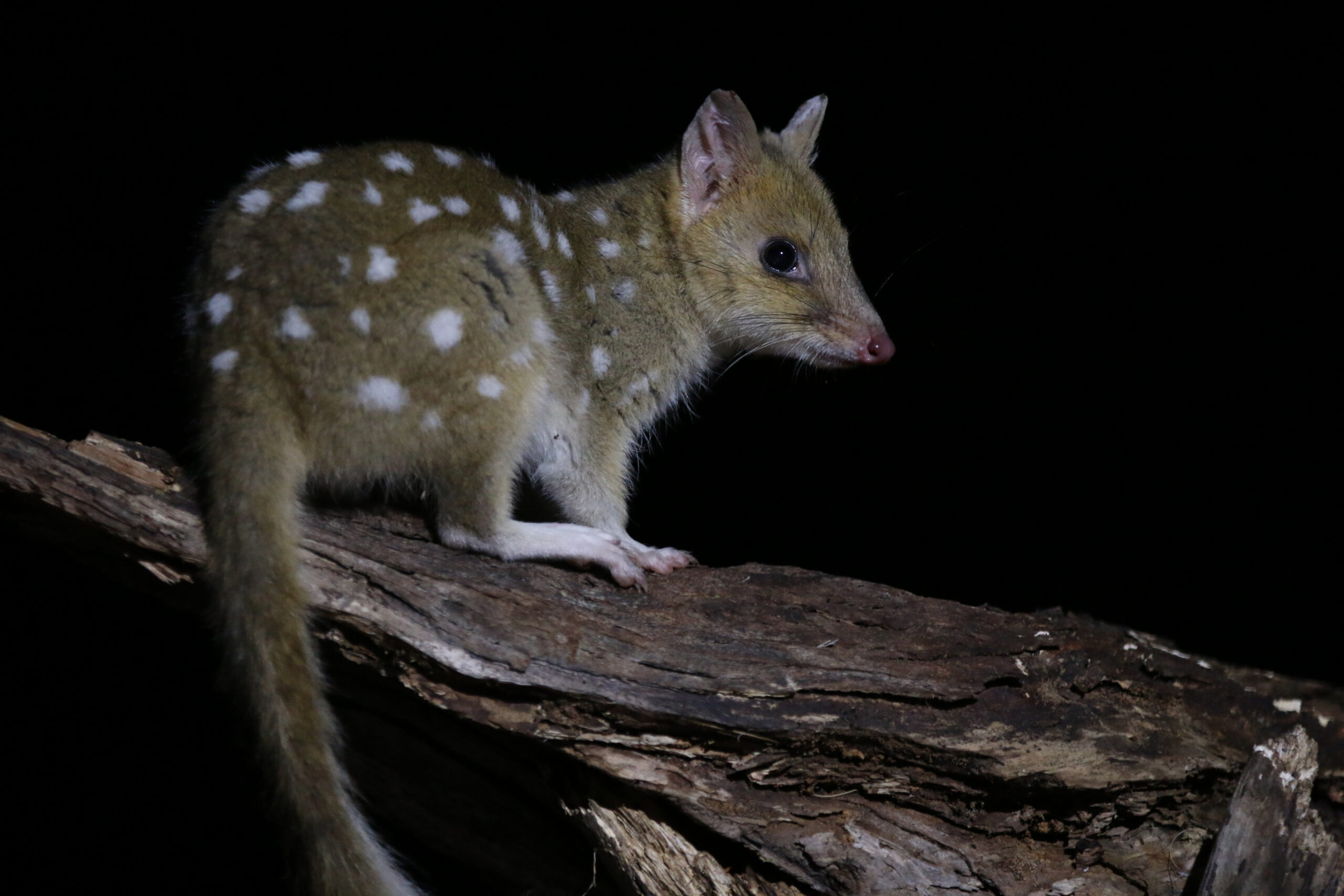
- The endangered eastern quolls are functionally extinct in the wild on the Australian mainland, but wild populations still survive in Tasmania.
- In fox-free Tasmania, predation by cats is likely a driver of wild population decline.
- Released captive-bred eastern quolls in Tasmania are now demonstrating successful interbreeding with wild populations.
- Meanwhile, work to rewild eastern quolls on the mainland has seen captive-bred quolls released into predator-proof conservation reserves, with plans to scale up over the coming years.
SYDNEY — The endangered eastern quoll, one of Australia’s species of quoll, is a nocturnal carnivorous marsupial that is small in stature with a ferret-like pointed face and a bushy tail. The mammal has two primary color variants: Light fawn and blackish-brown, with white spots on the body.
Once so widespread along the eastern coastal fringe of Australia, the eastern quoll (Dasyurus viverrinus) was described as being in “plague abundance” and was occasionally kept as a pet and prized by farmers for its skills in hunting rodents. It was even called a native cat in the 1800s due to its resemblance in both size and hunting behavior to the domestic feline, brought by settlers from Europe.
Despite its onetime abundance on the Australian mainland, by the 1960s the last known remaining eastern quoll population was lost. Disease, habitat loss, car strikes and predation by cats, dogs and invasive foxes led to the demise of the species.
However, a taxidermied specimen of an eastern quoll emerged in 2016, purportedly originally picked up as roadkill in the Barrington Tops, northwest of Sydney, in 1989 and handed over to the National Parks and Wildlife Service nearly three decades later. This could mean that the species survived for decades longer than official records suggest.
Although now considered extinct in the wild on the mainland, the eastern quoll has not been lost entirely. The southern Australian island of Tasmania, free of the predatory invasive foxes, is home to a number of wild populations of eastern quoll.
The exact number of eastern quolls is not available, though the IUCN Red List estimates the population to be between 10,000 and 12,000 mature individuals. However, those numbers are from a 2014 assessment.
They mainly lived in northern and eastern Tasmania, according to a 2023 study that used historical wildlife survey data and contemporary sightings. However, the research also revealed a dramatic drop in their population across Tasmania since records began in 1985, sharply dwindling in 2000 and in 2009.
“Some of the research that has come out over the last decade or so shows this concerning downward trajectory in eastern quolls in Tasmania,” said David Hamilton, a conservation ecologist at the Tasmanian Land Conservancy and adjunct researcher in the School of Natural Sciences at the University of Tasmania.
“There was a steep decline around the start of this century, and that’s continued unabated in some areas, whereas in some others they’ve recovered relatively well,” the scientist told Mongabay. “While the initial declines were strongly linked to climate, we don’t really know why some populations have failed to recover.”
Cats versus eastern quolls
Hamilton is part of a collaboration of scientists and conservationists at universities, zoos, sanctuaries, NGOs and captive-bred facilities who are working to better understand the threats eastern quolls face in Tasmania.

The collaborating scientists and conservationists are attempting to overcome the challenges posed by predation pressure as they attempt to bolster the wild populations of eastern quolls in Tasmania.
Rob Brewster, rewilding manager for NGO the Invasive Species Council and a partner in the collaboration, believes cats are a significant contributor to eastern quoll deaths in Tasmania.
“We know that some of our quolls that we’ve released in Tasmania as part of that Tasmanian Land Conservancy-University of Tasmania partnership have been killed by cats,” he told Mongabay. “We can directly implicate cats in the decline of eastern quoll populations in Tasmania.”
The state’s rules around cat containment, which are part of an effort to impose stronger protections for wildlife, are a major point of concern for Brewster. “We’re seeing the sort of dithering cat management plans that spend vast sums of money interviewing people around the state and cat lobby groups, and coming up with, ‘We’re not ready for cat containment,’” he said.
‘Rewilding’ efforts underway
The scientists and conservationists turn to “rewilding” to boost the populations of eastern quolls.
Rewilding is “a term to engage people and is a little more exciting than simply restoration,” Brewster explained, adding that it is about “replanting animals in the landscape.”
The rewilding efforts have gone through trial and error.
A 2025 study, written by Hamilton, Brewster and other scientists, documented the release of 20 captive-bred adult eastern quolls (10 males and 10 females) in November 2020 into Silver Plains, a 6,500-hectare (16,000-acre) conservation property owned by the Tasmanian Land Conservancy.
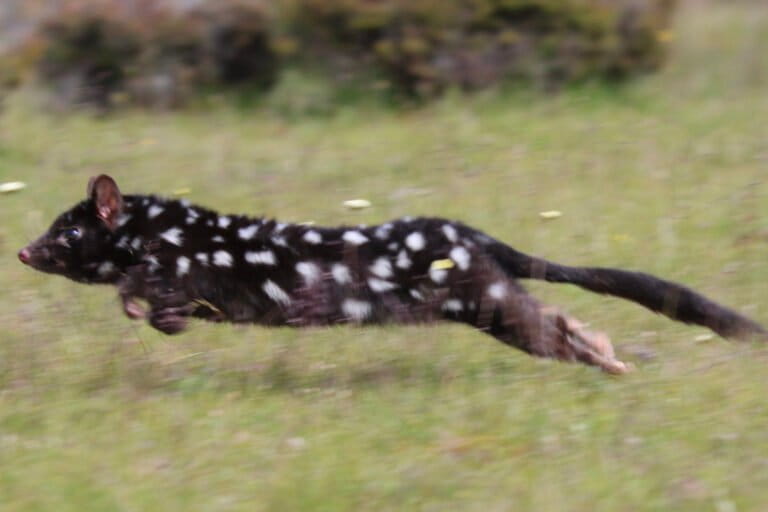
Although the researchers expected to see these translocated eastern quolls reproduce and help grow the population, genetic testing of juveniles trapped in December 2021 and January 2022 revealed that none of the released adult animals from the November 2020 cohort contributed to the genetic makeup of the population.
“We think that was partly down to the fact that there was a release of adults who hadn’t had any reproductive experience in the wild,” Hamilton said.
Not to be disheartened, Hamilton and the team have gone on to release multiple cohorts of eastern quoll into other parts of Tasmania where populations are struggling to recover, including The Quoin, a 5,000-hectare (12,360-acre) private conservation property.
In these subsequent releases, the researchers adopted a slightly different approach. Instead of all adults, they released a mix of adult and juvenile quolls.
After an initial slow start, captive-bred eastern quolls released into The Quoin in 2025 led to a promising discovery.
“These animals have gone out and reproduced successfully and contributed towards the next generation in their new environment,” Hamilton said.

Mainland challenge
While released eastern quolls in Tasmania giving birth to joeys is good news for conservation, the success of eastern quoll rewilding on the mainland is much less forthcoming.
Despite good captive-breeding numbers, it has been far more challenging to reintroduce the eastern quoll to the mainland, said Liz Gerber, conservation and community engagement manager and eastern quoll project lead at Sydney Zoo.
“They have a flight or freeze response,” Gerber told Mongabay. “They often choose freezing.”

Their survival tactic has served the eastern quoll well for thousands of years, as it is perfectly suited to hiding from a native predator like a bird of prey flying around up in the sky. However, it does not work well for predators like foxes, dogs and cats.
In a 2018 pilot program run by organizations led by Parks Australia, 20 eastern quolls were released into the unfenced Booderee National Park. In the first three months of that program, 14 were lost mainly due to fox predation.
Sydney Zoo began a breeding program in 2024 that aims to rear captive-bred eastern quolls for release into fox-free fenced conservation properties on the mainland.
So far, the zoo has released nine eastern quolls, including four joeys in January 2026, into Bannockburn Rewilding Sanctuary, approximately 150 kilometers (93 miles) south of Sydney.

The long-term goal, according to Gerber, is to see more fox-free fenced land become available so that more eastern quolls can be released, allowing them to return to their important role in the Australian landscape.
With a diet ranging from insects such as cockroaches and spiders to small mammals like mice and rats, the marsupials help keep the ecosystem in balance.
“They are a really important scavenger in our environment. We have lost that key role in our bushland, the little recycler, the little scavenger that stops the spread of disease; it’s one of those species that we’ve had missing for so long,” she said.
“The question is, if we brought something like that back, would we see a change in our environment?”
Banner image: Australia’s eastern quoll is a nocturnal carnivorous mammal. Image courtesy of David Hamilton/Tasmanian Land Conservancy.
Bogong moths support Australia’s alpine ecosystems, but face uncertain future
Rescue networks built by fire: Saving animals from Australia’s bushfires
Citations:
Cunningham, C., Aandahl, Z., Jones, M., Hamer, R, … Johnson, C. (2023). Regional patterns of continuing decline of the eastern quoll. Australian Mammalogy, 45(2). doi:10.1071/AM22010
Morrison, J., Brewster, R., Burridge, C., Hamilton, D., Harrison, P., Kutt, A., …and Hamer, R. (2025). To Breed or Not to Breed? An Examination of Reproductive Success of Translocated Eastern Quolls. Ecological Management and Restoration, 26(3). doi:10.1111/emr.70014
Cite this article
Paul Harvey (2026). The conservation population of Australia’s endangered eastern quoll welcomes joeys. Mongabay Conservation news. DOI: https://doi.org/10.66709/news-327711

