


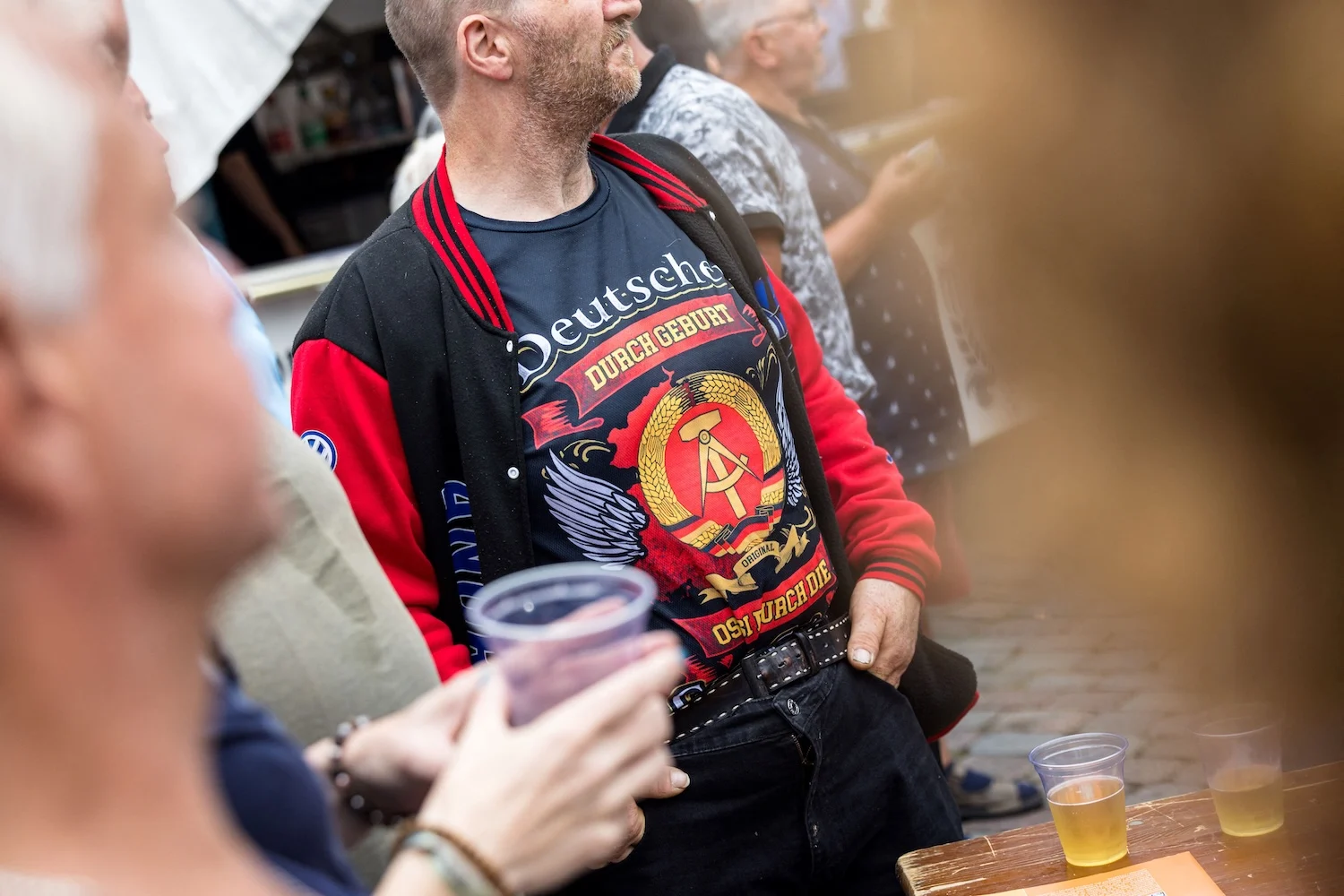
There’s a widespread consensus in Germany that the far-right Alternative for Germany (AfD) is a xenophobic far-right party that threatens the republic’s postwar political order. But there’s no accord on remedies—and, relatedly, no agreement about the sources of the scourge .
What seems clear is that the AfD’s variety of national populism is most heavily anchored in eastern Germany and traces back to the country’s Cold War division, the terms of its eventual unification, and East-West relations since 1990. But that surface-level agreement about recent history masks deeper disagreements about what exactly happened during those periods.
There’s a widespread consensus in Germany that the far-right Alternative for Germany (AfD) is a xenophobic far-right party that threatens the republic’s postwar political order. But there’s no accord on remedies—and, relatedly, no agreement about the sources of the scourge .
What seems clear is that the AfD’s variety of national populism is most heavily anchored in eastern Germany and traces back to the country’s Cold War division, the terms of its eventual unification, and East-West relations since 1990. But that surface-level agreement about recent history masks deeper disagreements about what exactly happened during those periods.
The AfD is not solely an eastern German phenomenon: Parties like it exist across the European Union, in the United Kingdom, and in the United States, too. In western Germany, the AfD breaks into double digits everywhere and even tops 20 percent in places. But its popularity is twice as high across eastern Germany—where polled rates of xenophobic sentiment are also much higher. The record result of 44 percent in Saxony-Anhalt’s state elections on Sept. 6 is conceivable only in an eastern state, at least for now.
One school of German historians explains the eastern mentality through the prism of the German Democratic Republic’s (GDR) fundamentally totalitarian character. Its clearest proponent is Ilko-Sascha Kowalczuk, a historian affiliated with the Stasi Records Archive, the repository of the GDR’s secret police files. Kowalczuk hails from a GDR family that was closely tied to the regime, a story he tells in his book Freiheitsschock (Freedom Shock), but broke with his family and cast off the system’s Marxist-Leninist straitjacket, which cost him the opportunity to attend university. (After unification, he studied history at Humboldt University.) At 22, he joined the countrywide demonstrations that eventually chased out GDR hardliners and caused the Berlin Wall to fall.
Kowalczuk emphasizes the all-encompassing totality of a state that dictated every facet of life to its subjects: “from cradle to grave,” indoctrinating and controlling through schools, party, mass organizations, and the workplace. Most historians who argue along Kowalczuk’s lines hold that the Stasi itself, through informant networks and an all-knowing, all-powerful apparatus, kept the GDR’s population of 16 million in line. Kowalczuk, however, argues that the Stasi itself was not as powerful as claimed or thought (or as portrayed in The Lives of Others): Much of its power of intimidation stemmed from its reputation, not its actual reach. In other words, eastern Germans, argues Kowalczuk, could have acted more independently and even defiantly had they had the gumption—but they didn’t.
Kowalczuk argues that East Germans passively allowed themselves to be subjugated, browbeaten, restricted, and instructed by the regime. They were obedient pupils internalizing its narrow-minded, racist, authoritarian character and reproducing it in families, schools, and society. He casts eastern Germans essentially as sheep who relinquished freedom in exchange for certainty and security. In his view, the so-called peaceful revolution of 1989 wasn’t instigated by these cowed masses but by a tiny minority of dissidents and rebels—like himself. The public took to the streets only once the regime was on the run, and then portrayed themselves as freedom fighters—and victims. The newly liberated East Germans had no conception of an alternative state or society beyond that which then-West German Chancellor Helmut Kohl, the “reunification chancellor,” dangled before their eyes.
Today’s eastern Germans, Kowalczuk says—even those born in a unified Germany—have undertaken too little to emancipate themselves from the GDR’s totalitarian mindset. They refuse to take responsibility for their own condition, demand the state provide for them, and express the same intolerance toward other cultures that the regime once did. The uncertainties that freedom presents are so unnerving that they retreat into nostalgia for the GDR—beyond even that in Goodbye, Lenin!—that idealizes its old ties to the Soviet Union and sympathizes with a dictator as ruthless as Vladimir Putin.
Kowalczuk’s most direct foil is Katja Hoyer, also a GDR-born historian, though she was only 4 years old when the peaceful revolution broke out. She’s known to English-language readers through her UK bestseller Beyond the Wall: East Germany, 1949 – 1990, which argues that life in the GDR was more textured than Kowalczuk acknowledges. East Germans lived and loved, had birthday parties and weddings, and enjoyed vacations and families. They weren’t passive, she argues, despite the formidable security apparatus. The GDR’s film industry—during periods of liberalization—even produced quality films like the 1973 cult classic Die Legende von Paul und Paula (The Legend of Paul and Paula).
Hoyer also credits GDR socialism with genuine achievements, such as women’s rights, affordable housing, and hands-on workplace participation. If unglamorous, just about everyone had a two-room apartment and, of course, a job. Rents were subsidized, healthcare free, and there was childcare for all families. Hoyer treats the relative material equality of the self-described “workers’ and farmers’ state” as a humane alternative to capitalism’s wealth gaps. “Many East Germans were proud of their achievements as social mobility provided unprecedented opportunities for the working classes,” she argues.
Although Beyond the Wall stops in 1990, elsewhere Hoyer argues that eastern Germans’ lives and achievements were dismissed in the united Germany as worthless “ballast.” West German condescension and the “sink or swim” into which eastern Germans were thrown in the 1990s caused resentment to fester, and snowball, and be passed on to subsequent generations. The problem today in Germany’s eastern states, she argues, isn’t that citizens are undemocratic but that the system is less democratic than they had expected. Materially, the easterners lag behind their western brethren not least because they had no assets when communism collapsed. She has sympathy for the hardships that economic union imposed.
Seen this way, the AfD vote is explicable. This party alone avoids demonizing the GDR, thus offering eastern Germans respect that none of the other parties do. The AfD may be German, Hoyer argues, but versions of it exist everywhere in Europe, including England, where she currently works. Eastern Germans’ “behaviors and characteristics have lazily been written off as a deviation from the west German norm, fostering a defiant us-against-them mentality,” she argued in 2024 in the Guardian. “This east German identity, combined with the feeling of being othered and marginalised, is a powerful thing for the AFD to exploit.” As for the racism and xenophobia, she attributes them to economic anxiety and condescension. The way to win back the easterners is to take their concerns seriously, including migration, and treat them with respect.
A third prominent commentator is Dirk Oschmann, a literature professor at Leipzig University. His take in Der Osten: eine westdeutsche Erfindung (The East: A West German Invention), a 2023 work widely discussed in Germany, is close to Hoyer’s but not identical. He contends that the western Germans’ derogatory labeling of easterners as lazy, dim-witted, bigoted complaining losers is a means to deflect legitimate criticism that the West itself flubbed unification. He argues that the lock-stock-and-barrel incorporation of eastern Germany into the Federal Republic constituted a one-sided takeover. There was, for example, no constitutional convention to create the unified Germany anew. East Germany’s economy was put on equal footing with West Germany’s overnight, causing it to implode—while western companies swooped into pick up the business. The East’s factories and firms were sold off to Western buyers, who made out like bandits. West German elites stepped into leadership posts across the East: in universities, police forces, hospitals—just about everywhere.
Oschmann considers Kowalczuk a proponent of this tendency by tracing everything back to the GDR itself, rather than the humiliation of unification and the travails of decades since. He explains the AfD and the power of the migration issue much as Hoyer does: as a response to grievances and disrespect. As for the East’s cultural racism, he admits its presence but calls the West’s pejorative treatment of the East a form of xenophobia or “othering.”
This surfeit of analysis begs the question of whether any response from the mainstream German parties can win AfD voters to their side. Certainly, German Chancellor Friedrich Merz thinks so. His remedy is to double down on restricting migration, the top reason for AfD voting. This was Merz’s answer before the Saxony-Anhalt vote and, while asylum applications have fallen by nearly half under Merz, there’s been no political payoff. Rather than vote for the copy act, 44 percent of Saxony-Anhalt’s voters cast their ballots for the original, the AfD, whose jingoism Merz chases after, while the CDU was rewarded with less than half of its previous vote share. The Social Democrats think better social safety nets will do the trick, even though AfD voters are not poor.
Germany’s political establishment is clueless how to handle the AfD’s surge—and the country’s historians, sadly, offer no concrete answers either.
