


For more information, contact Donald S. Parker, Kennedy Space Center, donald.s.parker@nasa.gov
Improper casting and forging processes in the manufacture of aluminum alloy 2219 can lead to microstructural defects that result in a sub-optimal response to anodic surface treatments and an increase in corrosion susceptibility. This Technical Bulletin communicates the risks of improper casting and recommends a homogenizing step followed by multidirectional deformation after conventional direct chill casting, especially for larger castings. 09/24/26 DOC ID: 20260008373
Background
Aluminum 2219 is an age-hardenable, over-saturated, aluminum-copper alloy developed by Aluminum Company of America (Alcoa) in 1954, for service up to 600 °F. Numerous aerospace applications include launch and space vehicles including space shuttle fuel tanks, and International Space Station human-rated pressurized modules. It has excellent cryogenic properties, weldability, workability, and mechanical properties at low and high temperatures [1].
Problem/Issue Description
Casting 2219 aluminum alloy ingots is a specialized process used to manufacture large-scale structures that are subsequently forged or rolled into final product forms. The as-cast ingot internal defects may include disparate grain sizes, macrosegregation of alloying elements, and residual banded and clustered copper-rich intermetallics, which can lead to unsatisfactory mechanical and corrosion properties including low ductility, low strength, and a non-uniform distribution of material properties in the final product form. [2,11,12]
These defects can be somewhat mitigated with post-casting processes, including mechanical deformation, solution treatment, quenching, and aging. However, if ingots already possess unrecoverable discontinuities such as interdendritic segregation, banded and clustered large copper intermetallics, and disparate grain sizes, no subsequent thermos-mechanical processing will remedy the deficiencies in properties, especially for larger ingot sizes.
Homogenization as an Essential Step
Homogenization after casting greatly improves the final properties’ subsequent mechanical processing. Studies show that Fick’s laws of diffusion drive the highly concentrated copper atoms out of the interdendritic boundary zones, distributing them evenly across the aluminum matrix grains; residual phases are dissolved into the matrix, and degree of segregation of all elements reduces dramatically. Homogenization processing parameters need to be optimized for ingot cross-section thickness to ensure proper and uniform thermal response. Wang et al., who focused on homogenization, effectively used a temperature and time of 535 °C for 10 hours [3].
Homogenization optimization variables include the melting point, amount and dissolution rate of the eutectic phase, ingot size, grain size and copper content. Several researchers demonstrated that tools such as X-ray Diffraction (XRD) or Differential Scanning Calorimetry (DSC) are valuable tools for defining and verifying the homogenization step [3,4,5,6,7,8,9]. Improvement of microstructure and mechanical properties of homogenized aluminum 2219 is well documented. Scanning Electron Microscope (SEM) images from a study examining aluminum 2219 with varying amounts of copper show change in the morphology of grain boundaries after homogenizing in Figure 1.
The table below lists the results of Wang et al. who examined nonhomogenized and homogenized 2219, which were forged and treated to the T6 temper. The homogenized 2219 is clearly superior [3].
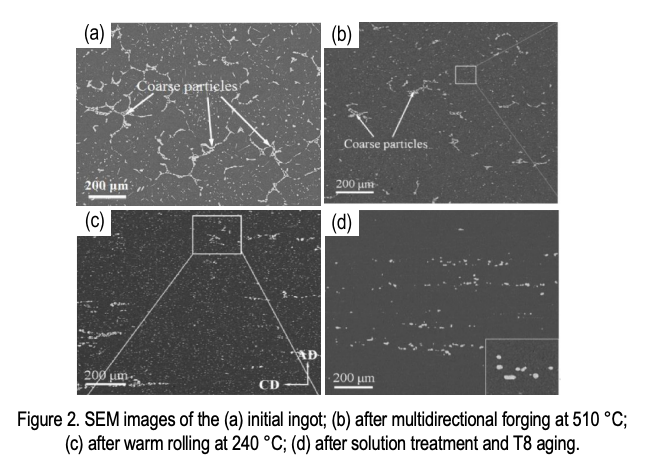
Thermomechanical Deformation Mechanical deformation such as forging — specifically, upset forging — and rolling, followed by solution treatment and aging, have been shown to drastically improve the aluminum 2219 microstructure by creating well distributed smaller-sized Al2Cu particles and significantly smaller grains leading to improved and less anisotropic mechanical properties. In one example of many studies, superior mechanical and microstructural properties were developed with a higher temperature multidirectional forging at 510 °C followed by warm rolling at 240 °C.
The upset forging and rolling followed by solution treatment and aging led to significantly reduced area fraction of coarse Al2Cu particles (5.5% to 1.0%) due to dissolution into the matrix. Grain size was reduced (230 micrometers to 58.6 micrometers) through increased storage energy and nucleation from the lower temperature rolling. Lastly, a uniformly distributed θ’ phase was increased by 118%. These changes in microstructure led to better strength, elongation and fracture properties[10].
Recommendation/Guidance
Homogenization after conventional direct chill casting is imperative to optimize the final properties of aluminum 2219 and should be explicitly included in procurement specifications. In addition, verification of effectiveness of the homogenization step is also recommended and could include before and after micrographs, DSC or XRD measurements. The initial micrographs are useful to verify a high-quality ingot. Multi-directional deformation is also important to aid fracturing of coarse particles, distribution of the Al2Cu and intermetallic phases, recrystallization, and nucleation of new grains leading to improved mechanical properties.
References
1. NASA-CR-74545
2. NASA-CR-123777
3. Wang et al., Materials 2018, 11, 914.
4. Chen et al., Metals 2020, 10, 197.
5. Zhang et al., Journal of Materials Research and Technology 2023, 27, 7470.
6. Gupta et al., Canadian Metallurgical Quarterly, 2006, 45, No. 3.
7. Xu et al., Metals 2021, 11, 174.
8. Zhang et al., Advanced Engineering Materials, 2024, 26.
9. Lin et al., Materials 2023, 16, 433.
10. Zhang et al., Journal of Materials Research and Technology 2023, 22, 1136.
11. NASA-TM-20230018439 12. NASA-TM-20240000329
