


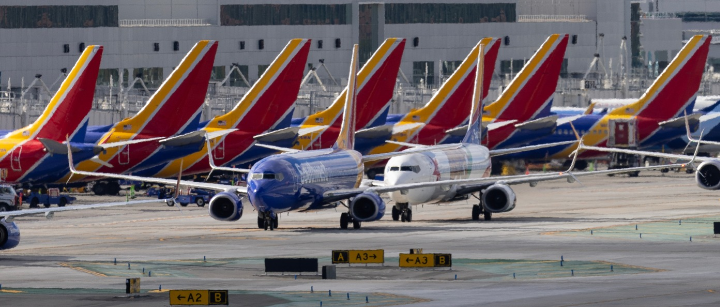
The grounding of thousands of flights on Nov. 13 set off a round of partisan finger-pointing over who’s to blame for the state of the nation’s aging air traffic control system.
In social media posts over the weekend, President Donald Trump blamed the Biden administration for “making an old and broken system worse.” But as we’ve written before, the Federal Aviation Administration’s struggles to modernize the air traffic control system go back decades and span administrations of both political parties.
Democrats in Congress, meanwhile, have responded to Transportation Secretary Sean Duffy’s calls for additional funding to modernize the air traffic control system by questioning why his department has spent only part of a $12.5 billion appropriation it received in 2025.
That funding lasts through the 2029 fiscal year, and Duffy has said the FAA will spend it all by then, though the agency has spent that money at a slower pace than it initially projected.
Duffy and other officials have also been clear that they consider the $12.5 billion a “down payment” and that it will take additional funding to fully modernize the system. We’ll explain more about this funding and how it’s being used.
The Department of Transportation has said the ground stop was caused by a technical issue with a new router installed by a contractor at a communications site, as part of the FAA’s efforts to replace old copper wiring with fiber-optic cable.
A former FAA official and outside experts told the Washington Post this week that a lack of funding was not the immediate cause of the failure, noting that efforts to overhaul the system have seen decades of delay and that upgrading older systems requires careful planning and redundancies.
“Nobody campaigns on the thrill of replacing old copper lines or painting rusting communications towers, so basic upkeep gets kicked down the road year after year,” Lance Sherry, director of the Center for Air Transportation Systems Research at George Mason University, told us in an email. “It is the exact same logic as ignoring a check-engine light until the car breaks down on the highway.”
Not Just a Biden Administration Issue
As we’ve explained before, efforts to modernize the nation’s air traffic control system go back to at least the 1980s, when the federal government contracted with IBM to lead implementation of what it called the Advanced Automation System. The FAA scrapped or scaled back much of the project in 1994 after years of delays and cost overruns, according to reports from the General Accounting Office, a nonpartisan congressional watchdog now called the Government Accountability Office.
In 2003, the FAA launched its Next Generation Air Transportation System, or NextGen, project, which aimed to modernize the country’s air traffic control system and other infrastructure by 2025. Despite putting $15 billion into the project, the FAA had achieved only about 16% of NextGen’s expected benefits by the end of 2024, according to a report from the Department of Transportation’s inspector general last year.
“Lengthy delays and cost growth have been a recurring feature of FAA’s modernization efforts through the course of NextGen’s over 20-year lifespan,” the report stated.
“So the FAA has a long history of problems that extended from the George W. Bush administration, through Obama, Trump I, and Biden,” John Strong, a professor and aviation-safety expert at the College of William & Mary, told us last year.
Trump, in a pair of social media posts on Nov. 15, nonetheless placed the blame largely on his immediate predecessor.
“The Biden Administration was an FAA disaster,” he said in one Truth Social post. “Everything they touched turned bad. Big money spent unwisely, making an old and broken system worse than when they began.”
In another post, he called on Congress to approve “desperately needed money for Air Traffic Control” and said the “Biden Administration set it back years!”
“Not sure I’d characterize it that way,” Strong told us in an email this week when we asked him about Trump’s posts.
“The system was under some strain prior to Covid, but … mostly operating OK,” Strong explained. “The biggest issue during the 2020-2022 period was the shutdown of the FAA Academy for 4 months in 2020, then reduced operations for nine months or more. The gap in training controllers, plus the fact that many controllers retired during Covid, contributed to the shortage of controllers that was real evident in the last years of the Biden period.”
Under Biden, the 2021 Infrastructure Investment and Jobs Act allocated $5 billion for air traffic control improvements, including replacing or upgrading towers, updating power and communications systems, and other infrastructure improvements, as well as hiring more air traffic controllers.
Strong told us last year that “the failure of [air traffic control] modernization predates the Biden administration,” but the funding under Biden “was mostly carrying on with plans that were inadequate in both scope and funding.” Most of it targeted “immediate problems” like staffing shortages and equipment breakdowns, he said.
Pete Buttigieg, who served as Biden’s transportation secretary, pushed back on the claims from Trump, who told reporters on Nov. 16 that “Buttigieg ruined the system.”
“As secretary, I made sure to leave air travel in better condition than when we arrived,” Buttigieg said in an X post, pointing to efforts to hire more air traffic controllers and modernize communications infrastructure that predated Trump’s second term. “I am glad the Trump administration has continued that work, but they have so far failed to explain why their execution of it triggered the worst FAA communications breakdown this century.”
FAA Funding
In the wake of last week’s ground stop, Duffy called on Congress to approve $50 billion in new funding for air travel infrastructure, including additional funds for air traffic control system upgrades.
The proposal has faced skepticism from lawmakers in both parties, with many noting that the Department of Transportation has spent less than half of the $12.5 billion it received for air traffic improvements in the 2025 One Big Beautiful Bill Act that was championed by Trump.
“Trump is now asking for $50 billion, despite sitting on most of the $12.5 billion that Congress gave him last year,” Senate Minority Leader Chuck Schumer said in a Nov. 16 floor speech, adding that lawmakers “want to give them all the money they need — but they gotta use it and know how to implement it, and they don’t. Mr. President Trump, what happened to the $12.5 billion we gave you?”
Some Republicans have also questioned the administration’s latest funding request and noted the availability of much of the OBBBA funding, Politico reported.
Whether Congress should approve more money is a policy debate, and we take no position on that. But here’s the context behind the $12.5 billion figure lawmakers are bringing up.
In May 2025, the Trump administration announced plans to build what it called a “brand-new state-of-the-art air traffic control system” by the end of 2028, including replacing outdated equipment and modernizing radar and communications networks. As we’ve reported, the project is an extension, and in some cases acceleration, of the NextGen initiative.
The One Big Beautiful Bill Act — which Trump signed in July 2025 — provided $12.5 billion toward those efforts. Duffy was clear at the time that he considered the money a “down payment” on what was expected to be a $31.5 billion project, a point FAA Administrator Bryan Bedford echoed in December when speaking to a Senate subcommittee.
Of that $12.5 billion, $9 billion was specifically designated for modernizing telecommunications, radar and other air traffic control systems, with the remainder set aside for construction and consolidation of air traffic facilities. The law made the money available through Sept. 30, 2029.
Bedford told lawmakers in December 2025 that he expected around $6 billion to $6.5 billion of the $12.5 billion would be obligated — that is, legally committed to specific uses, such as a contract to purchase equipment — “by the end of the year.” (We asked the FAA whether Bedford meant the 2025 calendar year or the 2026 fiscal year, which ended Sept. 30, and haven’t heard back.) The DOT told us this week that more than $4 billion has been obligated so far, but all the money is “accounted for” in the sense that the department has a plan for how to spend it.
Specifically, out of the $12.5 billion, a DOT spokesperson told us the department has obligated 48% of the $4.8 billion appropriated for telecommunications upgrades (including the replacement of copper wire with newer technologies, which the department says is 70% complete). Meanwhile, 34% of the $3.5 billion appropriation for radars and other surveillance systems has been obligated, with that number expected to rise as more radar production comes online as soon as next month. The department said it has also obligated 63% of the $800 million it received for “foundational upgrades,” such as replacing old floppy disks and making aviation-safety improvements in Alaska.
The spokesperson said most of the final $3.4 billion, which is for facility construction and consolidation, won’t be spent until 2027 or 2028 because it’s less of a priority. Just 6% of that funding has been obligated so far.
“I think it took longer than many of us thought to select a prime contractor for the project, and to develop priorities,” Strong, the aviation-safety expert at William & Mary, told us. “But for many projects like this, early stage is [a] lower share, then [there is a] ramp up in the middle period as initiatives are rolled out systemwide. Overall, a bit slow, but not unprecedented.”
That’s not to say there haven’t been issues with the implementation. The Government Accountability Office released a report in September criticizing aspects of how the FAA has managed the rollout, saying it hadn’t developed an integrated master schedule or comprehensive cost estimate.
Hours before the ground stop, Duffy had asked lawmakers to approve an additional $30 billion in funding for airport and air traffic control infrastructure. Asked for a breakdown of that funding, a Department of Transportation spokesperson referred us to a fact sheet for the Modern Skies Act, a bill sponsored by Republican Sen. Eric Schmitt of Missouri. The bill includes $10 billion to upgrade air traffic control systems, $2 billion for air traffic control towers, and $18 billion for new terminals and other improvements at airports. The bill is currently in committee.
On Nov. 13, after the nationwide ground stop, Duffy upped his request to $50.1 billion. According to a Nov. 17 letter from Duffy to leaders of the House and Senate appropriations committees, that includes $10.1 billion for “air traffic control modernization” including telecommunications and digital technology upgrades; $10 billion in discretionary grants for airport infrastructure improvements; $10 billion to “replace, modernize or fully reconstruct aging terminals at high-impact transitional hub airports”; $10 billion to build five consolidated air route traffic control centers to replace nearly two dozen aging facilities; and $10 billion to build, replace or improve up to 140 air traffic control towers.
Trump’s recent budget proposals have asked for $4 billion for FAA facilities and systems upgrades, well short of what his administration is now requesting from Congress.
Editor’s note: FactCheck.org does not accept advertising. We rely on grants and individual donations from people like you. Please consider a donation. Credit card donations may be made through our “Donate” page. If you prefer to give by check, send to: FactCheck.org, Annenberg Public Policy Center, P.O. Box 58100, Philadelphia, PA 19102.
